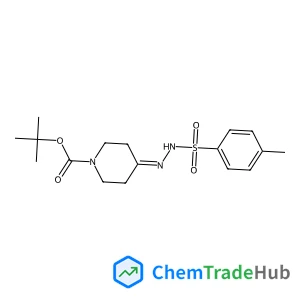
tert-Butyl 4-(2-(p-Tolylsulfonyl)hydrazono)piperidine-1-carboxylate
CAS Number:
1046478-89-0
Molecular Formula:
C17H25N3O4S
Guoyong Zhou, Yongmin Xu, Meiwan Chen, Du Cheng
A pH-sensitive ternary block copolymer comprising poly(ethylene glycol)methyl ether methacrylate (PEGMA), and pH-sensitive segments poly(2-(dimethylamino) ethylmethacrylate) (PDMA) and poly(2-(diisopropyl amino)ethyl methacrylate) (PDPA) (mal-PEGMA-b-PDPA-b-PDMA, PMDM) was synthesized. The copolymer effectively complexed with siRNA at pH 5.0 to form a polyplex which showed decreased positive charge along with the increase of pH value due to deprotonation of the PDPA block. The nearly non-charged polyplex at pH 7.4 exhibited enhanced stability and inertness in serum-containing media, which is favorable for a prolonged circulation time and reduced cytotoxicity. The pH-sensitivity of PDMA and PDPA also enhanced the lysosomal escape of polyplexes after endocytosis. Moreover, modification of the tumor-penetrating peptide iRGD endowed the polyplexes with effective intratumoral delivery and high transfection efficiency. A study using the luciferase expression assay achieved highly effective target gene silencing both in vitro and in vivo, which revealed the potential of our iRGD-modified and pH-sensitive siRNA polyplex as a promising siRNA delivery system in cancer treatment.
Ji Liu, Dominique Hoogland, Emma-Rose Janeček, Eric A. Appel, Oren A. Scherman
DOI: 10.1039/C7PY00574A
DOI: 10.1039/B005843M
Tamer Shoeib, Christopher F. Rodriquez, K. W. Michael Siu, Alan C. Hopkinson
DOI: 10.1039/B008836F
Marc Guerre, Mona Semsarilar, Cedric Totée, Gilles Silly, Bruno Améduri, Vincent Ladmiral
DOI: 10.1039/C7PY00346C
Minkyu Kim, Hoyong Chung
DOI: 10.1039/C7PY01535F
Marie A. F. Delgove, Juandré Luchies, Iris Wauters, Geert G. P. Deroover, Stefaan M. A. De Wildeman, Katrien V. Bernaerts
DOI: 10.1039/C7PY00976C
S. Weintraub, T. Shpigel, L. G. Harris, R. Schuster, E. C. Lewis, D. Y. Lewitus
DOI: 10.1039/C7PY00663B
Fang Qu, Beihong Yang, Qun He, Weifeng Bu
DOI: 10.1039/C7PY00993C
Sofia Telitel, Benoît Éric Petit, Salomé Poyer, Laurence Charles, Jean-François Lutz
DOI: 10.1039/C7PY00496F
When considering alternatives to 1-(4-Chlorophenyl)-N-hydroxymethanimine (CAS: 3...
This compound should be stored in a cool, dry place away from direct sunlight. I...
3-(4-Bromophenyl)-5-(2-fluorophenyl)-1,2,4-oxadiazole is synthesized through a m...
5-Chloro-2-(4-chlorophenyl)-4-methyl-6-[3-(1-piperidinyl)propoxy]pyrimidine (CAS...
2-Chloro-4-(difluoromethoxy)pyridine is used in the pharmaceutical industry for ...
3-Chloro-6-methylpyridazine (CAS: 1121-79-5) is classified under the Globally Ha...
Several alternatives can be used in the synthesis of Methyl 4,5-dimethyl-2-nitro...
Alternatives to (2E,2'E)-3,3'-(1,4-Phenylene)bisacrylaldehyde include other acry...
3-Amino-5-chloropyridin-2-ol hydrochloride is an organic compound with the CAS n...
When handling 6,7-Difluoro-2,3-dihydro-4H-chromen-4-one, it is essential to wear...

Polymer Chemistry welcomes submissions in all areas of polymer science that have a strong focus on macromolecular chemistry. Manuscripts may cover a broad range of fields, yet no direct application focus is required.