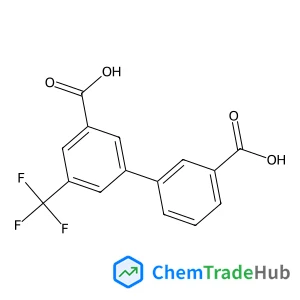
3-(3-Carboxyphenyl)-5-(trifluoromethyl)benzoic acid
CAS Number:
1261930-96-4
Molecular Formula:
C15H9F3O4
José Guadalupe Ibarra-Armenta, Alberto Martín-Molina, Manuel Quesada-Pérez
In this work we test the validity of a recent modified Poisson–Boltzmann (MPB) theory that includes ion size effects through a Langmuir-type correction. In particular, we will focus on an analytic charge–potential relationship accounting for such effects. Previous electric double layer (EDL) surveys have demonstrated that the inclusion of ions size in classical EDL theories, based on the Poisson–Boltzmann (PB) equation, can yield considerable improvements. In this sense, the theory we analyze assumes that, as a result of the excluded volume, the ion concentration close to the charged surface cannot exceed a fixed value determined by the close packing fraction. This leads to predictions of counterion concentrations (in this region) smaller than the corresponding PB values. In our opinion, it is worthwhile to test the validity of this novel theory. To this end, computer simulations appear as a useful tool for this kind of task. Our results prove that the above-mentioned analytical expression works fairly well for 1 : 1 electrolytes and large ions, and its predictions can be considerably improved with certain corrections in the estimation of some key parameters. However, it fails for multivalent electrolytes.
Pablo Gamallo, Sinan Akpinar, Paolo Defazio, Carlo Petrongolo
DOI: 10.1039/C6CP07756K
Tânia F. G. G. Cova, Sandra C. C. Nunes, Alberto A. C. C. Pais
DOI: 10.1039/C6CP08081B
Xueyao Hou, Xiaocha Wang, Guifeng Chen, Wenbo Mi
DOI: 10.1039/C6CP07858C
Florent Réal, Paweł Tecmer, André Severo Pereira Gomes, Örs Legeza, Paul W. Ayers, Valérie Vallet
DOI: 10.1039/C6CP05429C
Sarawoot Impeng, Siwarut Siwaipram, Sareeya Bureekaew, Michael Probst
DOI: 10.1039/C6CP07771D
L. A. Ferreira, V. N. Uversky, B. Y. Zaslavsky
DOI: 10.1039/C6CP08214A
Yuanjun Lu, Bryan E. G. Lucier, Yue Zhang, Anmin Zheng, Yining Huang
DOI: 10.1039/C7CP00199A
G. W. Driver, Y. Huang, A. Laaksonen, T. Sparrman, Y.-L. Wang, P.-O. Westlund
DOI: 10.1039/C6CP05801A
DOI: 10.1039/C6CP07827C
Sergio Giuffrida, Lorenzo Cordone
DOI: 10.1039/C6CP06848K
4-Amino-3-bromophenol (CAS: 74440-80-5) falls under the classification of a haza...
(17beta)-3-Oxoestr-4-en-17-yl acetate should be stored in a cool, dry place away...
2-[(2,2-Diethoxyethyl)disulfanyl]-1,1-diethoxyethane (CAS: 76505-71-0) is a colo...
The market and research for 1-(β-D-ribofuranosyl)-1H-imidazo[4,5-c]pyridin-4-ami...
Waste containing Conjugated Estrogen (CAS: 12126-59-9) should be collected and d...
The market for Bis(2,2,2-trifluoroethyl) (methoxycarbonylmethyl)phosphonate (CAS...
There are several alternatives to 3,4'-Di-O-methylellagic acid (CAS: 57499-59-9)...
2-Chloro-N,N-dimethylpyridin-4-amine (CAS: 59047-70-0) is regulated under the Gl...
Cerium(3+);oxygen(2-);vanadium(5+) (CAS: 13597-19-8) is a complex inorganic comp...
7-Chloro-1-iodoisoquinoline (CAS: 1203579-27-4) is generally considered safe whe...

Physical Chemistry Chemical Physics (PCCP) is an international journal co-owned by 19 physical chemistry and physics societies from around the world. This journal publishes original, cutting-edge research in physical chemistry, chemical physics and biophysical chemistry. To be suitable for publication in PCCP, articles must include significant innovation and/or insight into physical chemistry; this is the most important criterion that reviewers and Editors will judge against when evaluating submissions. The journal has a broad scope and welcomes contributions spanning experiment, theory, computation and data science. Topical coverage includes spectroscopy, dynamics, kinetics, statistical mechanics, thermodynamics, electrochemistry, catalysis, surface science, quantum mechanics, quantum computing and machine learning. Interdisciplinary research areas such as polymers and soft matter, materials, nanoscience, energy, surfaces/interfaces, and biophysical chemistry are welcomed if they demonstrate significant innovation and/or insight into physical chemistry. Joined experimental/theoretical studies are particularly appreciated when complementary and based on up-to-date approaches.
![(2S)-2-({N-[(2S)-2-Ammonio-4-methylpentanoyl]glycyl}amino)-3-phenylpropanoate structure](https://static.chemtradehub.com/structs/429/4294-25-1-0842.webp "(2S)-2-({N-[(2S)-2-Ammonio-4-methylpentanoyl]glycyl}amino)-3-phenylpropanoate structure")