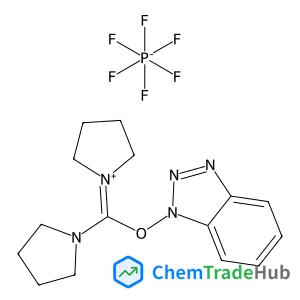
(1H-Benzotriazol-1-yloxy)(di-1-pyrrolidinyl)methylium hexafluorophosphate
CAS Number:
105379-24-6
Molecular Formula:
C15H21F6N5OP
Jamie R. Moffat, Gordon J. Seeley, Jeff T. Carter, Andrew Burgess, David K. Smith
Generating polymers in the presence of a self-assembling gelator with terminal double bonds yields polymeric materials with embedded reactive nano-skeletons—subsequent washing gives nanoscale imprinted materials with fibrillar architectures.
Douglas P. Linder, Brett E. Baker, Kenton R. Rodgers
DOI: 10.1039/C8CP03121E
Sergei A. Chernyak, Anton S. Ivanov, Angelina M. Podgornova, Ekaterina A. Arkhipova, Stepan Yu. Kupreenko, Alexei V. Shumyantsev, Natalia E. Strokova, Konstantin I. Maslakov, Serguei V. Savilov, Valery V. Lunin
DOI: 10.1039/C8CP05149F
H. Fabio Busnengo
DOI: 10.1039/C8CP03515F
Jose M. Ortiz-Roldan, Gustavo Esteban-Manzanares, Sofía Calero, A. Rabdel Ruiz-Salvador, Said Hamad
DOI: 10.1039/C8CP02591F
Christian Dietrich, Raimund Koerver, Michael W. Gaultois, Gregor Kieslich, Giannantonio Cibin, Wolfgang G. Zeier
DOI: 10.1039/C8CP01968A
Feng-Wei Gao, Hong-Liang Xu, Shabbir Muhammad, Zhong-Min Su
DOI: 10.1039/C8CP00416A
Guoling Li, Liben Li, Xingqiang Shi, Bingbing Liu
DOI: 10.1039/C8CP02742K
Fan W. Zeng, Dajie Zhang, James B. Spicer
DOI: 10.1039/C8CP04997A
Swapan K. Ghosh
DOI: 10.1039/C8CP00844B
When handling 4-(2-Furylmethyl)thiomorpholine 1,1-dioxide (CAS: 79206-94-3), it ...
When handling 4-Chloro-N-[2-(4-morpholinyl)ethyl]benzamide (CAS: 71320-77-9), it...
Waste containing this compound (CAS: 62921-74-8) should be handled according to ...
Waste containing (S)-Methyl 2-amino-3-cyclohexylpropanoate should be collected i...
This compound can be synthesized using a multi-step process involving the conjug...
There are several alternatives to (2E)-3-(3,4-Dichlorophenyl)acrylic acid in syn...
Ethyl 6-(2-nitrophenyl)imidazo[2,1-b][1,3]thiazole-3-carboxylate (CAS: 925437-84...
Waste containing 2-(1,3-Thiazol-2-yl)ethanamine (CAS: 18453-07-1) should be coll...
Methyl 5-iodo-2-methylbenzoate can be synthesized through the iodination of meth...
5-Chloro[1,2,4]triazolo[1,5-a]pyridine is commonly synthesized via the condensat...

ChemComm publishes urgent research which is of outstanding significance and interest to experts in the field, while also appealing to the journal’s broad chemistry readership. Our communication format is ideally suited to short, urgent studies that are of such importance that they require accelerated publication. Our scope covers all topics in chemistry, and research at the interface of chemistry and other disciplines (such as materials science, nanoscience, physics, engineering and biology) where there is a significant novelty in the chemistry aspects. Major topic areas covered include: Analytical Chemistry Catalysis Chemical Biology and medicinal chemistry Computational Chemistry and Machine Learning Energy and sustainable chemistry Environmental Chemistry Green Chemistry Inorganic Chemistry Materials Chemistry Nanoscience Organic Chemistry Physical Chemistry Polymer Chemistry Supramolecular Chemistry