












![[4-(Heptyloxy)phenyl]boronic acid structure](https://static.chemtradehub.com/structs/136/136370-19-9-ad33.webp "[4-(Heptyloxy)phenyl]boronic acid structure")
Stimulating intra- and intermolecular charge transfer and nonlinear optical response for biphenalenyl biradicaloid dimer under an external electric field
Literature Information
Publication Date
2018-06-19
DOI
10.1039/C8CP00416A
Impact Factor
3.676
Authors
Feng-Wei Gao, Hong-Liang Xu, Shabbir Muhammad, Zhong-Min Su
View Original
Abstract
An interesting biphenalenyl biradicaloid (IDPL) dimer consisting of both-middle superimposed phenalenyls and both-end nonsuperimposed phenalenyls has been synthesized, and has attracted intensive research interest due to its intra- and intermolecular interactions and semiconductive characteristics. It is significant that under regulation of the external electric field the directional charge transfer (CT) can produce attractive properties. In the present work, the structure and electronic properties of the IDPL dimer under an external electric field (along the horizontal Fx or the vertical Fz directions) are explored, and the following properties determined: (i) as the horizontal Fx increases, the intramolecular CT becomes larger, which induces the intermolecular CT of the IDPL dimer. (ii) In contrast, as the vertical Fz increases, the large intermolecular CT gives rise to the intramolecular CT of the IDPL dimer. (iii) More importantly, the external electric field effectively regulates and controls the first hyperpolarizability (βtot) of the IDPL dimer. Compared with the vertical Fz, the horizontal Fx induces a larger first hyperpolarizability (βtot = 5.48 × 10⁵ a.u.). Furthermore, the application of a uniform external electric field (Fx,y,z) to the IDPL dimer was investigated to define the external electric field direction of the material application. The βtot values were increased with increasing of the uniform Fx,y,z. Our study provides an effective strategy for developing high-performance NLO materials by tuning the external electric field, and could be of significance for application in switch devices.
Related Literature
Soft-trilinear constraints for improved quantitation in multivariate curve resolution
Hamid Abdollahi, Paul J. Gemperline
2019-11-11
Paper
DOI: 10.1039/C8AN00615F
Investigating the effect of Ag nanocube polydispersity on gap-mode SERS enhancement factors
Tyler J. Dill, Matthew J. Rozin, Eric R. Brown, Stephen Palani, Andrea R. Tao
2016-04-29
Paper
DOI: 10.1039/C6AN00212A
A wavelength-resolved electrochemiluminescence resonance energy transfer ratiometric immunosensor for detection of cardiac troponin I
Liping Zhu, Jing Ye, Qiuju Zhu
2019-09-17
Paper
DOI: 10.1039/C9AN01445D
A novel logic gate based on liquid-crystals responding to the DNA conformational transition
Fubing Xiao, Hui Tan, Yan Wu, Shuzhen Liao, Zhaoyang Wu, Guoli Shen, Ruqin Yu
2016-04-13
Communication
DOI: 10.1039/C6AN00504G
Recent advances in inorganic materials for LDI-MS analysis of small molecules
C. Y. Shi, C. H. Deng
2016-03-18
Minireview
DOI: 10.1039/C6AN00220J
Spectrochemical analysis of sycamore (Acer pseudoplatanus) leaves for environmental health monitoring
Holly J. Butler, Martin R. McAinsh
2016-04-06
Paper
DOI: 10.1039/C6AN00392C
Ambient electrospray deposition Raman spectroscopy (AESD RS) using soft landed preformed silver nanoparticles for rapid and sensitive analysis
Tripti Ahuja, Atanu Ghosh, Sandip Mondal, Pallab Basuri, Shantha Kumar Jenifer, Pillalamarri Srikrishnarka, Jyoti Sarita Mohanty, Sandeep Bose, Thalappil Pradeep
2019-10-15
Paper
DOI: 10.1039/C9AN01700C
Electrochemical performance of ruthenium nanoparticles decorated on nitride carbon for non-enzymatic detection of hydrogen peroxide
Xia Cheng, Caili Xu, Qian Chen, Yi Wang, Yun Zhang, Guangyin Fan
2019-09-21
Paper
DOI: 10.1039/C9AN01480B
A new label-free fluorescent sensor for human immunodeficiency virus detection based on exonuclease III-assisted quadratic recycling amplification and DNA-scaffolded silver nanoclusters
Wen Yang, Jianniao Tian, Lijun Wang, Shui Fu, Hongyun Huang, Yanchun Zhao, Shulin Zhao
2016-03-23
Paper
DOI: 10.1039/C6AN00184J
You might also like
Compound Q&A
What precautions should be taken when handling 4-(2-Furylmethyl)thiomorpholine 1,1-dioxide (CAS: 79206-94-3)?
When handling 4-(2-Furylmethyl)thiomorpholine 1,1-dioxide (CAS: 79206-94-3), it ...
79206-94-34-(2-Furylmethyl)thi...
Compound Q&A
What precautions should be taken when handling 4-Chloro-N-[2-(4-morpholinyl)ethyl]benzamide (CAS: 71320-77-9)?
When handling 4-Chloro-N-[2-(4-morpholinyl)ethyl]benzamide (CAS: 71320-77-9), it...
71320-77-94-Chloro-N-[2-(4-mor...
Compound Q&A
How should waste containing 2-[2-(2-Methoxyethoxy)ethoxy]ethyl 4-methylbenzenesulfonate (CAS: 62921-74-8) be handled?
Waste containing this compound (CAS: 62921-74-8) should be handled according to ...
62921-74-82-[2-(2-Methoxyethox...
Compound Q&A
How should waste containing (S)-Methyl 2-amino-3-cyclohexylpropanoate be handled?
Waste containing (S)-Methyl 2-amino-3-cyclohexylpropanoate should be collected i...
40056-18-6(S)-Methyl 2-amino-3...
Compound Q&A
How is 5-({4-[(2S,4R)-4-Hydroxy-2-methyltetrahydro-2H-pyran-4-yl]-2-thienyl}sulfanyl)-1-methyl-1,3-dihydro-2H-indol-2-one (CAS: 166882-70-8) typically synthesized?
This compound can be synthesized using a multi-step process involving the conjug...
166882-70-85-({4-[(2S,4R)-4-Hyd...
Compound Q&A
Are there alternatives to (2E)-3-(3,4-Dichlorophenyl)acrylic acid (CAS: 7312-27-8) in synthesis?
There are several alternatives to (2E)-3-(3,4-Dichlorophenyl)acrylic acid in syn...
7312-27-8(2E)-3-(3,4-Dichloro...
Compound Q&A
How should Ethyl 6-(2-nitrophenyl)imidazo[2,1-b][1,3]thiazole-3-carboxylate (CAS: 925437-84-9) be stored?
Ethyl 6-(2-nitrophenyl)imidazo[2,1-b][1,3]thiazole-3-carboxylate (CAS: 925437-84...
925437-84-9Ethyl 6-(2-nitrophen...
Compound Q&A
How should waste containing 2-(1,3-Thiazol-2-yl)ethanamine (CAS: 18453-07-1) be handled?
Waste containing 2-(1,3-Thiazol-2-yl)ethanamine (CAS: 18453-07-1) should be coll...
18453-07-12-(1,3-Thiazol-2-yl)...
Compound Q&A
How is Methyl 5-iodo-2-methylbenzoate (CAS: 103440-54-6) typically synthesized?
Methyl 5-iodo-2-methylbenzoate can be synthesized through the iodination of meth...
103440-54-6Methyl 5-iodo-2-meth...
Compound Q&A
How is 5-Chloro[1,2,4]triazolo[1,5-a]pyridine (CAS: 1427399-34-5) typically synthesized?
5-Chloro[1,2,4]triazolo[1,5-a]pyridine is commonly synthesized via the condensat...
1427399-34-55-Chloro[1,2,4]triaz...
Source Journal
Physical Chemistry Chemical Physics

CiteScore:
5.5
Self-citation Rate:
10.3%
Articles per Year:
3036
Physical Chemistry Chemical Physics (PCCP) is an international journal co-owned by 19 physical chemistry and physics societies from around the world. This journal publishes original, cutting-edge research in physical chemistry, chemical physics and biophysical chemistry. To be suitable for publication in PCCP, articles must include significant innovation and/or insight into physical chemistry; this is the most important criterion that reviewers and Editors will judge against when evaluating submissions. The journal has a broad scope and welcomes contributions spanning experiment, theory, computation and data science. Topical coverage includes spectroscopy, dynamics, kinetics, statistical mechanics, thermodynamics, electrochemistry, catalysis, surface science, quantum mechanics, quantum computing and machine learning. Interdisciplinary research areas such as polymers and soft matter, materials, nanoscience, energy, surfaces/interfaces, and biophysical chemistry are welcomed if they demonstrate significant innovation and/or insight into physical chemistry. Joined experimental/theoretical studies are particularly appreciated when complementary and based on up-to-date approaches.
Recommended Compounds
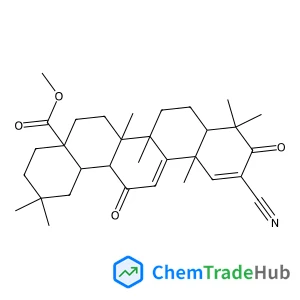
Methyl 2-cyano-3,12-dioxooleana-1,9(11)-dien-28-oate
CAS Number:
218600-53-4
Molecular Formula:
C32H43NO4

Recommended Suppliers





Disclaimer
This page provides academic journal information for reference and research purposes only. We are not affiliated with any journal publishers and do not handle publication submissions. For publication-related inquiries, please contact the respective journal publishers directly.
If you notice any inaccuracies in the information displayed, please contact us at support@chemtradehub.com. We will promptly review and address your concerns.