












Designed molecular propellers based on tetraarylterephthalamide and their chiroptical properties induced by biased helicity through transmission of point chirality
Literature Information
Publication Date
2008-09-10
DOI
10.1039/B808936A
Impact Factor
6.222
Authors
Ryo Katoono, Hidetoshi Kawai, Kenshu Fujiwara, Takanori Suzuki
View Original
Abstract
The syn-atropisomers of the title bis(tertiary amide)s were designed as six-bladed molecular propellers based on the “directing effects” of amide dipoles; the helicity of the propeller is biased to prefer one handedness upon the attachment of point chirality to the amide nitrogens to attain stronger circular-dichroism activity than for the non-propeller-shaped anti-isomers.
Recommended Journals
Related Literature
In silico investigation of DNA minor groove binding bibenzimidazoles in the context of UVA phototherapy
Andrew Hung
2021-12-06
Paper
DOI: 10.1039/D1CP04841D
Can calculated harmonic vibrational spectra rationalize the structure of TiC-based nanoparticles?
Juan José Piñero, Francesc Viñes
2021-12-07
Paper
DOI: 10.1039/D1CP03406E
Formation and properties of iodine- and acetonitrile-functionalized two-dimensional Si materials: a Density Functional Theory study
Dimitrios Kaltsas, Panagiotis Pappas, Leonidas Tsetseris
2021-12-07
Paper
DOI: 10.1039/D1CP03442A
On the nature of bonding in a new boronyl species Zn2(BO)2: a linear four-center two-electron σ bond
Da-Zhi Li, Li-Juan Zhang, Ling Pei
2021-11-20
Paper
DOI: 10.1039/D1CP03920B
The influence of the cation structure on the basicity-related polarity of ionic liquids
Nadine Weiß, Gabi Thielemann, Kevin Nagel, Caroline H. Schmidt, Andreas Seifert, Lysann Kaßner, Veronika Strehmel, Björn Corzilius, Christian Schröder, Stefan Spange
2021-11-17
Paper
DOI: 10.1039/D1CP03986E
The effect of temperature on the kinetics of enhanced amide bond formation from lactic acid and valine driven by deep eutectic solvents
Yi-Ting Tsai, Cong-Wei Huang
2021-11-24
Paper
DOI: 10.1039/D1CP03243G
Decomposition of nitric oxide by rhodium cluster cations at high temperatures
Toshiaki Nagata, Kimihiro Kawada, Xuemei Chen, Masato Yamaguchi, Ken Miyajima, Fumitaka Mafuné
2021-11-23
Paper
DOI: 10.1039/D1CP04633K
The states that hide in the shadows: the potential role of conical intersections in the ground state unimolecular decay of a Criegee intermediate
Barbara Marchetti, Vincent J. Esposito, Rachel E. Bush, Tolga N. V. Karsili
2021-12-06
Paper
DOI: 10.1039/D1CP02601A
Model free analysis of experimental residual dipolar couplings in small organic compounds
Felix A. Roth, Volker Schmidts, Jan Rettig, Christina M. Thiele
2021-11-30
Paper
DOI: 10.1039/D1CP02324A
Raman spectroscopy and DFT calculations of PEDOT:PSS in a dipolar field
Stanislav Nešpůrek, Petr Kuberský, Radek Polanský, Miroslava Trchová, Jakub Šebera, Vladimír Sychrovský
2021-12-14
Paper
DOI: 10.1039/D1CP03899K
You might also like
Compound Q&A
What are the main uses of 1-(3-Aminophenyl)-3-[(3R)-1-(3,3-dimethyl-2-oxobutyl)-2-oxo-5-(2-pyridinyl)-2,3-dihydro-1H-1,4-benzodiazepin-3-yl]urea (CAS: 155412-88-7)?
This compound is mainly used as an intermediate in the synthesis of antipsychoti...
155412-88-71-(3-Aminophenyl)-3-...
Compound Q&A
How should waste containing 1-(D-Ribofuranosyl)-1,4-dihydro-3-pyridinecarboxamide (CAS: 19132-12-8) be handled?
Waste containing 1-(D-Ribofuranosyl)-1,4-dihydro-3-pyridinecarboxamide (CAS: 191...
19132-12-81-(D-Ribofuranosyl)-...
Compound Q&A
What regulatory guidelines apply to 2-Methyl-2-propanyl 3-bromo-3-(hydroxymethyl)-1-azetidinecarboxylate (CAS: 2007919-81-3)?
2-Methyl-2-propanyl 3-bromo-3-(hydroxymethyl)-1-azetidinecarboxylate (CAS: 20079...
2007919-81-32-Methyl-2-propanyl ...
Compound Q&A
What is N-(4-Chloro-2-pyridinyl)acetamide (CAS: 245056-66-0)?
N-(4-Chloro-2-pyridinyl)acetamide (CAS: 245056-66-0) is a chemical compound with...
245056-66-0N-(4-Chloro-2-pyridi...
Compound Q&A
What is 5-Chloro-2-hydroxybenzoic acid (CAS: 321-14-2)?
5-Chloro-2-hydroxybenzoic acid, also known as 5-chlorosalicylic acid, is an arom...
321-14-25-Chloro-2-hydroxybe...
Compound Q&A
What precautions should be taken when handling 1,1-Dichloro-1-fluoroethane (CAS: 1717-00-6)?
When handling 1,1-Dichloro-1-fluoroethane (CAS: 1717-00-6), it is important to u...
1717-00-61,1-Dichloro-1-fluor...
Compound Q&A
What are the physical and chemical properties of Fmoc-(2S,3R)-3-phenylpyrrolidine-2-carboxylic acid (CAS: 281655-32-1)?
Fmoc-(2S,3R)-3-phenylpyrrolidine-2-carboxylic acid is a white crystalline solid ...
281655-32-1Fmoc-(2S,3R)-3-pheny...
Compound Q&A
What are the main uses of 4-Amino-5-bromo-2-pyridinecarboxylic acid (CAS: 1363381-01-4)?
4-Amino-5-bromo-2-pyridinecarboxylic acid is primarily used as a precursor in th...
1363381-01-44-Amino-5-bromo-2-py...
Compound Q&A
What precautions should be taken when handling (S)-tert-butyl 2-((2-(4-bromophenyl)-2-oxoethyl)carbamoyl)pyrrolidine-1-carboxylate (CAS: 1007881-98-2)?
Handling this compound should be done with personal protective equipment (PPE) i...
1007881-98-2(S)-tert-butyl 2-((2...
Compound Q&A
What precautions should be taken when handling 8-bromo-2,2-dimethyl-3,4-dihydro-2H-1,4-benzoxazin-3-one (CAS: 688363-73-7)?
When handling 8-bromo-2,2-dimethyl-3,4-dihydro-2H-1,4-benzoxazin-3-one, use prop...
688363-73-78-bromo-2,2-dimethyl...
Source Journal
Chemical Communications

CiteScore:
8.6
Self-citation Rate:
4.7%
Articles per Year:
2458
ChemComm publishes urgent research which is of outstanding significance and interest to experts in the field, while also appealing to the journal’s broad chemistry readership. Our communication format is ideally suited to short, urgent studies that are of such importance that they require accelerated publication. Our scope covers all topics in chemistry, and research at the interface of chemistry and other disciplines (such as materials science, nanoscience, physics, engineering and biology) where there is a significant novelty in the chemistry aspects. Major topic areas covered include: Analytical Chemistry Catalysis Chemical Biology and medicinal chemistry Computational Chemistry and Machine Learning Energy and sustainable chemistry Environmental Chemistry Green Chemistry Inorganic Chemistry Materials Chemistry Nanoscience Organic Chemistry Physical Chemistry Polymer Chemistry Supramolecular Chemistry
Recommended Compounds
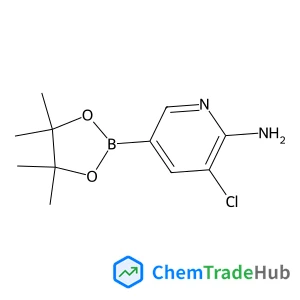
3-Chloro-5-(4,4,5,5-tetramethyl-1,3,2-dioxaborolan-2-yl)-2-pyridinamine
CAS Number:
1032758-99-8
Molecular Formula:
C11H16BClN2O2
Recommended Suppliers



Disclaimer
This page provides academic journal information for reference and research purposes only. We are not affiliated with any journal publishers and do not handle publication submissions. For publication-related inquiries, please contact the respective journal publishers directly.
If you notice any inaccuracies in the information displayed, please contact us at support@chemtradehub.com. We will promptly review and address your concerns.