












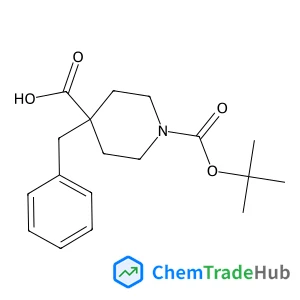
4-Benzyl-1-(tert-butoxycarbonyl)piperidine-4-carboxylic acid
CAS Number:
170838-87-6
Molecular Formula:
C18H25NO4
Seulki Lee, Kyeongsoon Park, Kwangmeyung Kim, Kuiwon Choi, Ick Chan Kwon
Current optical imaging probe applications are hampered by poor sensitivity and specificity to the target, but molecular-level fluorescent signal activation strategies can efficiently overcome these limitations. Recent interdisciplinary research that couples the imaging sciences to fluorophore, peptide, polymer, and inorganic-based chemistry has generated novel imaging probes that exhibit high sensitivity and low background noise in both in vitro and in vivo applications. This feature article introduces and discusses the various approaches described by the term “fluorescent signal activation methods” with respect to their unique imaging probe design strategies and applications.
Ritu Mamgain, Gana R. J., Abhrajeet Malik, Fateh V. Singh
DOI: 10.1039/D3NJ03458E
Yan-E Liu, Ye Zhou, Xiao-Yu Li, Jun Yao, Qiu-Xia Li, Quan-Qing Xu, Rong-Rong Zhu, Ai-Xin Zhu
DOI: 10.1039/D3NJ03489E
Huiling Hu, Changjun Liu, Chaojie Zhu, Chenghong Liu, Tiandi Tang
DOI: 10.1039/D3NJ04522F
Julia Torres, Nicolás Veiga, Matteo Savastano, Carlos Kremer, Antonio Bianchi
DOI: 10.1039/D3NJ04652D
Mounesh, K. V. Yatish, Anup Pandith, Gaber E. Eldesoky, Bhari Mallanna Nagaraja
DOI: 10.1039/D3TB01859H
Karthikeyan Vijayan, Logu Thirumalaisamy, S. P. Vijayachamundeeswari, Kalainathan Sivaperuman, Nazmul Ahsan, Yoshitaka Okada
DOI: 10.1039/D3NJ03894G
Rais Ahmad Khan, Amal AlFawaz, Afnan Abdullah Alhamed, Nouf Abdulrahman AlMuryyi, Imran Hasan, Anup Paul, Sandeep Dey, Saad. G. Alshammari, Hadi D. Arman, Ali Alsalme
DOI: 10.1039/D3NJ03938B
Chang Shu, Yadong Chen, Zhenzhen Zhang, Yuqing Lei, Jiajia Xu, Weiwei Lao, Qingping Xi, Qiang Sun, Xiaojun Li, Hongbing Liao, Qiaojie Luo, Xiaodong Li
DOI: 10.1039/D3TB02083E
Iram Amin, Sajad Ahmad Bhat, Murtaza Manzoor Bhat, Feroz Ahmad Sofi, Aamir Y. Bhat, Pravin P. Ingole, Ritwik Mondal, Musthafa Ottakam Thotiyl, Mohsin Ahmad Bhat
DOI: 10.1039/D3NJ04229D
When handling 4-(2-Furylmethyl)thiomorpholine 1,1-dioxide (CAS: 79206-94-3), it ...
When handling 4-Chloro-N-[2-(4-morpholinyl)ethyl]benzamide (CAS: 71320-77-9), it...
Waste containing this compound (CAS: 62921-74-8) should be handled according to ...
Waste containing (S)-Methyl 2-amino-3-cyclohexylpropanoate should be collected i...
This compound can be synthesized using a multi-step process involving the conjug...
There are several alternatives to (2E)-3-(3,4-Dichlorophenyl)acrylic acid in syn...
Ethyl 6-(2-nitrophenyl)imidazo[2,1-b][1,3]thiazole-3-carboxylate (CAS: 925437-84...
Waste containing 2-(1,3-Thiazol-2-yl)ethanamine (CAS: 18453-07-1) should be coll...
Methyl 5-iodo-2-methylbenzoate can be synthesized through the iodination of meth...
5-Chloro[1,2,4]triazolo[1,5-a]pyridine is commonly synthesized via the condensat...

ChemComm publishes urgent research which is of outstanding significance and interest to experts in the field, while also appealing to the journal’s broad chemistry readership. Our communication format is ideally suited to short, urgent studies that are of such importance that they require accelerated publication. Our scope covers all topics in chemistry, and research at the interface of chemistry and other disciplines (such as materials science, nanoscience, physics, engineering and biology) where there is a significant novelty in the chemistry aspects. Major topic areas covered include: Analytical Chemistry Catalysis Chemical Biology and medicinal chemistry Computational Chemistry and Machine Learning Energy and sustainable chemistry Environmental Chemistry Green Chemistry Inorganic Chemistry Materials Chemistry Nanoscience Organic Chemistry Physical Chemistry Polymer Chemistry Supramolecular Chemistry

![Methyl 4-({[(2-methyl-2-propanyl)oxy]carbonyl}amino)bicyclo[2.2.2]octane-1-carboxylate structure](https://static.chemtradehub.com/structs/943/943845-74-7-b7e5.webp "Methyl 4-({[(2-methyl-2-propanyl)oxy]carbonyl}amino)bicyclo[2.2.2]octane-1-carboxylate structure")




