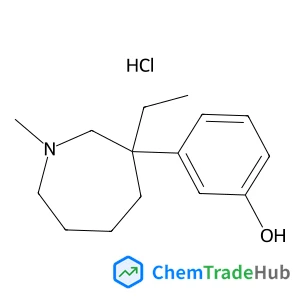
3-(3-Ethyl-1-methyl-3-azepanyl)phenol hydrochloride (1:1)
CAS Number:
59263-76-2
Molecular Formula:
C15H24ClNO
Huiling Hu, Changjun Liu, Chaojie Zhu, Chenghong Liu, Tiandi Tang
Controlling the spatial selectivity of the coupling sites in two-molecule reactions is critical for stereoselective product synthesis. Herein, we report a novel strategy that uses basic ETS-10 zeolite-supported copper (Cu/ETS-10) as a catalyst for the highly selective synthesis of Z-3-methyleneisoindolin-1-ones in the absence of ligands. It was found that the rigidity of the zeolite skeleton was conducive to the high configurational selectivity of the product. The Cu/ETS-10 catalyst was easily recovered by simple filtration and could be reused five times without loss of its initial activity.
K. Mirabbaszadeh, M. Davoudiniya, M. Yarmohammadi
DOI: 10.1039/C8CP04446E
Nobuyoshi Koga, Satoki Kodani
DOI: 10.1039/C8CP05701J
Ilia A. Vovk, Nikita V. Tepliakov, Anvar S. Baimuratov, Mikhail Yu. Leonov, Alexander V. Baranov, Anatoly V. Fedorov, Ivan D. Rukhlenko
DOI: 10.1039/C8CP04724C
Yosslen Aray, Antonio Díaz Barrios
DOI: 10.1039/C8CP03387K
Sehee Na, Sascha Jurkovic, Thorsten Friedrich, Thorsten Koslowski
DOI: 10.1039/C8CP02420K
Jordi Ribas-Arino, Juan J. Novoa, Ria Broer, Mercè Deumal
DOI: 10.1039/C8CP03173H
DOI: 10.1039/C8CP01594E
DOI: 10.1039/C8CP05106B
When handling 4-(2-Furylmethyl)thiomorpholine 1,1-dioxide (CAS: 79206-94-3), it ...
When handling 4-Chloro-N-[2-(4-morpholinyl)ethyl]benzamide (CAS: 71320-77-9), it...
Waste containing this compound (CAS: 62921-74-8) should be handled according to ...
Waste containing (S)-Methyl 2-amino-3-cyclohexylpropanoate should be collected i...
This compound can be synthesized using a multi-step process involving the conjug...
There are several alternatives to (2E)-3-(3,4-Dichlorophenyl)acrylic acid in syn...
Ethyl 6-(2-nitrophenyl)imidazo[2,1-b][1,3]thiazole-3-carboxylate (CAS: 925437-84...
Waste containing 2-(1,3-Thiazol-2-yl)ethanamine (CAS: 18453-07-1) should be coll...
Methyl 5-iodo-2-methylbenzoate can be synthesized through the iodination of meth...
5-Chloro[1,2,4]triazolo[1,5-a]pyridine is commonly synthesized via the condensat...

NJC (New Journal of Chemistry) is a broad-based primary journal encompassing all branches of chemistry and its sub-disciplines. It contains full research articles, communications, perspectives and focus articles. This well-established journal, owned by the Centre National de la Recherche Scientifique (CNRS) of France, has been co-published with the Royal Society of Chemistry since January 1998. NJC is the forum for the publication of high-quality, original and significant work that opens new directions in chemistry or other scientific disciplines. In addition to having a significant chemical component, work published in NJC must demonstrate that it will have an impact on areas of research other than that of the reported work.