












Differences in magnetically induced motion of diamagnetic, paramagnetic, and superparamagnetic microparticles detected by cell tracking velocimetry
Literature Information
Publication Date
2008-09-09
DOI
10.1039/B802113A
Impact Factor
4.616
Authors
Yang Zhao, Aaron Richardson, Lee Moore, P. Stephen Williams, Maciej Zborowski, Jeffrey J. Chalmers
View Original
Abstract
Magnetic separation in biomedical applications is based on differential magnetophoretic mobility (MM) of microparticulate matter in viscous media. Typically, the difference in MM is obtained by selectively labeling the target cells with superparamagnetic iron oxide nanoparticles (SPIONs). We have measured the MM of monodisperse, polystyrene microspheres (PSMs), with and without attached SPIONs as a model of cell motion induced by nanoparticle magnetization, using variable H field and cell tracking velocimetry (CTV). As a model of paramagnetic microparticle motion, the MM measurements were performed on the same PSMs in paramagnetic gadolinium solutions, and on spores of a prokaryotic organism, Bacillus globigii (shown to contain paramagnetic manganese). The CTV analysis was sensitive to the type of the microparticle magnetization, producing a value of MM independent of the applied H field for the paramagnetic species, and a decreasing MM value with an increasing field for superparamagnetic species, as predicted from theory. The SPION-labeled PSMs exhibited a saturation magnetization above H ≅ 64 000 A m−1 (or 0.08 tesla). Based on those data, the average saturation magnetizations of the SPIONs was calculated and shown to vary between different commercial sources. The results demonstrate sensitivity of the CTV analysis to different magnetization mechanisms of the microparticles.
Related Literature
Phenothiazine-based small-molecule organic solar cells with power conversion efficiency over 7% and open circuit voltage of about 1.0 V using solvent vapor annealing
Yogajivan Rout, Rajneesh Misra, Rahul Singhal, Subhayan Biswas, Ganesh D. Sharma
2018-01-30
Paper
DOI: 10.1039/C7CP08308D
Imperfect mixing as a dominant factor leading to stochastic behavior: a new system exhibiting crazy clock behavior
László Valkai, Attila K. Horváth
2018-05-11
Paper
DOI: 10.1039/C8CP01156G
The structure–electrochemical property relationship of quinone electrodes for lithium-ion batteries
Licheng Miao, Luojia Liu, Zhenfeng Shang, Yixin Li, Yong Lu, Fangyi Cheng, Jun Chen
2018-04-17
Paper
DOI: 10.1039/C8CP00597D
Magnetic field effects dynamics of ethylammonium nitrate ionic liquid confined between glass plates
2018-01-31
Paper
DOI: 10.1039/C7CP06554J
Unexpected protonation state of Glu197 discovered from simulations of tacrine in butyrylcholinesterase
Xiao Wan, Yuan Yao, Lei Fang, Junjun Liu
2018-05-08
Paper
DOI: 10.1039/C8CP01566J
UV absorption of Criegee intermediates: quantitative cross sections from high-level ab initio theory
Š. Sršeň, D. Hollas, P. Slavíček
2018-01-31
Paper
DOI: 10.1039/C8CP00199E
Structural and electronic properties of V2O5 and their tuning by doping with 3d elements – modelling using the DFT+U method and dispersion correction
A. S. Dobrota, L. D. Rafailović
2018-04-18
Paper
DOI: 10.1039/C8CP00992A
Structural dynamics upon photoexcitation-induced charge transfer in a dicopper(i)–disulfide complex
Mateusz Rebarz, Martin Rohrmüller, Shirly Espinoza, Miroslav Kloz, Norman Kretzschmar, Adam Neuba, Jochen Ortmeyer, Roland Schoch, Matthias Bauer, Wolf Gero Schmidt, Gerald Henkel
2018-02-12
Paper
DOI: 10.1039/C7CP04880G
Small stoichiometric (MoS2)n clusters with the 1T phase
Ya-Ya Wang, Jia-Jun Deng, Xin Wang, Jian-Tao Che, Xun-Lei Ding
2018-01-30
Paper
DOI: 10.1039/C7CP07914A
Room temperature chiral reorganization of interfacial assembly of achiral double-decker phthalocyanine
Xiqian Wang, Chenxi Liu, Yuying Jiang, Chiming Wang, Tianyu Wang, Ming Bai, Jianzhuang Jiang
2018-02-14
Paper
DOI: 10.1039/C7CP08647D
You might also like
Compound Q&A
What precautions should be taken when handling 2-Chloro-1,2-bis(4-methylphenyl)ethanone (CAS: 71193-32-3)?
When handling 2-Chloro-1,2-bis(4-methylphenyl)ethanone (CAS: 71193-32-3), it is ...
71193-32-32-Chloro-1,2-bis(4-m...
Compound Q&A
What industries use 4-Ethoxy-3-(5-methyl-4-oxo-7-propyl-1,4-dihydroimidazo[5,1-f][1,2,4]triazin-2-yl)benzenesulfonyl chloride (CAS: 224789-26-8)?
4-Ethoxy-3-(5-methyl-4-oxo-7-propyl-1,4-dihydroimidazo[5,1-f][1,2,4]triazin-2-yl...
224789-26-84-Ethoxy-3-(5-methyl...
Compound Q&A
How should Methyl 3-Oxo-4-Androsten-17-Carboxylate (CAS: 2681-55-2) be stored?
Methyl 3-Oxo-4-Androsten-17-Carboxylate (CAS: 2681-55-2) should be stored in a c...
2681-55-2Methyl 3-Oxo-4-Andro...
Compound Q&A
What are the main uses of (R)-3-Amino-4-(3-hexylphenylamino)-4-oxobutylphosphonic acid (CAS: 909725-61-7)?
(R)-3-Amino-4-(3-hexylphenylamino)-4-oxobutylphosphonic acid is primarily used i...
909725-61-7(R)-3-Amino-4-(3-hex...
Compound Q&A
What regulatory guidelines apply to 2-Methyl-2-propanyl 3-amino-3-carbamoyl-1-azetidinecarboxylate (CAS: 1254120-14-3)?
2-Methyl-2-propanyl 3-amino-3-carbamoyl-1-azetidinecarboxylate (CAS: 1254120-14-...
1254120-14-32-Methyl-2-propanyl ...
Compound Q&A
Are there alternatives to (E)-4-(tert-Butoxy)-4-oxobut-2-enoic acid (CAS: 135355-96-3) in synthesis?
There are alternative reagents that can be used in synthesis instead of (E)-4-(t...
135355-96-3(E)-4-(tert-Butoxy)-...
Compound Q&A
What are the physical and chemical properties of [2-(3-Chlorophenyl)-1,3-thiazol-4-yl]methanol (CAS: 121202-20-8)?
[2-(3-Chlorophenyl)-1,3-thiazol-4-yl]methanol (CAS: 121202-20-8) is a crystallin...
121202-20-8[2-(3-Chlorophenyl)-...
Compound Q&A
What is the market or research trend for Methyl (2S)-[(4S)-2,2-dimethyl-1,3-dioxolan-4-yl]{[(4-methylphenyl)sulfonyl]oxy}acetate (CAS: 166249-17-8)?
The market and research trends for Methyl (2S)-[(4S)-2,2-dimethyl-1,3-dioxolan-4...
166249-17-8Methyl (2S)-[(4S)-2,...
Compound Q&A
What is the market or research trend for 1-Bromo-2-isocyanatoethane (CAS: 42865-19-0)?
The market for 1-Bromo-2-isocyanatoethane (CAS: 42865-19-0) is driven by its use...
42865-19-01-Bromo-2-isocyanato...
Compound Q&A
What are the main uses of 4-Nitro-D-phenylalanine hydrochloride (CAS: 147065-06-3)?
4-Nitro-D-phenylalanine hydrochloride (CAS: 147065-06-3) is primarily used in re...
147065-06-34-Nitro-D-phenylalan...
Source Journal
Analyst

CiteScore:
7.8
Self-citation Rate:
5.6%
Articles per Year:
653
Analyst publishes analytical and bioanalytical research that reports premier fundamental discoveries and inventions, and the applications of those discoveries, unconfined by traditional discipline barriers.
Recommended Compounds
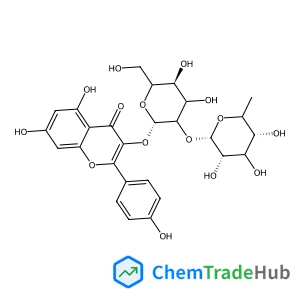
5,7-Dihydroxy-2-(4-hydroxyphenyl)-4-oxo-4H-chromen-3-yl 2-O-(6-deoxy-alpha-L-mannopyranosyl)-beta-D-glucopyranoside
CAS Number:
32602-81-6
Molecular Formula:
C27H30O15


3,5-Dihydroxy-4-(3-methylbutanoyl)-2,6,6-tris(3-methyl-2-buten-1-yl)-2,4-cyclohexadien-1-one
CAS Number:
468-28-0
Molecular Formula:
C26H38O4
Recommended Suppliers






Disclaimer
This page provides academic journal information for reference and research purposes only. We are not affiliated with any journal publishers and do not handle publication submissions. For publication-related inquiries, please contact the respective journal publishers directly.
If you notice any inaccuracies in the information displayed, please contact us at support@chemtradehub.com. We will promptly review and address your concerns.