












Analysis of DNA and single-base mutations using magnetic particles for purification, amplification and DNAzyme detection
Literature Information
Publication Date
2008-04-23
DOI
10.1039/B802015A
Impact Factor
4.616
Authors
Itamar Willner, Zoya Cheglakov, Yossi Weizmann, Etteri Sharon
View Original
Abstract
The amplified detection of DNA or of single-base mismatches in DNA is achieved by the use of nucleic acid-functionalized magnetic particles that separate the recognition duplexes and, upon amplification, yield chemiluminescence-generating DNAzymes as reporter units. The analysis of M13 phage ssDNA is achieved by the hybridization of the analyte to capture nucleic acid-functionalized magnetic particles followed by the binding of a DNA machine unit to the analyte domain. The magnetic separation of the multi-component-functionalized magnetic particles, followed by their reaction with polymerase, dNTPs, and the nicking enzyme (Nb.BbvCI) activate the autonomous synthesis of the horseradish peroxidase-mimicking DNAzyme that acts as chemiluminescent reporter. The single-base mutation in DNA is achieved by coupling of the DNA machine to the mutant DNA/capture nucleic acid-functionalized magnetic particles hybrid structure. The activation of the polymerization/nicking cycles yield the chemiluminescent reporting DNAzyme. The magnetic separation of the DNA recognition hybrids improves the signal-to-noise ratio of the analytical protocol as compared to related DNAzyme synthesizing schemes.
Recommended Journals
Related Literature
Enhancing electrochemical performance by control of transport properties in buffer layers – solid oxide fuel/electrolyser cells
Devaraj Ramasamy, Narendar Nasani, Ana D. Brandão, Domingo Pérez Coll, Duncan P. Fagg
2015-04-02
Paper
DOI: 10.1039/C5CP00778J
Synthesis, characterization and theoretical studies of nonlinear optical crystal Sr2B5O9(OH)·H2O
Fangfang Zhang, Jing Qun, Shilie Pan, Zhihua Yang, Dianzeng Jia
2015-03-16
Paper
DOI: 10.1039/C5CP00864F
Interfacial interaction and lateral association of cross-seeding assemblies between hIAPP and rIAPP oligomers
Mingzhen Zhang, Rundong Hu, Hong Chen, Yung Chang, Xiong Gong, Fufeng Liu, Jie Zheng
2015-02-16
Paper
DOI: 10.1039/C4CP05658B
Influence of electric potentials on friction of sliding contacts lubricated by an ionic liquid
Christian Dold, Tobias Amann, Andreas Kailer
2015-03-12
Communication
DOI: 10.1039/C4CP05965D
Adsorption of polyelectrolytes to like-charged substrates induced by multivalent counterions as exemplified by poly(styrene sulfonate) and silica
Plinio Maroni, Michal Borkovec
2015-03-23
Communication
DOI: 10.1039/C5CP00910C
Nitric oxide activation by caa3 oxidoreductase from Thermus thermophilus
Takehiro Ohta, Tewfik Soulimane, Teizo Kitagawa, Constantinos Varotsis
2015-03-23
Paper
DOI: 10.1039/C5CP01013F
Prediction of a stable associated liquid of short amyloidogenic peptides
Jurriaan A. Luiken, Peter G. Bolhuis
2015-03-12
Paper
DOI: 10.1039/C5CP00284B
Formation of 5- and 6-methyl-1H-indene (C10H10) via the reactions of the para-tolyl radical (C6H4CH3) with allene (H2CCCH2) and methylacetylene (HCCCH3) under single collision conditions
Tao Yang, Dorian S. N. Parker, Beni B. Dangi, Ralf I. Kaiser, Alexander M. Mebel
2015-03-03
Paper
DOI: 10.1039/C4CP04288C
On the relation of energy and electron transfer in multidimensional chromophores based on polychlorinated triphenylmethyl radicals and triarylamines
Markus Steeger, Stefanie Griesbeck, Alexander Schmiedel, Marco Holzapfel, Ivo Krummenacher, Holger Braunschweig, Christoph Lambert
2015-04-14
Paper
DOI: 10.1039/C4CP05929H
Tuning the electronic and magnetic properties of graphene-like AlN nanosheets by surface functionalization and thickness
W. X. Zhang, T. Li, S. B. Gong, C. He, L. Duan
2015-03-23
Paper
DOI: 10.1039/C5CP00123D
You might also like
Compound Q&A
Is 2-(2-chloroacetamido)-3-phenylpropanoic acid (CAS: 7765-11-9) safe?
2-(2-Chloroacetamido)-3-phenylpropanoic acid (CAS: 7765-11-9) is generally consi...
7765-11-92-(2-chloroacetamido...
Compound Q&A
Is 2-(Benzyloxy)-5-bromobenzoic acid (CAS: 62176-31-2) safe?
2-(Benzyloxy)-5-bromobenzoic acid can be handled safely if appropriate precautio...
62176-31-22-(Benzyloxy)-5-brom...
Compound Q&A
What is (4-Methyl-1,2,5-oxadiazol-3-yl)methanamine hydrochloride (CAS: 1159825-48-5)?
(4-Methyl-1,2,5-oxadiazol-3-yl)methanamine hydrochloride is a chemical compound ...
1159825-48-5(4-Methyl-1,2,5-oxad...
Compound Q&A
What is 2-(5-Hexylthiophen-2-yl)-4,4,5,5-tetramethyl-1,3,2-dioxaborolane (CAS: 917985-54-7)?
2-(5-Hexylthiophen-2-yl)-4,4,5,5-tetramethyl-1,3,2-dioxaborolane (CAS: 917985-54...
917985-54-72-(5-Hexylthiophen-2...
Compound Q&A
Are there alternatives to 4-(8-Methyl-9H-1,3-dioxolo[4,5-h][2,3]benzodiazepin-5-yl)benzenamine (CAS: 102771-26-6) in synthesis?
While 4-(8-Methyl-9H-1,3-dioxolo[4,5-h][2,3]benzodiazepin-5-yl)benzenamine (CAS:...
102771-26-64-(8-Methyl-9H-1,3-d...
Compound Q&A
What is the market or research trend for tert-butyl 3-hydroxy-4,5,7,8-tetrahydro-2H-pyrazolo[3,4-d]azepine-6-carboxylate (CAS: 851376-80-2)?
The market for tert-butyl 3-hydroxy-4,5,7,8-tetrahydro-2H-pyrazolo[3,4-d]azepine...
851376-80-2tert-butyl 3-hydroxy...
Compound Q&A
How should waste containing 3,5-Diamino-1H-pyrazole-4-carbonitrile (CAS: 6844-58-2) be handled?
Waste containing 3,5-Diamino-1H-pyrazole-4-carbonitrile (CAS: 6844-58-2) should ...
6844-58-23,5-Diamino-1H-pyraz...
Compound Q&A
How is (6-Fluoro-3-pyridinyl)boronic acid (CAS: 351019-18-6) typically synthesized?
(6-Fluoro-3-pyridinyl)boronic acid can be synthesized through the reaction of 6-...
351019-18-6(6-Fluoro-3-pyridiny...
Compound Q&A
What industries use Dibenzyl carbonimidoylbiscarbamate (CAS: 10065-79-9)?
Dibenzyl carbonimidoylbiscarbamate (CAS: 10065-79-9) finds applications in vario...
10065-79-9Dibenzyl carbonimido...
Compound Q&A
What is the market or research trend for (beta,beta,2,3,4,5,6-~2~H_7_)Phenylalanine (CAS: 74228-83-4)?
The market for (beta,beta,2,3,4,5,6-~2~H_7_)Phenylalanine (CAS: 74228-83-4) is g...
74228-83-4(beta,beta,2,3,4,5,6...
Source Journal
Analyst

CiteScore:
7.8
Self-citation Rate:
5.6%
Articles per Year:
653
Analyst publishes analytical and bioanalytical research that reports premier fundamental discoveries and inventions, and the applications of those discoveries, unconfined by traditional discipline barriers.
Recommended Compounds
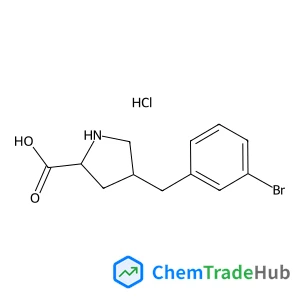
(2S,4R)-4-(3-Bromobenzyl)pyrrolidine-2-carboxylic acid hydrochloride
CAS Number:
1049734-10-2
Molecular Formula:
C12H15BrClNO2
Recommended Suppliers





Disclaimer
This page provides academic journal information for reference and research purposes only. We are not affiliated with any journal publishers and do not handle publication submissions. For publication-related inquiries, please contact the respective journal publishers directly.
If you notice any inaccuracies in the information displayed, please contact us at support@chemtradehub.com. We will promptly review and address your concerns.