












Cationic iridium(iii) complexes for phosphorescence staining in the cytoplasm of living cells
Literature Information
Publication Date
2008-02-27
DOI
10.1039/B800939B
Impact Factor
6.222
Authors
Mengxiao Yu, Qiang Zhao, Linxi Shi, Fuyou Li, Zhiguo Zhou, Hong Yang, Tao Yi, Chunhui Huang
View Original
Abstract
Two cationic iridium(III) complexes with bright green and red emissions were demonstrated as phosphorescent dyes for living cell imaging. In particular, their exclusive staining in cytoplasm, low cytotoxicity and reduced photobleaching, as well as cell membrane permeability, make the two complexes promising candidates for the design of specific bioimaging agents.
Related Literature
Stereoselective synthesis of individual isomers of Leu-enkephalin analogues containing substituted β-turn bicyclic dipeptide mimetics
Chiyi Xiong, Junyi Zhang, Peg Davis, Jinfa Ying, Frank Porreca, Victor J. Hruby
2003-06-04
Communication
DOI: 10.1039/B302235H
Olefin/paraffin solubility in a solid polymer electrolyte membrane
T. C. Merkel, Z. He, A. Morisato, I. Pinnau
2003-06-03
Communication
DOI: 10.1039/B301420G
Mesoporous hybrid materials containing two transition metal ions, one in the framework, the other in the channel pores
Robert J. P. Corriu, Ahmad Mehdi, Catherine Reyé, Chloé Thieuleux
2003-06-03
Communication
DOI: 10.1039/B303492P
Titanium dipyrrolylmethane derivatives: rapid intermolecular alkyne hydroamination
Yanhui Shi, Christopher Hall, James T. Ciszewski, Changsheng Cao, Aaron L. Odom
2003-02-04
Communication
DOI: 10.1039/B212423H
Synthesis of carbon tubes with mesoporous wall structure using designed silica tubes as templates
Minsuk Kim, Kwonnam Sohn, Jaeyun Kim, Taeghwan Hyeon
2003-02-10
Communication
DOI: 10.1039/B212336C
Ba2−xSrxPdO2F2 (0 ≤ x ≤ 1.5): The first palladium–oxide–fluorides
Thomas Baikie, Emma L. Dixon, John F. Rooms, Nigel A. Young, M. Grazia Francesconi
2003-05-29
Communication
DOI: 10.1039/B303402J
Evidence for spatially-coherent trans-molecular electron tunnelling through two-dimensional arrays of Photosystem II core complexes
Philip B. Lukins, Christopher S. Barton
2003-02-03
Communication
DOI: 10.1039/B210596A
An N-lithio-indole from the reaction of LiCH(TMS)2 and PhNC
Manuel A. Fernandes, Michael F. Lappert, Marcus Layh, Bernard Omondi
2003-02-11
Communication
DOI: 10.1039/B212103D
Chiral shape and enantioselective growth of colloidal particles of self-assembled meso-tetra(phenyl and 4-sulfonatophenyl)porphyrins
Joaquim Crusats, Josep Claret, Ismael Díez-Pérez, Zoubir El-Hachemi, Héctor García-Ortega, Raimon Rubires, Francesc Sagués, Josep M. Ribó
2003-05-29
Communication
DOI: 10.1039/B303273F
Osmium tetroxide in poly(ethylene glycol) (PEG): a recyclable reaction medium for rapid asymmetric dihydroxylation under Sharpless conditions‡
S. Chandrasekhar, Ch. Narsihmulu, S. Shameem Sultana, N. Ramakrishna Reddy
2003-06-16
Communication
DOI: 10.1039/B305154B
You might also like
Compound Q&A
What are the main uses of (3.beta.)-3-Hydroxy-N,N-dimethyl-chol-5-en-24-amide (CAS: 79066-03-8)?
(3.beta.)-3-Hydroxy-N,N-dimethyl-chol-5-en-24-amide (CAS: 79066-03-8) is primari...
79066-03-8(3.beta.)-3-Hydroxy-...
Compound Q&A
What regulatory guidelines apply to 5-(aminomethyl)-2-methoxyphenol (CAS: 89702-89-6)?
5-(Aminomethyl)-2-methoxyphenol (CAS: 89702-89-6) is classified under GHS as a s...
89702-89-65-(aminomethyl)-2-me...
Compound Q&A
What is Thieno[2,3-c]pyridin-7(6H)-one (CAS: 28981-13-7)?
Thieno[2,3-c]pyridin-7(6H)-one (CAS: 28981-13-7) is a heterocyclic organic compo...
28981-13-7Thieno[2,3-c]pyridin...
Compound Q&A
Is 1-[(6-Methoxy-3-pyridinyl)methyl]-4-piperidinamine dihydrochloride (CAS: 1185311-28-7) safe?
1-[(6-Methoxy-3-pyridinyl)methyl]-4-piperidinamine dihydrochloride is generally ...
1185311-28-71-[(6-Methoxy-3-pyri...
Compound Q&A
What regulatory guidelines apply to [(2E)-3-Phenyl-2-propen-1-yl]phosphonic acid (CAS: 146404-58-2)?
[(2E)-3-Phenyl-2-propen-1-yl]phosphonic acid (CAS: 146404-58-2) is regulated und...
146404-58-2[(2E)-3-Phenyl-2-pro...
Compound Q&A
What regulatory guidelines apply to 6-Bromo-7-methoxyquinoline (CAS: 1620515-86-7)?
6-Bromo-7-methoxyquinoline (CAS: 1620515-86-7) falls under the scope of the Glob...
1620515-86-76-Bromo-7-methoxyqui...
Compound Q&A
What industries use (2R)-1-(1-Benzofuran-2-yl)-N-propyl-2-pentanamine (CAS: 260550-89-8)?
This compound is primarily used in the pharmaceutical industry for the developme...
260550-89-8(2R)-1-(1-Benzofuran...
Compound Q&A
What are the main uses of 1-Ethyl-7-[2-methyl-6-(4H-1,2,4-triazol-3-yl)-3-pyridinyl]-3,5-dihydropyrazino[2,3-b]pyrazin-2(1H)-one (CAS: 1228013-15-7)?
1-Ethyl-7-[2-methyl-6-(4H-1,2,4-triazol-3-yl)-3-pyridinyl]-3,5-dihydropyrazino[2...
1228013-15-71-Ethyl-7-[2-methyl-...
Compound Q&A
Are there alternatives to {5-(Acryloylamino)-2-[(dimethylamino)methyl]phenyl}boronic acid (CAS: 1217500-78-1) in synthesis?
Alternative reagents such as 2-[(dimethylamino)methyl]phenylboronic acid or rela...
1217500-78-1{5-(Acryloylamino)-2...
Compound Q&A
What is 3-(Piperidin-4-yloxy)pyridine (CAS: 310881-48-2)?
3-(Piperidin-4-yloxy)pyridine (CAS: 310881-48-2) is an organic compound with the...
310881-48-23-(Piperidin-4-yloxy...
Source Journal
Chemical Communications

CiteScore:
8.6
Self-citation Rate:
4.7%
Articles per Year:
2458
ChemComm publishes urgent research which is of outstanding significance and interest to experts in the field, while also appealing to the journal’s broad chemistry readership. Our communication format is ideally suited to short, urgent studies that are of such importance that they require accelerated publication. Our scope covers all topics in chemistry, and research at the interface of chemistry and other disciplines (such as materials science, nanoscience, physics, engineering and biology) where there is a significant novelty in the chemistry aspects. Major topic areas covered include: Analytical Chemistry Catalysis Chemical Biology and medicinal chemistry Computational Chemistry and Machine Learning Energy and sustainable chemistry Environmental Chemistry Green Chemistry Inorganic Chemistry Materials Chemistry Nanoscience Organic Chemistry Physical Chemistry Polymer Chemistry Supramolecular Chemistry
Recommended Compounds
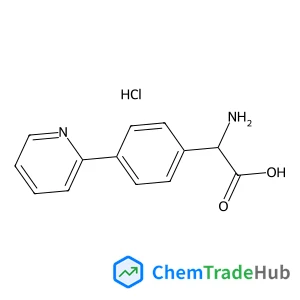
2-Amino-2-(4-(pyridin-2-YL)phenyl)acetic acid hydrochloride
CAS Number:
1135818-89-1
Molecular Formula:
C13H13ClN2O2
Recommended Suppliers





Disclaimer
This page provides academic journal information for reference and research purposes only. We are not affiliated with any journal publishers and do not handle publication submissions. For publication-related inquiries, please contact the respective journal publishers directly.
If you notice any inaccuracies in the information displayed, please contact us at support@chemtradehub.com. We will promptly review and address your concerns.