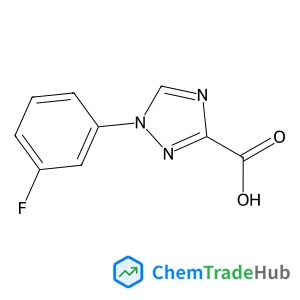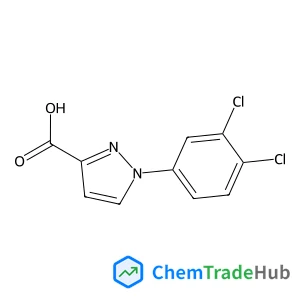
1-(3,4-Dichlorophenyl)-1H-pyrazole-3-carboxylic acid
CAS Number:
1152949-12-6
Molecular Formula:
C10H6Cl2N2O2
P. von Hessberg, N. Pouvesle, A. K. Winkler, G. Schuster, J. N. Crowley
The physical adsorption of formic (HC(O)OH) and acetic (CH3C(O)OH) acid on ice was measured as a function of concentration and temperature. At low concentrations, the gas–ice interaction could be analysed by applying Langmuir adsorption isotherms to determine temperature dependent partition constants, KLang. Using temperature independent saturation coverages (Nmax) of (2.2 ± 0.5) × 1014 molecule cm−2 and (2.4 ± 0.6) × 1014 molecule cm−2 for HC(O)OH and CH3C(O)OH, respectively, we derive KLang(HC(O)OH) = 1.54 × 10⁻²⁴ exp (6150/T) and KLang(CH3C(O)OH) = 6.55 × 10⁻²⁵ exp (6610/T) cm3 molecule−1. Via a van’t Hoff analysis, adsorption enthalpies were obtained for HC(O)OH and CH3C(O)OH. Experiments in which both acids or HC(O)OH and methanol interacted with the ice surface simultaneously were adequately described by competitive adsorption kinetics. The results are compared to previous measurements and used to calculate the equilibrium partitioning of these trace gases to ice surfaces under conditions relevant to the atmosphere.
Yanfei Shen, Yuanjian Zhang, Qixian Zhang, Tianyan You, Ari Ivaska
DOI: 10.1039/B507688A
Nicolai Dieltiens, Diederica D. Claeys, Bart Allaert, Francis Verpoort, Christian V. Stevens
DOI: 10.1039/B508663A
Victorio Cadierno, Sergio E. García-Garrido, José Gimeno, Noel Nebra
DOI: 10.1039/B506788J
Kazunori Nakashima, Tatsuo Maruyama, Noriho Kamiya, Masahiro Goto
DOI: 10.1039/B505479F
Hui Hong, Tim Stinear, Paul Skelton, Jonathan B. Spencer, Peter F. Leadlay
DOI: 10.1039/B506835E
Jinxing Ye, Darren J. Dixon, Peter S. Hynes
DOI: 10.1039/B508833J
Guo-Ping Wang, Er-Qun Song, Hai-Yan Xie, Zhi-Ling Zhang, Zhi-Quan Tian, Chao Zuo, Dai-Wen Pang, Dao-Cheng Wu, Yun-Bo Shi
DOI: 10.1039/B508075D
Waste containing N-Methoxy-N-methyl-1,3-thiazole-5-carboxamide (CAS: 898825-89-3...
N-(4-Biphenylyl)dibenzo[b,d]furan-4-amine should be stored in a tightly sealed c...
The market for 3-Acetamido-5-amino-2,4,6-triiodobenzoic acid (CAS: 1713-07-1) is...
Benzyl 2-O-acetyl-3,4,6-tri-O-benzyl-beta-D-galactopyranoside (CAS: 61820-03-9) ...
2-Ethylpiperazine dihydrochloride (CAS: 438050-52-3) is regulated under the Glob...
1,1'-[1,3-Phenylenebis(methylene)]bis(3-methyl-1H-pyrrole-2,5-dione) (CAS: 11946...
Several alternatives can be used in the synthesis of 5-Fluoro-2-(1-pyrrolidinyl)...
Proper personal protective equipment (PPE) must be worn when handling this compo...
When handling 6-Bromoimidazo[1,2-a]pyridin-8-amine, it is important to wear appr...
Alternatives to (2S,4R)-4-(4-Nitrobenzyl)pyrrolidine-2-carboxylic acid hydrochlo...

Physical Chemistry Chemical Physics (PCCP) is an international journal co-owned by 19 physical chemistry and physics societies from around the world. This journal publishes original, cutting-edge research in physical chemistry, chemical physics and biophysical chemistry. To be suitable for publication in PCCP, articles must include significant innovation and/or insight into physical chemistry; this is the most important criterion that reviewers and Editors will judge against when evaluating submissions. The journal has a broad scope and welcomes contributions spanning experiment, theory, computation and data science. Topical coverage includes spectroscopy, dynamics, kinetics, statistical mechanics, thermodynamics, electrochemistry, catalysis, surface science, quantum mechanics, quantum computing and machine learning. Interdisciplinary research areas such as polymers and soft matter, materials, nanoscience, energy, surfaces/interfaces, and biophysical chemistry are welcomed if they demonstrate significant innovation and/or insight into physical chemistry. Joined experimental/theoretical studies are particularly appreciated when complementary and based on up-to-date approaches.