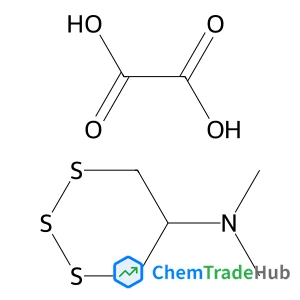
Oxalic acid compound with cyclohexylsulfamothioic O-acid (11)
CAS Number:
31895-22-4
Molecular Formula:
C7H13NO4S3
Bart Tijsebaert, Csaba Varszegi, Hermann Gies, Feng-Shou Xiao, Xinhe Bao, Takashi Tatsumi, Ulrich Müller, Dirk De Vos
The all-silica zeolite RUB-41, containing 8- and 10-membered rings, is able to separate trans-2-butene and cis-2-butene from 1-butene and represents a possible improvement in isolating pure 1-butene from a butene mixture.
Priyanka Bhattacharya, Nicholas K. Geitner, Sapna Sarupria, Pu Chun Ke
DOI: 10.1039/C3CP44591G
Adrian Porch, Peter P. Edwards
DOI: 10.1039/C2CP43310A
Guillermo Pérez-Hernández, Burkhard Schmidt
DOI: 10.1039/C3CP44278K
Yufeng Liu, Yian Xie, Houlei Cui, Wei Zhao, Chongyin Yang, Yaoming Wang, Ning Dai
DOI: 10.1039/C3CP44485F
Kateryna Sykina, Guang Yang, Claire Roiland, Laurent Le Pollès, Eric Le Fur, Chris J. Pickard, Bruno Bureau, Eric Furet
DOI: 10.1039/C3CP41689E
Petr Milko, Jana Roithová, Kevin A. Schug, Karel Lemr
DOI: 10.1039/C3CP44444A
Ana Stefanova, Siegfried Ernst, Helmut Baltruschat
DOI: 10.1039/C3CP44643C
Marco Savoca, Martin Andreas Robert George, Judith Langer, Otto Dopfer
DOI: 10.1039/C2CP43773B
Waste containing (6-Bromo-2-naphthyl)oxy](dimethyl)(2-methyl-2-propanyl)silane (...
7-Fluoro-4-isoquinolinecarboxylic acid can be synthesized via a multi-step proce...
2,3,5,6-Tetrabromothieno[3,2-b]thiophene is a crystalline compound with a high m...
1-[4-(Benzylamino)-7,8-dihydro-5H-pyrano[4,3-d]pyrimidin-2-yl]-2-methyl-1H-indol...
The market for imidazo[5,1-d]-1,2,3,5-tetrazine-8-carboxylic acid, 3,4-dihydro-3...
3-(Triisopropylsilyl)propiolaldehyde is a synthetic organic compound with the CA...
6-Nitro-2H-1,4-benzoxazin-3(4H)-one (CAS: 81721-87-1) is subject to various regu...
Waste containing (3-Fluorophenyl)(4-{[(2-methyl-2-propanyl)oxy]carbonyl}-1-piper...
N,N'-4,4'-Biphenyldiyldiisonicotinamide is a white crystalline solid with a mole...
6-Bromo-8-fluoro-2-quinazolinol is primarily used in the pharmaceutical industry...

ChemComm publishes urgent research which is of outstanding significance and interest to experts in the field, while also appealing to the journal’s broad chemistry readership. Our communication format is ideally suited to short, urgent studies that are of such importance that they require accelerated publication. Our scope covers all topics in chemistry, and research at the interface of chemistry and other disciplines (such as materials science, nanoscience, physics, engineering and biology) where there is a significant novelty in the chemistry aspects. Major topic areas covered include: Analytical Chemistry Catalysis Chemical Biology and medicinal chemistry Computational Chemistry and Machine Learning Energy and sustainable chemistry Environmental Chemistry Green Chemistry Inorganic Chemistry Materials Chemistry Nanoscience Organic Chemistry Physical Chemistry Polymer Chemistry Supramolecular Chemistry
![(2S)-2-({[(2-Methyl-2-propanyl)oxy]carbonyl}amino)-4-pentynoic acid structure](https://static.chemtradehub.com/structs/630/63039-48-5-b66d.webp "(2S)-2-({[(2-Methyl-2-propanyl)oxy]carbonyl}amino)-4-pentynoic acid structure")