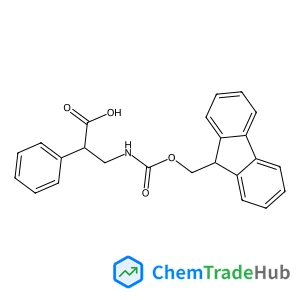
(S)-3-((((9H-Fluoren-9-yl)methoxy)carbonyl)amino)-2-phenylpropanoic acid
CAS Number:
1217663-60-9
Molecular Formula:
C24H21NO4
Guido Verniest, Karel Piron, Eva Van Hende, Jan Willem Thuring, Gregor Macdonald, Frederik Deroose, Norbert De Kimpe
A short and efficient synthesis of 4-aminomethyl-4-fluoropiperidines and 3-aminomethyl-3-fluoropyrrolidines is described. These fluorinated azaheterocycles are of specific interest as bifunctional building blocks for fluorinated pharmaceutical compounds. The key step of the synthetic pathway involves the regioselective bromofluorination of N-Boc-4-methylenepiperidine and 3-methylenepyrrolidine using Et3N.3HF and NBS.
Haifeng Xu, Zhong Jin
DOI: 10.1039/D0SE00494D
Limin Zhang, Wenqing Zhao, Feng Jiang, Mengjie Tian, Yue Yang, Peng Ge, Wei Sun
DOI: 10.1039/D0SE00305K
Yuying Chang, Cenqi Yan, Qianguang Yang, Zhipeng Kan, Ranbir Singh, Manish Kumar, Gang Li, Shirong Lu, Tainan Duan
DOI: 10.1039/D0SE00335B
Meng Yang, Lingjun Zhu, Yexin Zhuo, Jiacheng Liang, Shurong Wang
DOI: 10.1039/D0SE00468E
DOI: 10.1039/AN8992400178
Guibin Shen, Hongye Dong, Qingbin Cai, Xiaoning Wen, Xiangning Xu, Cheng Mu
DOI: 10.1039/D0SE00200C
DOI: 10.1039/AN8992400202
(1R,3S)-1,3-Cyclopentanediol finds applications in various industries. In the ph...
When handling N'-[4-(Dimethylamino)phenyl]-N,N-dimethyl-1,4-benzenediamine, it i...
There are several alternatives to 5-(2,4-Difluorophenyl)-2-methoxypyrimidine in ...
1-(3-Methoxyphenoxy)propan-2-ol (CAS: 382141-68-6) must comply with the Globally...
Tetrodotoxin Citrate is extremely dangerous and should be handled with extreme c...
2-Methyl-2-propanyl [(1R,3S)-3-hydroxycyclopentyl]carbamate (CAS: 225641-84-9) i...
Waste containing 4-(2-Hydroxyhexafluoroisopropyl)Benzoic Acid (CAS: 16261-80-6) ...
2-Methyl-2-proanyl {(2S)-1-[(benzyloxy)amino]-3-hydroxy-3-methyl-1-oxo-2-butanyl...
Benzeneethanamine, α-ethyl-, hydrochloride (1:1) is an organic compound with the...
In the synthesis of compounds similar to 3-{(E)-[4-(Dimethylamino)phenyl]diazeny...

Organic & Biomolecular Chemistry (OBC) publishes original and high impact research and reviews in organic chemistry. We welcome research that shows new or significantly improved protocols or methodologies in total synthesis, synthetic methodology or physical and theoretical organic chemistry as well as research that shows a significant advance in the organic chemistry or molecular design aspects of chemical biology, catalysis, supramolecular and macromolecular chemistry, theoretical chemistry, mechanism-oriented physical organic chemistry, medicinal chemistry or natural products. Articles published in the journal should report new work which makes a highly-significant impact in the field. Routine and incremental work is generally not suitable for publication in the journal. More details about key areas of our scope are below. In all cases authors should include in their article clear rationale for why their research has been carried out.