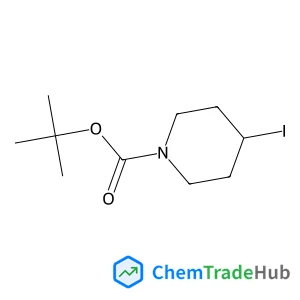
2-Methyl-2-propanyl 4-iodo-1-piperidinecarboxylate
CAS Number:
301673-14-3
Molecular Formula:
C10H18INO2
The coordination of boron to a range of polypyrrole-containing ligands is explored in this feature article. The boron dipyrromethenes are well-known as laser dyes and fluorescent labels in biology. Subphthalocyanine and subporphyrin macrocycles containing only three pyrrole rings can exist only when templated by a central boron atom. Boron complexes of expanded porphyrins (six or eight pyrroles) can complex boron in dipyrromethene (but not bipyrrole) sites. The primary focus of the article is on boron porphyrin and corrole complexes, where the tight fit of two boron atoms within the very constrained coordination site gives rise to unexpected chemistry at both boron and the porphyrin ligand. These unusual features are described and reasons for their occurrence postulated.
Rajeev Kumar, Monojoy Goswami, Bobby G. Sumpter
DOI: 10.1039/C3CP43737J
Alessandro Biancardi, Tarita Biver, Fernando Secco, Benedetta Mennucci
DOI: 10.1039/C3CP44058C
Wenqing Fan, Qinghong Zhang, Ye Wang
DOI: 10.1039/C2CP43524A
Jenny Du, Xiaofen Chen, Alexander W. Thomas, Nathan D. Kirchhofer, Logan E. Garner, Myat Thiri Maw, Wee Han Poh, Jamie Hinks, Qichun Zhang
DOI: 10.1039/C3CP50437A
Ignacio Vayá, Paula Bonancía, M. Consuelo Jiménez, Dimitra Markovitsi, Thomas Gustavsson, Miguel A. Miranda
DOI: 10.1039/C3CP43847C
Vahid Mortazavi, Roshan M. D'Souza, Michael Nosonovsky
DOI: 10.1039/C2CP44039C
Waste containing (6-Bromo-2-naphthyl)oxy](dimethyl)(2-methyl-2-propanyl)silane (...
7-Fluoro-4-isoquinolinecarboxylic acid can be synthesized via a multi-step proce...
2,3,5,6-Tetrabromothieno[3,2-b]thiophene is a crystalline compound with a high m...
1-[4-(Benzylamino)-7,8-dihydro-5H-pyrano[4,3-d]pyrimidin-2-yl]-2-methyl-1H-indol...
The market for imidazo[5,1-d]-1,2,3,5-tetrazine-8-carboxylic acid, 3,4-dihydro-3...
3-(Triisopropylsilyl)propiolaldehyde is a synthetic organic compound with the CA...
6-Nitro-2H-1,4-benzoxazin-3(4H)-one (CAS: 81721-87-1) is subject to various regu...
Waste containing (3-Fluorophenyl)(4-{[(2-methyl-2-propanyl)oxy]carbonyl}-1-piper...
N,N'-4,4'-Biphenyldiyldiisonicotinamide is a white crystalline solid with a mole...
6-Bromo-8-fluoro-2-quinazolinol is primarily used in the pharmaceutical industry...

ChemComm publishes urgent research which is of outstanding significance and interest to experts in the field, while also appealing to the journal’s broad chemistry readership. Our communication format is ideally suited to short, urgent studies that are of such importance that they require accelerated publication. Our scope covers all topics in chemistry, and research at the interface of chemistry and other disciplines (such as materials science, nanoscience, physics, engineering and biology) where there is a significant novelty in the chemistry aspects. Major topic areas covered include: Analytical Chemistry Catalysis Chemical Biology and medicinal chemistry Computational Chemistry and Machine Learning Energy and sustainable chemistry Environmental Chemistry Green Chemistry Inorganic Chemistry Materials Chemistry Nanoscience Organic Chemistry Physical Chemistry Polymer Chemistry Supramolecular Chemistry