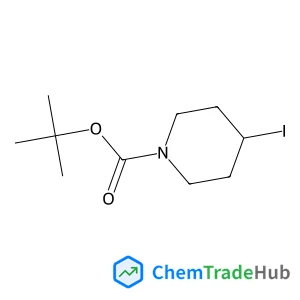
2-Methyl-2-propanyl 4-iodo-1-piperidinecarboxylate
CAS Number:
301673-14-3
Molecular Formula:
C10H18INO2
Alessandro Biancardi, Tarita Biver, Fernando Secco, Benedetta Mennucci
The fluorescent probe 4′,6-diamidino-2-phenylindole (DAPI) is a dye known to interact with polynucleotides in a non-univocal manner, both intercalation and minor groove binding modes being possible, and to specifically change its photophysical properties according to the different environments. To investigate this behavior, quantum-mechanical calculations using time-dependent density functional theory (TDDFT), coupled with polarizable continuum and/or atomistic models, were performed in combination with spectroscopic measurements of the probe in the different environments, ranging from a homogeneous solution to the minor groove or intercalation pockets of double stranded nucleic acids. According to our simulation, the electronic transition involves a displacement of the electron charge towards the external amidine groups and this feature makes the absorption energies very environment-sensitive while a much smaller sensitivity is seen in the fluorescence energies. Moreover, the calculations show that the DAPI molecule, when minor groove bound to the nucleic acid, presents both a reduced geometrical flexibility because of the rigid DNA pocket and a reduced polarization due to the very “apolar” microenvironment. All these effects can be used to better understand the observed enhancement of the fluorescence, which makes it an excellent marker for DNA.
Hiroki Hifumi, Akihiro Tanimoto, Daniel Citterio, Hirokazu Komatsu, Koji Suzuki
DOI: 10.1039/B707225B
Rohan D. Sanzgiri, Tracy A. McKinnon, Brian T. Cooper
DOI: 10.1039/B603441A
Zhaoyang He, Zifeng Yan
DOI: 10.1039/C2AN36446H
Anne P. Vonderheide, Sandra Mounicou, Juris Meija, Heather F. Henry, Joseph A. Caruso, Jodi R. Shann
DOI: 10.1039/B510712A
Beata M. Kolakowski, Zoltán Mester
DOI: 10.1039/B706039D
Gustav Liljegren, Niklas Forsgard, Camilla Zettersten, Jean Pettersson, Malin Svedberg, Merja Herranen, Leif Nyholm
DOI: 10.1039/B508388E
María J. Culzoni, Héctor C. Goicoechea, Ariana P. Pagani, Miguel A. Cabezón, Alejandro C. Olivieri
DOI: 10.1039/B603383K
Andrew Mills, David Hazafy
DOI: 10.1039/B713450A
Jaromir Ruzicka, Andrea D. Carroll, Ilkka Lähdesmäki
DOI: 10.1039/B603768B
Waste containing (6-Bromo-2-naphthyl)oxy](dimethyl)(2-methyl-2-propanyl)silane (...
7-Fluoro-4-isoquinolinecarboxylic acid can be synthesized via a multi-step proce...
2,3,5,6-Tetrabromothieno[3,2-b]thiophene is a crystalline compound with a high m...
1-[4-(Benzylamino)-7,8-dihydro-5H-pyrano[4,3-d]pyrimidin-2-yl]-2-methyl-1H-indol...
The market for imidazo[5,1-d]-1,2,3,5-tetrazine-8-carboxylic acid, 3,4-dihydro-3...
3-(Triisopropylsilyl)propiolaldehyde is a synthetic organic compound with the CA...
6-Nitro-2H-1,4-benzoxazin-3(4H)-one (CAS: 81721-87-1) is subject to various regu...
Waste containing (3-Fluorophenyl)(4-{[(2-methyl-2-propanyl)oxy]carbonyl}-1-piper...
N,N'-4,4'-Biphenyldiyldiisonicotinamide is a white crystalline solid with a mole...
6-Bromo-8-fluoro-2-quinazolinol is primarily used in the pharmaceutical industry...

Physical Chemistry Chemical Physics (PCCP) is an international journal co-owned by 19 physical chemistry and physics societies from around the world. This journal publishes original, cutting-edge research in physical chemistry, chemical physics and biophysical chemistry. To be suitable for publication in PCCP, articles must include significant innovation and/or insight into physical chemistry; this is the most important criterion that reviewers and Editors will judge against when evaluating submissions. The journal has a broad scope and welcomes contributions spanning experiment, theory, computation and data science. Topical coverage includes spectroscopy, dynamics, kinetics, statistical mechanics, thermodynamics, electrochemistry, catalysis, surface science, quantum mechanics, quantum computing and machine learning. Interdisciplinary research areas such as polymers and soft matter, materials, nanoscience, energy, surfaces/interfaces, and biophysical chemistry are welcomed if they demonstrate significant innovation and/or insight into physical chemistry. Joined experimental/theoretical studies are particularly appreciated when complementary and based on up-to-date approaches.
![(2S)-2-({[(2-Methyl-2-propanyl)oxy]carbonyl}amino)-4-pentynoic acid structure](https://static.chemtradehub.com/structs/630/63039-48-5-b66d.webp "(2S)-2-({[(2-Methyl-2-propanyl)oxy]carbonyl}amino)-4-pentynoic acid structure")