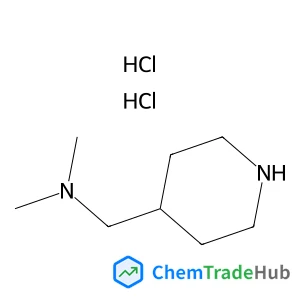
N,N-dimethyl(piperidin-4-yl)methanamine hydrochloride
CAS Number:
172281-72-0
Molecular Formula:
C8H20Cl2N2
Tatsuo Tsunoda, Akiko Kawai, Fujio Mizukami, Kengo Sakaguchi
Calcination of lysozyme–silica hybrid hollow particles gives novel cage-like hollow spherical silicas with differently patterned through-holes on their shell structure.
Takao Sakuma, Hayato Sakai, Yasuyuki Araki, Takehiko Wada, Taku Hasobe
DOI: 10.1039/C5CP07110K
DOI: 10.1039/C5CP07052J
Fethi Khaled, Binod Raj Giri, Aamir Farooq
DOI: 10.1039/C5CP90156A
Joyita Banerjee, Ajay S. Panwar, Kingsuk Mukhopadhyay, A. K. Saxena, Arup R. Bhattacharyya
DOI: 10.1039/C5CP03736K
Tran B. Nguyen, Geoffrey S. Tyndall, John D. Crounse, Alexander P. Teng, Kelvin H. Bates, Rebecca H. Schwantes, Matthew M. Coggon, Li Zhang, Philip Feiner, David O. Milller, Kate M. Skog, Jean C. Rivera-Rios, Matthew Dorris, Abigail Koss, Steven S. Brown, Joost A. de Gouw, William H. Brune, Frank N. Keutsch
DOI: 10.1039/C6CP00053C
Anna Kamecka, Andrzej Kapturkiewicz
DOI: 10.1039/C5CP03299G
DOI: 10.1039/C5CP07134H
Hui Li, Wei Chen, Yuanhui Sun, Xuri Huang, Guangtao Yu
DOI: 10.1039/C5CP03482E
1-(2,4,6-Trifluorophenyl)ethanol is an organic compound with the CAS number 1250...
1-(2,4-Dimethoxybenzyl)-4-(hydroxymethyl)-2-pyrrolidinone (CAS: 919111-34-5) is ...
(7S,15R)-6β,15-Diacetoxy-7α,20-epoxy-7-hydroxykaura-2,16-dien-1-one is a crystal...
The compound rac-ethyl (1r,4r)-4-hydroxycyclohexane-1-carboxylate, trans (CAS: 3...
The market for 2-(2,4-Difluorophenoxy)-3-nitropyridine (CAS: 175135-62-3) is cur...
The main uses of 6-Diazo-5-oxo-L-norleucine (CAS: 157-03-9) include research in ...
When handling 2-Aminoethyl-mono-amide-DOTA-tris(tBu ester) (CAS: 173308-19-5), i...
5-Methylimidazo[1,2-a]pyridine-3-carbaldehyde (CAS: 178488-37-4) can be synthesi...
There are alternative reagents that can be used in the synthesis of 2,4,6-Trihyd...
(2Z)-3-(5-Fluoro-1H-indol-3-yl)-2-sulfanylacrylic acid is a chemical compound wi...

ChemComm publishes urgent research which is of outstanding significance and interest to experts in the field, while also appealing to the journal’s broad chemistry readership. Our communication format is ideally suited to short, urgent studies that are of such importance that they require accelerated publication. Our scope covers all topics in chemistry, and research at the interface of chemistry and other disciplines (such as materials science, nanoscience, physics, engineering and biology) where there is a significant novelty in the chemistry aspects. Major topic areas covered include: Analytical Chemistry Catalysis Chemical Biology and medicinal chemistry Computational Chemistry and Machine Learning Energy and sustainable chemistry Environmental Chemistry Green Chemistry Inorganic Chemistry Materials Chemistry Nanoscience Organic Chemistry Physical Chemistry Polymer Chemistry Supramolecular Chemistry
![4-[(1-Methyl-1H-pyrrol-2-yl)methylene]-1,3(2H,4H)-isoquinolinedione structure](https://static.chemtradehub.com/structs/110/1104546-89-5-a600.webp "4-[(1-Methyl-1H-pyrrol-2-yl)methylene]-1,3(2H,4H)-isoquinolinedione structure")