












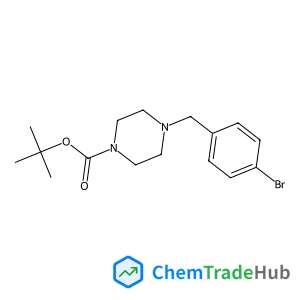
2-Methyl-2-propanyl 4-(4-bromobenzyl)-1-piperazinecarboxylate
CAS Number:
844891-10-7
Molecular Formula:
C16H23BrN2O2
Hanh V. Ly, Heikki M. Tuononen, Masood Parvez, Roland Roesler
A neutral, formally 16π-electron, tricyclic tetrahydrazidotetraborane was obtained in a two-step procedure involving self-assembly of a dilithiodiborate with B4N8 framework and subsequent oxidation of the phenylborate moieties to boranes and biphenyl using Fe(II) as an oxidant.
Konrad Swiderski, Andrew McLean, Charles M. Gordon, D. H. Vaughan
DOI: 10.1039/B315781D
Erwan Le Fur, Eric Demers, Thierry Maris, James D. Wuest
DOI: 10.1039/B308355A
Mike Casey, Claire M. Keaveney
DOI: 10.1039/B312245J
Colin D. Abernethy
DOI: 10.1039/B314558A
Bo Yang, Shoko Kamiya, Kaname Yoshida
DOI: 10.1039/B313100A
Lee J. Higham, P. Gabriel Kelly, David M. Corr, Helge Müller-Bunz, Brian J. Walker, Declan G. Gilheany
DOI: 10.1039/B316759C
James P. Collman, Li Zeng, Richard A. Decréau
DOI: 10.1039/B310763A
Ilya D. Gridnev, Fabio Pichierri
DOI: 10.1039/B311885A
Judith J. van Gorp, Jef A. J. M. Vekemans, E. W. Meijer
DOI: 10.1039/B312407J
Qing Wen Shi, Françoise Sauriol, Alain Lesimple, Lolita O. Zamir
DOI: 10.1039/B316051C
Waste containing 2-Ethyl-4-Methyl-1H-Imidazole-5-Carbaldehyde (CAS: 88634-80-4) ...
Triethoxy(octyl)silane (CAS: 1385031-14-0) is widely used in the pharmaceuticals...
Several alternatives to 3-iodo-7-nitro-1H-indazole (CAS: 864724-64-1) exist in t...
Yes, there are alternatives to Benzene, bis[(trimethoxysilyl)ethyl] (CAS: 266317...
Isothiazole-3-carbonitrile (CAS: 1452-17-1) is generally considered safe when us...
(3-Chlorophenyl)methanol (CAS: 873-63-2) is considered low to moderately toxic. ...
(2S,3S)-2-Hydroxy-3-({[(2-methyl-2-propanyl)oxy]carbonyl}amino)-3-(2-naphthyl)pr...
Proper handling of methyl 2-(bromomethyl)-5-methoxybenzoate requires the use of ...
6,8-Dibromoimidazo[1,2-a]pyridine-2-carboxylic acid (CAS: 904805-36-3) is an aro...
3-Amino-5-bromo-2-pyridinecarbonitrile is considered safe when handled under pro...

ChemComm publishes urgent research which is of outstanding significance and interest to experts in the field, while also appealing to the journal’s broad chemistry readership. Our communication format is ideally suited to short, urgent studies that are of such importance that they require accelerated publication. Our scope covers all topics in chemistry, and research at the interface of chemistry and other disciplines (such as materials science, nanoscience, physics, engineering and biology) where there is a significant novelty in the chemistry aspects. Major topic areas covered include: Analytical Chemistry Catalysis Chemical Biology and medicinal chemistry Computational Chemistry and Machine Learning Energy and sustainable chemistry Environmental Chemistry Green Chemistry Inorganic Chemistry Materials Chemistry Nanoscience Organic Chemistry Physical Chemistry Polymer Chemistry Supramolecular Chemistry
![[3-Chloro-5-(diethylcarbamoyl)phenyl]boronic acid structure](https://static.chemtradehub.com/structs/957/957120-59-1-febc.webp "[3-Chloro-5-(diethylcarbamoyl)phenyl]boronic acid structure")
![2,2'-[(Abieta-8,11,13-trien-18-ylimino)bis(2,1-ethanediyloxy)]diethanol structure](https://static.chemtradehub.com/structs/513/51344-62-8-8518.webp "2,2'-[(Abieta-8,11,13-trien-18-ylimino)bis(2,1-ethanediyloxy)]diethanol structure")




