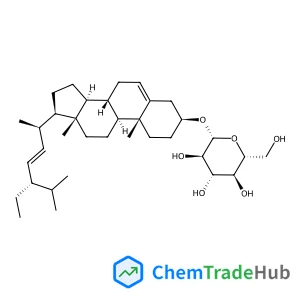
(3beta,22E)-Stigmasta-5,22-dien-3-yl beta-D-glucopyranoside
CAS Number:
19716-26-8
Molecular Formula:
C35H58O6
Zhenhua Wang, Sizhu Wu, Wenchuan Wang
Nano-strengthening by employing nanoparticles is necessary for high-efficiency strengthening of elastomers, which has already been validated by numerous researches and industrial applications, but the underlying mechanism is still an open challenge. In this work, we mainly focus our attention on studying the variation of the tensile strength of nanofilled elastomers by gradually increasing the filler content, within a low loading range. Interestingly, the percolation phenomenon is observed in the relationship between the tensile strength and the filler loading, which shares some similarities with the percolation phenomenon occurring in rubber toughened plastics. That is, as the loading of nanofillers (carbon black, zinc oxide) increases, the tensile strength of rubber nanocomposites (SBR, EPDM) increases slowly at first, then increases abruptly and finally levels off. Meanwhile, the bigger the particle size, the higher the filler content at the percolation point, and the lower the corresponding tensile strength of rubber nanocomposites. The concept of a critical particle–particle distance (CPD) is proposed to explain the observed percolation phenomenon. It is suggested that rubber strengthening through nanoparticles is attributed to the formation of stretched straight polymer chains between neighbor particles, induced by the slippage of adsorbed polymer chains on the filler surface during tension. Meanwhile, the factors to govern this CPD and the critical minimum particle size (CMPS) figured out in this work are both discussed and analyzed in detail. Within the framework of this percolation phenomenon, this paper also clearly answers two important and intriguing issues: (1) why is it necessary and essential to strengthen elastomers through nanofillers; (2) why does it need enough loading of nanofillers to effectively strengthen elastomers. Moreover, on the basis of the percolation phenomenon, we give out some guidance for reinforcement design of rubbery materials: the interfacial interactions between rubber and fillers cannot be complete chemical bonding, and partial physical absorption of macromolecular chains on the filler surface is necessary, otherwise the formation of stretched straight chains would be seriously hindered. There should exist such an optimum crosslinking density for a certain filler reinforced rubber system, and as well an optimum filler loading for rubber strengthening. Additionally, the different percolation behaviors of Young’s modulus, the tensile strength and the electrical conductivity are compared and analyzed in our work. Lastly, molecular simulation indicates that it is not possible to strengthen glassy or hard polymer matrices by incorporating spherical nanoparticles. In general, by providing substantial experimental data and detailed analyses, this work is believed to promote the fundamental understanding of rubber reinforcement, as well provide better guidance for the design of high-performance and multi-functional rubber nanocomposites.
Xiaohui Sun, Wengang Zong, Jingbo Wang, Zerong Li, Xiangyuan Li
DOI: 10.1039/C9CP01207A
Azeem Banday, Mahboob Ali, Raghvendra Pandey, Sevi Murugavel
DOI: 10.1039/C9CP00408D
Ya Wang, Yang Liu, Isaac B. Bersuker
DOI: 10.1039/C9CP01023H
Marat R. Talipov, Esther Steiner
DOI: 10.1039/C9CP02271F
Bhaskar Chilukuri, Ursula Mazur, K. W. Hipps
DOI: 10.1039/C9CP01774G
L. Marciniak, A. Bednarkiewicz, K. Trejgis, K. Maciejewska, K. Elzbieciak, K. Ledwa
DOI: 10.1039/C9CP01806A
Adam Sieradzan, Ferenc Zsila, Tünde Juhász, Szilvia Bősze, Adam Liwo, Sergey A. Samsonov
DOI: 10.1039/C9CP00471H
Valery Andrushchenko, Walter Pohle
DOI: 10.1039/C9CP01475F
DOI: 10.1039/C9CP00243J
When handling 2-Chloro-1,2-bis(4-methylphenyl)ethanone (CAS: 71193-32-3), it is ...
4-Ethoxy-3-(5-methyl-4-oxo-7-propyl-1,4-dihydroimidazo[5,1-f][1,2,4]triazin-2-yl...
Methyl 3-Oxo-4-Androsten-17-Carboxylate (CAS: 2681-55-2) should be stored in a c...
(R)-3-Amino-4-(3-hexylphenylamino)-4-oxobutylphosphonic acid is primarily used i...
2-Methyl-2-propanyl 3-amino-3-carbamoyl-1-azetidinecarboxylate (CAS: 1254120-14-...
There are alternative reagents that can be used in synthesis instead of (E)-4-(t...
[2-(3-Chlorophenyl)-1,3-thiazol-4-yl]methanol (CAS: 121202-20-8) is a crystallin...
The market and research trends for Methyl (2S)-[(4S)-2,2-dimethyl-1,3-dioxolan-4...
The market for 1-Bromo-2-isocyanatoethane (CAS: 42865-19-0) is driven by its use...
4-Nitro-D-phenylalanine hydrochloride (CAS: 147065-06-3) is primarily used in re...

Physical Chemistry Chemical Physics (PCCP) is an international journal co-owned by 19 physical chemistry and physics societies from around the world. This journal publishes original, cutting-edge research in physical chemistry, chemical physics and biophysical chemistry. To be suitable for publication in PCCP, articles must include significant innovation and/or insight into physical chemistry; this is the most important criterion that reviewers and Editors will judge against when evaluating submissions. The journal has a broad scope and welcomes contributions spanning experiment, theory, computation and data science. Topical coverage includes spectroscopy, dynamics, kinetics, statistical mechanics, thermodynamics, electrochemistry, catalysis, surface science, quantum mechanics, quantum computing and machine learning. Interdisciplinary research areas such as polymers and soft matter, materials, nanoscience, energy, surfaces/interfaces, and biophysical chemistry are welcomed if they demonstrate significant innovation and/or insight into physical chemistry. Joined experimental/theoretical studies are particularly appreciated when complementary and based on up-to-date approaches.