


Cyclopropenylidenecarbeneligands in palladium C–C coupling catalysis
Literature Information
Publication Date
2007-04-17
DOI
10.1039/B702827J
Impact Factor
6.222
Authors
Duncan F. Wass, Mairi F. Haddow, Thomas W. Hey, A. Guy Orpen, Christopher A. Russell, Richard L. Wingad, Michael Green
View Original
Abstract
A palladium complex supported by a 2,3-diphenylcyclopropenylidene carbene ligand is a highly active and robust catalyst for Heck and Suzuki coupling reactions.
Recommended Journals

Journal of Physics and Chemistry of Solids

Planta Medica

Nature

European Journal of Wood and Wood Products

Proceedings of the National Academy of Sciences of the United States of America

Pharmacological Reviews

Pure and Applied Chemistry

Organic Preparations and Procedures International

Russian Chemical Reviews

Journal of Heterocyclic Chemistry
Related Literature
Independent pairs and Monte-Carlo simulations of the geminate recombination of solvated electrons in liquid-to-supercritical water
Joel Torres-Alacan, Stephan Kratz, Peter Vöhringer
2011-10-14
Paper
DOI: 10.1039/C1CP21678C
One-pot synthesis of reduced graphene oxide–cadmium sulfide nanocomposite and its photocatalytic hydrogen production
Peng Zeng, Qinggang Zhang, Tianyou Peng, Xiaohu Zhang
2011-11-08
Paper
DOI: 10.1039/C1CP22059D
Evaluation of potential reaction mechanisms leading to the formation of coniferyl alcohol α-linkages in lignin: a density functional theory study
2011-10-18
Paper
DOI: 10.1039/C1CP21906E
Environmental effects on vibrational properties of carotenoids: experiments and calculations on peridinin
Daniele Bovi, Bertrand Chazallon, Riccardo Spezia
2011-09-23
Paper
DOI: 10.1039/C1CP21985E
Accurate thermochemistry and spectroscopy of the oxygen-protonated sulfur dioxide isomers
Cristina Puzzarini
2011-10-27
Paper
DOI: 10.1039/C1CP22675D
pH-dependent bending in and out of purple membranes comprising BR-D85T
R.-P. Baumann, J. Eussner
2011-10-27
Paper
DOI: 10.1039/C1CP22098E
Aromaticity in heterocyclic analogues of benzene: comprehensive analysis of structural aspects, electron delocalization and magnetic characteristics
Irina V. Omelchenko, Jerzy Leszczynski, Stijn Fias, Patrick Bultinck
2011-07-04
Paper
DOI: 10.1039/C1CP20905A
Do we fully understand what controls chemical selectivity?
Julia Rehbein, Barry K. Carpenter
2011-10-27
Perspective
DOI: 10.1039/C1CP22565K
Visible-light photocurrent response of TiO2–polyheptazine hybrids: evidence for interfacial charge-transfer absorption
Michal Bledowski, Lidong Wang, Ayyappan Ramakrishnan, Oleksiy V. Khavryuchenko, Volodymyr D. Khavryuchenko, P. Carlo Ricci, Jennifer Strunk, Till Cremer, Claudia Kolbeck
2011-11-07
Paper
DOI: 10.1039/C1CP22861G
You might also like
Compound Q&A
What industries use (1R,3S)-1,3-Cyclopentanediol (CAS: 16326-97-9)?
(1R,3S)-1,3-Cyclopentanediol finds applications in various industries. In the ph...
16326-97-9(1R,3S)-1,3-Cyclopen...
Compound Q&A
What precautions should be taken when handling N'-[4-(Dimethylamino)phenyl]-N,N-dimethyl-1,4-benzenediamine (CAS: 637-31-0)?
When handling N'-[4-(Dimethylamino)phenyl]-N,N-dimethyl-1,4-benzenediamine, it i...
637-31-0N'-[4-(Dimethylamino...
Compound Q&A
Are there alternatives to 5-(2,4-Difluorophenyl)-2-methoxypyrimidine (CAS: 1352318-16-1) in synthesis?
There are several alternatives to 5-(2,4-Difluorophenyl)-2-methoxypyrimidine in ...
1352318-16-15-(2,4-Difluoropheny...
Compound Q&A
What regulatory guidelines apply to 1-(3-Methoxyphenoxy)propan-2-ol (CAS: 382141-68-6)?
1-(3-Methoxyphenoxy)propan-2-ol (CAS: 382141-68-6) must comply with the Globally...
382141-68-61-(3-Methoxyphenoxy)...
Compound Q&A
Is Tetrodotoxin Citrate (CAS: 18660-81-6) safe?
Tetrodotoxin Citrate is extremely dangerous and should be handled with extreme c...
18660-81-6Tetrodotoxin Citrate
Compound Q&A
What are the main uses of 2-Methyl-2-propanyl [(1R,3S)-3-hydroxycyclopentyl]carbamate (CAS: 225641-84-9)?
2-Methyl-2-propanyl [(1R,3S)-3-hydroxycyclopentyl]carbamate (CAS: 225641-84-9) i...
225641-84-92-Methyl-2-propanyl ...
Compound Q&A
How should waste containing 4-(2-Hydroxyhexafluoroisopropyl)Benzoic Acid (CAS: 16261-80-6) be handled?
Waste containing 4-(2-Hydroxyhexafluoroisopropyl)Benzoic Acid (CAS: 16261-80-6) ...
16261-80-64-(2-Hydroxyhexafluo...
Compound Q&A
How is 2-Methyl-2-proanyl {(2S)-1-[(benzyloxy)amino]-3-hydroxy-3-methyl-1-oxo-2-butanyl}carbamate (CAS: 102507-19-7) typically synthesized?
2-Methyl-2-proanyl {(2S)-1-[(benzyloxy)amino]-3-hydroxy-3-methyl-1-oxo-2-butanyl...
102507-19-72-Methyl-2-propanyl ...
Compound Q&A
What is Benzeneethanamine, α-ethyl-, hydrochloride (1:1) (CAS: 20735-15-3)?
Benzeneethanamine, α-ethyl-, hydrochloride (1:1) is an organic compound with the...
20735-15-3Benzeneethanamine, α...
Compound Q&A
Are there alternatives to 3-{(E)-[4-(Dimethylamino)phenyl]diazenyl}benzoic acid (CAS: 20691-84-3) in synthesis?
In the synthesis of compounds similar to 3-{(E)-[4-(Dimethylamino)phenyl]diazeny...
20691-84-33-{(E)-[4-(Dimethyla...
Source Journal
Chemical Communications

CiteScore:
8.6
Self-citation Rate:
4.7%
Articles per Year:
2458
ChemComm publishes urgent research which is of outstanding significance and interest to experts in the field, while also appealing to the journal’s broad chemistry readership. Our communication format is ideally suited to short, urgent studies that are of such importance that they require accelerated publication. Our scope covers all topics in chemistry, and research at the interface of chemistry and other disciplines (such as materials science, nanoscience, physics, engineering and biology) where there is a significant novelty in the chemistry aspects. Major topic areas covered include: Analytical Chemistry Catalysis Chemical Biology and medicinal chemistry Computational Chemistry and Machine Learning Energy and sustainable chemistry Environmental Chemistry Green Chemistry Inorganic Chemistry Materials Chemistry Nanoscience Organic Chemistry Physical Chemistry Polymer Chemistry Supramolecular Chemistry
Recommended Compounds
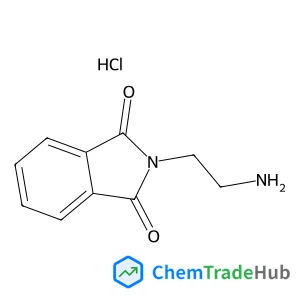
2-(2-Aminoethyl)-1H-isoindole-1,3(2H)-dione hydrochloride (1:1)
CAS Number:
30250-67-0
Molecular Formula:
C10H11ClN2O2
![Ethyl 3-((6-(4,5-dihydro-1H-benzo[d]azepin-3(2H)-yl)-2-(pyridin-2-yl)pyrimidin-4-yl)amino)propanoate structure](https://static.chemtradehub.com/structs/137/1373423-53-0-496a.webp "Ethyl 3-((6-(4,5-dihydro-1H-benzo[d]azepin-3(2H)-yl)-2-(pyridin-2-yl)pyrimidin-4-yl)amino)propanoate structure")
Ethyl 3-((6-(4,5-dihydro-1H-benzo[d]azepin-3(2H)-yl)-2-(pyridin-2-yl)pyrimidin-4-yl)amino)propanoate
CAS Number:
1373423-53-0
Molecular Formula:
C24H27N5O2
Recommended Suppliers






Disclaimer
This page provides academic journal information for reference and research purposes only. We are not affiliated with any journal publishers and do not handle publication submissions. For publication-related inquiries, please contact the respective journal publishers directly.
If you notice any inaccuracies in the information displayed, please contact us at support@chemtradehub.com. We will promptly review and address your concerns.