


Visible-light photocurrent response of TiO2–polyheptazine hybrids: evidence for interfacial charge-transfer absorption
Literature Information
Publication Date
2011-11-07
DOI
10.1039/C1CP22861G
Impact Factor
3.676
Authors
Michal Bledowski, Lidong Wang, Ayyappan Ramakrishnan, Oleksiy V. Khavryuchenko, Volodymyr D. Khavryuchenko, P. Carlo Ricci, Jennifer Strunk, Till Cremer, Claudia Kolbeck
View Original
Abstract
We investigated photoelectrodes based on TiO2–polyheptazine hybrid materials. Since both TiO2 and polyheptazine are extremely chemically stable, these materials are highly promising candidates for fabrication of photoanodes for water photooxidation. The properties of the hybrids were experimentally determined by a careful analysis of optical absorption spectra, luminescence properties and photoelectrochemical measurements, and corroborated by quantum chemical calculations. We provide for the first time clear experimental evidence for the formation of an interfacial charge-transfer complex between polyheptazine (donor) and TiO2 (acceptor), which is responsible for a significant red shift of absorption and photocurrent response of the hybrid as compared to both of the single components. The direct optical charge transfer from the HOMO of polyheptazine to the conduction band edge of TiO2 gives rise to an absorption band centered at 2.3 eV (540 nm). The estimated potential of photogenerated holes (+1.7 V vs.NHE, pH 7) allows for photooxidation of water (+0.82 V vs.NHE, pH 7) as evidenced by visible light-driven (λ > 420 nm) evolution of dioxygen on hybrid electrodes modified with IrO2 nanoparticles as a co-catalyst. The quantum-chemical simulations demonstrate that the TiO2–polyheptazine interface is a complex and flexible system energetically favorable for proton-transfer processes required for water oxidation. Apart from water splitting, this type of hybrid materials may also find further applications in a broader research area of solar energy conversion and photo-responsive devices.
Recommended Journals

NDT & E International

Bioorganic & Medicinal Chemistry Letters

Journal of the Indian Institute of Science

Acta Metallurgica Sinica-English Letters

Journal of Asian Natural Products Research

Bioorganic & Medicinal Chemistry

Main Group Chemistry

Heteroatom Chemistry

Colloid Journal

Journal of Chemical Sciences
Related Literature
Construction of spirooxindole-fused spiropyrazolones containing contiguous three stereogenic centres via [3 + 2] annulation utilizing a ferrocene derived bifunctional phosphine catalyst
Wenjun Luo, Bingxuan Shao, Jingyi Li, Xiao Xiao, Dingguo Song, Fei Ling, Weihui Zhong
2020-03-19
Research Article
DOI: 10.1039/D0QO00140F
Examining the vinyl moiety as a protecting group for hydroxyl (–OH) functionality under basic conditions
Vladimir V. Voronin, Maria S. Ledovskaya
2020-04-08
Research Article
DOI: 10.1039/D0QO00202J
Mechanism and origins of stereo- and enantioselectivities of palladium-catalyzed hydroamination of racemic internal allenes via dynamic kinetic resolution: a computational study
Zhenzhen Wu, Mei Zhang, Yu Shi, Genping Huang
2020-05-08
Research Article
DOI: 10.1039/D0QO00174K
Direct synthesis of 2,4,5-trisubstituted imidazoles from primary alcohols by diruthenium(ii) catalysts under aerobic conditions
Saranya Sundar, Ramesh Rengan
2019-01-09
Paper
DOI: 10.1039/C8OB02785D
Synthesis of a non-natural glucose-2-phosphate ester able to dupe the acc system of Agrobacterium fabrum
Si-Zhe Li, Armelle Vigouroux, Mohammed Ahmar, Abbas El Sahili, Laurent Soulère, Laïla Sago, David Cornu, Solange Moréra, Yves Queneau
2019-01-04
Paper
DOI: 10.1039/C8OB03086C
Metal-free difunctionalization of alkynes to access tetrasubstituted olefins through spontaneous selenosulfonylation of vinylidene ortho-quinone methide (VQM)
Zhili Chen, Hui Mao, Fangli Hu, Dongmei Li, Yu Tan, Fengqing Yang, Wenling Qin
2019-01-07
Paper
DOI: 10.1039/C8OB02967A
One-pot stapling of interchain disulfides of antibodies using an isobutylene motif
Shuang Sun, Padma Akkapeddi, Nuria Martínez-Sáez, Vukosava M. Torres, Carlos Cordeiro, Omar Boutureira
2018-12-10
Paper
DOI: 10.1039/C8OB02877J
Transition metal-catalyzed coupling of heterocyclic alkenes via C–H functionalization: recent trends and applications
Sundaravel Vivek Kumar, Sonbidya Banerjee, Tharmalingam Punniyamurthy
2020-04-29
Review Article
DOI: 10.1039/D0QO00279H
The protecting group enabled para-selective C–H benzylation of anilides via iron(ii) catalysis: a convenient approach for the synthesis of triarylmethanes
Yi Han, Guobao Li, Lingling Liu, Chenyang Dai, Da-Qing Shi, Yingsheng Zhao
2020-06-10
Research Article
DOI: 10.1039/D0QO00402B
Imidazole carbamate probes for affinity guided azide-transfer to metal-binding proteins
Johan Palmfeldt
2019-01-16
Communication
DOI: 10.1039/C8OB03017K
You might also like
Compound Q&A
What industries use (1R,3S)-1,3-Cyclopentanediol (CAS: 16326-97-9)?
(1R,3S)-1,3-Cyclopentanediol finds applications in various industries. In the ph...
16326-97-9(1R,3S)-1,3-Cyclopen...
Compound Q&A
What precautions should be taken when handling N'-[4-(Dimethylamino)phenyl]-N,N-dimethyl-1,4-benzenediamine (CAS: 637-31-0)?
When handling N'-[4-(Dimethylamino)phenyl]-N,N-dimethyl-1,4-benzenediamine, it i...
637-31-0N'-[4-(Dimethylamino...
Compound Q&A
Are there alternatives to 5-(2,4-Difluorophenyl)-2-methoxypyrimidine (CAS: 1352318-16-1) in synthesis?
There are several alternatives to 5-(2,4-Difluorophenyl)-2-methoxypyrimidine in ...
1352318-16-15-(2,4-Difluoropheny...
Compound Q&A
What regulatory guidelines apply to 1-(3-Methoxyphenoxy)propan-2-ol (CAS: 382141-68-6)?
1-(3-Methoxyphenoxy)propan-2-ol (CAS: 382141-68-6) must comply with the Globally...
382141-68-61-(3-Methoxyphenoxy)...
Compound Q&A
Is Tetrodotoxin Citrate (CAS: 18660-81-6) safe?
Tetrodotoxin Citrate is extremely dangerous and should be handled with extreme c...
18660-81-6Tetrodotoxin Citrate
Compound Q&A
What are the main uses of 2-Methyl-2-propanyl [(1R,3S)-3-hydroxycyclopentyl]carbamate (CAS: 225641-84-9)?
2-Methyl-2-propanyl [(1R,3S)-3-hydroxycyclopentyl]carbamate (CAS: 225641-84-9) i...
225641-84-92-Methyl-2-propanyl ...
Compound Q&A
How should waste containing 4-(2-Hydroxyhexafluoroisopropyl)Benzoic Acid (CAS: 16261-80-6) be handled?
Waste containing 4-(2-Hydroxyhexafluoroisopropyl)Benzoic Acid (CAS: 16261-80-6) ...
16261-80-64-(2-Hydroxyhexafluo...
Compound Q&A
How is 2-Methyl-2-proanyl {(2S)-1-[(benzyloxy)amino]-3-hydroxy-3-methyl-1-oxo-2-butanyl}carbamate (CAS: 102507-19-7) typically synthesized?
2-Methyl-2-proanyl {(2S)-1-[(benzyloxy)amino]-3-hydroxy-3-methyl-1-oxo-2-butanyl...
102507-19-72-Methyl-2-propanyl ...
Compound Q&A
What is Benzeneethanamine, α-ethyl-, hydrochloride (1:1) (CAS: 20735-15-3)?
Benzeneethanamine, α-ethyl-, hydrochloride (1:1) is an organic compound with the...
20735-15-3Benzeneethanamine, α...
Compound Q&A
Are there alternatives to 3-{(E)-[4-(Dimethylamino)phenyl]diazenyl}benzoic acid (CAS: 20691-84-3) in synthesis?
In the synthesis of compounds similar to 3-{(E)-[4-(Dimethylamino)phenyl]diazeny...
20691-84-33-{(E)-[4-(Dimethyla...
Source Journal
Physical Chemistry Chemical Physics

CiteScore:
5.5
Self-citation Rate:
10.3%
Articles per Year:
3036
Physical Chemistry Chemical Physics (PCCP) is an international journal co-owned by 19 physical chemistry and physics societies from around the world. This journal publishes original, cutting-edge research in physical chemistry, chemical physics and biophysical chemistry. To be suitable for publication in PCCP, articles must include significant innovation and/or insight into physical chemistry; this is the most important criterion that reviewers and Editors will judge against when evaluating submissions. The journal has a broad scope and welcomes contributions spanning experiment, theory, computation and data science. Topical coverage includes spectroscopy, dynamics, kinetics, statistical mechanics, thermodynamics, electrochemistry, catalysis, surface science, quantum mechanics, quantum computing and machine learning. Interdisciplinary research areas such as polymers and soft matter, materials, nanoscience, energy, surfaces/interfaces, and biophysical chemistry are welcomed if they demonstrate significant innovation and/or insight into physical chemistry. Joined experimental/theoretical studies are particularly appreciated when complementary and based on up-to-date approaches.
Recommended Compounds
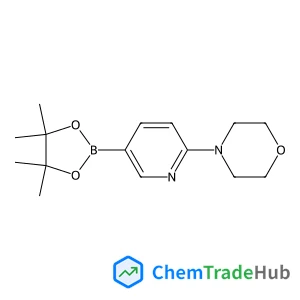
4-(5-(4,4,5,5-tetramethyl-1,3,2-dioxaborolan-2-yl)pyridin-2-yl)morpholine
CAS Number:
485799-04-0
Molecular Formula:
C15H23BN2O3
Recommended Suppliers





Disclaimer
This page provides academic journal information for reference and research purposes only. We are not affiliated with any journal publishers and do not handle publication submissions. For publication-related inquiries, please contact the respective journal publishers directly.
If you notice any inaccuracies in the information displayed, please contact us at support@chemtradehub.com. We will promptly review and address your concerns.