


Promiscuous zinc-dependent acylase-mediated carbon–carbon bond formation in organic media
Literature Information
Publication Date
2007-02-22
DOI
10.1039/B700327G
Impact Factor
6.222
Authors
Jian-Ming Xu, Fu Zhang, Bo-Kai Liu, Qi Wu, Xian-Fu Lin
View Original
Abstract
A zinc-dependent acylase, D-aminoacylase from Escherichia. Coli, displays a promiscuous activity to catalyze the carbon–carbon bond formation reaction of 1,3-dicarbonyl compounds to methyl vinyl ketone in organic media.
Recommended Journals

Heteroatom Chemistry

Journal of Chemical Sciences

Chinese Journal of Chemistry

Biocatalysis and Biotransformation

Atomization and Sprays

Medicinal Chemistry Research

Journal of Asian Natural Products Research

Acta Metallurgica Sinica-English Letters

Polycyclic Aromatic Compounds

Critical Reviews in Solid State and Materials Sciences
Related Literature
An experimental confirmation of the products of the reaction between CN radicals and NH3
Mark A. Blitz, Paul W. Seakins, Ian W. M. Smith
2009-10-20
Communication
DOI: 10.1039/B917734E
Impact of vibrational excitation on the kinetics of a nascent ketene
Thomas Schmierer, Wolfgang J. Schreier, Florian O. Koller, Tobias E. Schrader
2009-11-05
Paper
DOI: 10.1039/B915451E
Spectroscopical properties of organic/metal nanohybrids
Giovanna Dellepiane, Carla Cuniberti, Marina Alloisio, Anna Demartini
2010-02-03
Paper
DOI: 10.1039/B912921A
Investigation of the nucleation and growth dynamics of FePt nanoparticles prepared via a high-temperature synthesis route employing PtCl2 as platinum precursor
Hauke Heller, Kirsten Ahrenstorf, Jose A. C. Broekaert, Horst Weller
2009-03-19
Paper
DOI: 10.1039/B822306H
Computational identification of a metal organic framework for high selectivity membrane-based CO2/CH4 separations: Cu(hfipbb)(H2hfipbb)0.5
Taku Watanabe, Seda Keskin, Sankar Nair, David S. Sholl
2009-10-29
Communication
DOI: 10.1039/B918254N
The influence of alkaline earth ions on the structural organization of acetone probed by the noncoincidence effect of the ν(CO) band: experimental and quantum chemical results
Maria Grazia Giorgini, Hajime Torii, Maurizio Musso
2009-11-07
Paper
DOI: 10.1039/B912164A
Integral and differential cross sections for the S(1D)+HD reaction employing the ground adiabatic electronic state
H. Yang, K.-L. Han, G. C. Schatz, S.-H. Lee, K. Liu, S. C. Smith, M. Hankel
2009-11-05
Paper
DOI: 10.1039/B917972K
Polymer–microporous host interactions probed by photoluminescence spectroscopy
Carmen Tiseanu, Vasile Ion Parvulescu, Bogdan Cojocaru, Victor A. Lorenz-Fonfria, Michael Kumke, Andre Gessner, Ion Enculescu
2010-02-03
Paper
DOI: 10.1039/B922591A
An electrochemical study of lithium insertion into Cr5−yTiySe8 (y = 1, 2, 3, 4, 4.5) beyond the intercalation limit
Joseph Wontcheu, Wolfgang Bensch
2009-03-12
Paper
DOI: 10.1039/B822397A
Chirality transition in the epoxidation of (−)-α-pinene and successive hydrolysis studied by Raman optical activity and DFT
Zhaochi Feng, Can Li
2010-02-09
Paper
DOI: 10.1039/B919993D
You might also like
Compound Q&A
What precautions should be taken when handling 2-Chloro-1,2-bis(4-methylphenyl)ethanone (CAS: 71193-32-3)?
When handling 2-Chloro-1,2-bis(4-methylphenyl)ethanone (CAS: 71193-32-3), it is ...
71193-32-32-Chloro-1,2-bis(4-m...
Compound Q&A
What industries use 4-Ethoxy-3-(5-methyl-4-oxo-7-propyl-1,4-dihydroimidazo[5,1-f][1,2,4]triazin-2-yl)benzenesulfonyl chloride (CAS: 224789-26-8)?
4-Ethoxy-3-(5-methyl-4-oxo-7-propyl-1,4-dihydroimidazo[5,1-f][1,2,4]triazin-2-yl...
224789-26-84-Ethoxy-3-(5-methyl...
Compound Q&A
How should Methyl 3-Oxo-4-Androsten-17-Carboxylate (CAS: 2681-55-2) be stored?
Methyl 3-Oxo-4-Androsten-17-Carboxylate (CAS: 2681-55-2) should be stored in a c...
2681-55-2Methyl 3-Oxo-4-Andro...
Compound Q&A
What are the main uses of (R)-3-Amino-4-(3-hexylphenylamino)-4-oxobutylphosphonic acid (CAS: 909725-61-7)?
(R)-3-Amino-4-(3-hexylphenylamino)-4-oxobutylphosphonic acid is primarily used i...
909725-61-7(R)-3-Amino-4-(3-hex...
Compound Q&A
What regulatory guidelines apply to 2-Methyl-2-propanyl 3-amino-3-carbamoyl-1-azetidinecarboxylate (CAS: 1254120-14-3)?
2-Methyl-2-propanyl 3-amino-3-carbamoyl-1-azetidinecarboxylate (CAS: 1254120-14-...
1254120-14-32-Methyl-2-propanyl ...
Compound Q&A
Are there alternatives to (E)-4-(tert-Butoxy)-4-oxobut-2-enoic acid (CAS: 135355-96-3) in synthesis?
There are alternative reagents that can be used in synthesis instead of (E)-4-(t...
135355-96-3(E)-4-(tert-Butoxy)-...
Compound Q&A
What are the physical and chemical properties of [2-(3-Chlorophenyl)-1,3-thiazol-4-yl]methanol (CAS: 121202-20-8)?
[2-(3-Chlorophenyl)-1,3-thiazol-4-yl]methanol (CAS: 121202-20-8) is a crystallin...
121202-20-8[2-(3-Chlorophenyl)-...
Compound Q&A
What is the market or research trend for Methyl (2S)-[(4S)-2,2-dimethyl-1,3-dioxolan-4-yl]{[(4-methylphenyl)sulfonyl]oxy}acetate (CAS: 166249-17-8)?
The market and research trends for Methyl (2S)-[(4S)-2,2-dimethyl-1,3-dioxolan-4...
166249-17-8Methyl (2S)-[(4S)-2,...
Compound Q&A
What is the market or research trend for 1-Bromo-2-isocyanatoethane (CAS: 42865-19-0)?
The market for 1-Bromo-2-isocyanatoethane (CAS: 42865-19-0) is driven by its use...
42865-19-01-Bromo-2-isocyanato...
Compound Q&A
What are the main uses of 4-Nitro-D-phenylalanine hydrochloride (CAS: 147065-06-3)?
4-Nitro-D-phenylalanine hydrochloride (CAS: 147065-06-3) is primarily used in re...
147065-06-34-Nitro-D-phenylalan...
Source Journal
Chemical Communications

CiteScore:
8.6
Self-citation Rate:
4.7%
Articles per Year:
2458
ChemComm publishes urgent research which is of outstanding significance and interest to experts in the field, while also appealing to the journal’s broad chemistry readership. Our communication format is ideally suited to short, urgent studies that are of such importance that they require accelerated publication. Our scope covers all topics in chemistry, and research at the interface of chemistry and other disciplines (such as materials science, nanoscience, physics, engineering and biology) where there is a significant novelty in the chemistry aspects. Major topic areas covered include: Analytical Chemistry Catalysis Chemical Biology and medicinal chemistry Computational Chemistry and Machine Learning Energy and sustainable chemistry Environmental Chemistry Green Chemistry Inorganic Chemistry Materials Chemistry Nanoscience Organic Chemistry Physical Chemistry Polymer Chemistry Supramolecular Chemistry
Recommended Compounds
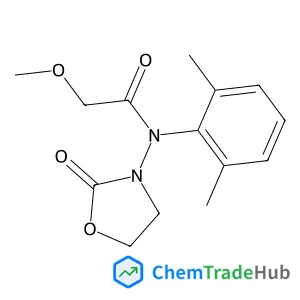
N-(2,6-Dimethylphenyl)-2-methoxy-N-(2-oxo-1,3-oxazolidin-3-yl)acetamide
CAS Number:
77732-09-3
Molecular Formula:
C14H18N2O4
Recommended Suppliers






Disclaimer
This page provides academic journal information for reference and research purposes only. We are not affiliated with any journal publishers and do not handle publication submissions. For publication-related inquiries, please contact the respective journal publishers directly.
If you notice any inaccuracies in the information displayed, please contact us at support@chemtradehub.com. We will promptly review and address your concerns.