













Spectroscopical properties of organic/metal nanohybrids
Literature Information
Publication Date
2010-02-03
DOI
10.1039/B912921A
Impact Factor
3.676
Authors
Giovanna Dellepiane, Carla Cuniberti, Marina Alloisio, Anna Demartini
View Original
Abstract
The aim of our work was to prepare stable nanohybrids of controlled size and shape consisting of a noble metal core decorated with polydiacetylenes (PDAs). Due to the combination of the outstanding linear and nonlinear optical properties of the polydiacetylenic chains with the electromagnetic field-enhancing capability of metal nanostructures, these novel composites can find potential application in different fields. In particular, the different colours exhibited by PDAs in relation to the chemical nature of the monomer and the polymerization procedure, as well as in response to environmental perturbations, make them excellent materials for the fabrication of sensing devices. On the basis of our previous work on PDA self-assembled monolayers on flat metal surfaces, the results of which are briefly reported, we prepared differently-shaped gold and silver nanocores (spheres, cages) coated with various diacetylenic monomers having end-groups able to firmly anchor to the metal surface. These nanohybrids exhibit in aqueous colloidal solution an enhanced photochemical polymerization monitored step by step with UV-Vis and SERS techniques. It is shown that in these stable assemblies an intra-particle polymerization takes place and that the dominant PDA form is conditioned by the core size and geometry. While the nanoparticles are SERS active in the visible, the nanocages should be excellent SERS substrates from the visible to the near infrared regions.
Recommended Journals
Related Literature
Investigating the coverage dependent behaviour of CO on Gd/Pt(111)
Elisabeth Therese Ulrikkeholm, Jan Rossmeisl, Ib Chorkendorff
2016-09-22
Paper
DOI: 10.1039/C6CP04575H
Surface reaction network of CO oxidation on CeO2/Au(110) inverse model catalysts
Liangbing Ding, Feng Xiong, Yuekang Jin, Zhengming Wang, Guanghui Sun, Weixin Huang
2016-11-09
Paper
DOI: 10.1039/C6CP05951A
Magnetic anisotropy of a CoII single ion magnet with distorted trigonal prismatic coordination: theory and experiment
Karin Fink, Valeriu Mereacre, Christopher E. Anson
2016-10-11
Paper
DOI: 10.1039/C6CP03157A
Salt gradient driven ion transport in solid-state nanopores: the crucial role of reservoir geometry and size
Chih-Yuan Lin, Fu Chen, Li-Hsien Yeh, Jyh-Ping Hsu
2016-10-12
Paper
DOI: 10.1039/C6CP06459K
A stochastic study of electron transfer kinetics in nano-particulate photocatalysis: a comparison of the quasi-equilibrium approximation with a random walking model
Baoshun Liu, Xiujian Zhao, Jiaguo Yu, Akira Fujishima
2016-11-15
Paper
DOI: 10.1039/C6CP06320A
Structure and stability of neutral Al–Mg nanoclusters up to 55 atoms
Mateus A. M. Paiva, Bárbara M. T. C. Peluzo, Jadson C. Belchior, Breno R. L. Galvão
2016-10-20
Paper
DOI: 10.1039/C6CP05605A
Glycation induces conformational changes in the amyloid-β peptide and enhances its aggregation propensity: molecular insights
Neelanjana Sengupta
2016-10-25
Paper
DOI: 10.1039/C6CP05041G
An accurate multi-channel multi-reference full-dimensional global potential energy surface for the lowest triplet state of H2O2
Richard Dawes, Hua Guo
2016-10-06
Paper
DOI: 10.1039/C6CP06232F
Dynamic nitroxyl formation in the ammonia oxidation on platinum via Eley–Rideal reactions
Yunxi Yao, Konstantinos P. Giapis
2016-10-14
Paper
DOI: 10.1039/C6CP06533C
You might also like
Compound Q&A
What are the main uses of (3.beta.)-3-Hydroxy-N,N-dimethyl-chol-5-en-24-amide (CAS: 79066-03-8)?
(3.beta.)-3-Hydroxy-N,N-dimethyl-chol-5-en-24-amide (CAS: 79066-03-8) is primari...
79066-03-8(3.beta.)-3-Hydroxy-...
Compound Q&A
What regulatory guidelines apply to 5-(aminomethyl)-2-methoxyphenol (CAS: 89702-89-6)?
5-(Aminomethyl)-2-methoxyphenol (CAS: 89702-89-6) is classified under GHS as a s...
89702-89-65-(aminomethyl)-2-me...
Compound Q&A
What is Thieno[2,3-c]pyridin-7(6H)-one (CAS: 28981-13-7)?
Thieno[2,3-c]pyridin-7(6H)-one (CAS: 28981-13-7) is a heterocyclic organic compo...
28981-13-7Thieno[2,3-c]pyridin...
Compound Q&A
Is 1-[(6-Methoxy-3-pyridinyl)methyl]-4-piperidinamine dihydrochloride (CAS: 1185311-28-7) safe?
1-[(6-Methoxy-3-pyridinyl)methyl]-4-piperidinamine dihydrochloride is generally ...
1185311-28-71-[(6-Methoxy-3-pyri...
Compound Q&A
What regulatory guidelines apply to [(2E)-3-Phenyl-2-propen-1-yl]phosphonic acid (CAS: 146404-58-2)?
[(2E)-3-Phenyl-2-propen-1-yl]phosphonic acid (CAS: 146404-58-2) is regulated und...
146404-58-2[(2E)-3-Phenyl-2-pro...
Compound Q&A
What regulatory guidelines apply to 6-Bromo-7-methoxyquinoline (CAS: 1620515-86-7)?
6-Bromo-7-methoxyquinoline (CAS: 1620515-86-7) falls under the scope of the Glob...
1620515-86-76-Bromo-7-methoxyqui...
Compound Q&A
What industries use (2R)-1-(1-Benzofuran-2-yl)-N-propyl-2-pentanamine (CAS: 260550-89-8)?
This compound is primarily used in the pharmaceutical industry for the developme...
260550-89-8(2R)-1-(1-Benzofuran...
Compound Q&A
What are the main uses of 1-Ethyl-7-[2-methyl-6-(4H-1,2,4-triazol-3-yl)-3-pyridinyl]-3,5-dihydropyrazino[2,3-b]pyrazin-2(1H)-one (CAS: 1228013-15-7)?
1-Ethyl-7-[2-methyl-6-(4H-1,2,4-triazol-3-yl)-3-pyridinyl]-3,5-dihydropyrazino[2...
1228013-15-71-Ethyl-7-[2-methyl-...
Compound Q&A
Are there alternatives to {5-(Acryloylamino)-2-[(dimethylamino)methyl]phenyl}boronic acid (CAS: 1217500-78-1) in synthesis?
Alternative reagents such as 2-[(dimethylamino)methyl]phenylboronic acid or rela...
1217500-78-1{5-(Acryloylamino)-2...
Compound Q&A
What is 3-(Piperidin-4-yloxy)pyridine (CAS: 310881-48-2)?
3-(Piperidin-4-yloxy)pyridine (CAS: 310881-48-2) is an organic compound with the...
310881-48-23-(Piperidin-4-yloxy...
Source Journal
Physical Chemistry Chemical Physics

CiteScore:
5.5
Self-citation Rate:
10.3%
Articles per Year:
3036
Physical Chemistry Chemical Physics (PCCP) is an international journal co-owned by 19 physical chemistry and physics societies from around the world. This journal publishes original, cutting-edge research in physical chemistry, chemical physics and biophysical chemistry. To be suitable for publication in PCCP, articles must include significant innovation and/or insight into physical chemistry; this is the most important criterion that reviewers and Editors will judge against when evaluating submissions. The journal has a broad scope and welcomes contributions spanning experiment, theory, computation and data science. Topical coverage includes spectroscopy, dynamics, kinetics, statistical mechanics, thermodynamics, electrochemistry, catalysis, surface science, quantum mechanics, quantum computing and machine learning. Interdisciplinary research areas such as polymers and soft matter, materials, nanoscience, energy, surfaces/interfaces, and biophysical chemistry are welcomed if they demonstrate significant innovation and/or insight into physical chemistry. Joined experimental/theoretical studies are particularly appreciated when complementary and based on up-to-date approaches.
Recommended Compounds

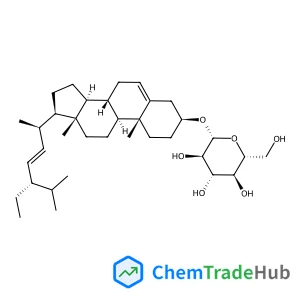
(3beta,22E)-Stigmasta-5,22-dien-3-yl beta-D-glucopyranoside
CAS Number:
19716-26-8
Molecular Formula:
C35H58O6

Recommended Suppliers






Disclaimer
This page provides academic journal information for reference and research purposes only. We are not affiliated with any journal publishers and do not handle publication submissions. For publication-related inquiries, please contact the respective journal publishers directly.
If you notice any inaccuracies in the information displayed, please contact us at support@chemtradehub.com. We will promptly review and address your concerns.