



Impact of vibrational excitation on the kinetics of a nascent ketene
Literature Information
Publication Date
2009-11-05
DOI
10.1039/B915451E
Impact Factor
3.676
Authors
Thomas Schmierer, Wolfgang J. Schreier, Florian O. Koller, Tobias E. Schrader
View Original
Abstract
The formation and decay of a ketene intermediate photochemically formed from o-nitrobenzaldehyde has been studied by femtosecond UV/Vis and IR spectroscopy. The ketene is formed predominantly within a few 100 fs and to a minor extent within ∼200 ps via the recombination of a triplet phased bi-radical. In tetrahydrofuran solution the ketene intermediate is seen to form a secondary intermediate with biphasic kinetics. The first phase of this decay occurs within a few picoseconds. It can be attributed to the reaction of vibrationally excited ketenes. The second phase characterized by a time constant of 2 ns is due to the reaction of thermalized molecules. In 2-butanol solution the lifetime of the thermalized ketene is only ∼60 ps and the rapid and the slow phases of the decay start to merge.
Recommended Journals

Critical Reviews in Solid State and Materials Sciences

Colloid Journal

Topics in Catalysis

Main Group Chemistry

Chinese Journal of Chemistry

Electroanalysis

Journal of Asian Natural Products Research

Bioorganic & Medicinal Chemistry Letters

Acta Metallurgica Sinica-English Letters

Biocatalysis and Biotransformation
Related Literature
Theoretical study of the H/D isotope effect on phase transition of hydrogen-bonded organic conductor κ-H3(Cat-EDT-TTF)2
Kaichi Yamamoto, Yusuke Kanematsu, Umpei Nagashima, Akira Ueda, Hatsumi Mori, Masanori Tachikawa
2016-10-06
Communication
DOI: 10.1039/C6CP05414E
Interface phonon modes in the [AlN/GaN]20 and [Al0.35Ga0.65N/Al0.55Ga0.45N]20 2D multi-quantum well structures
A. K. Sivadasan, Chirantan Singha, A. Bhattacharyya, Sandip Dhara
2016-10-04
Paper
DOI: 10.1039/C6CP05520F
Enhanced photoelectrochemical water oxidation of bismuth vanadate via a combined strategy of W doping and surface RGO modification
Xiaokang Wan, Fujun Niu, Jinzhan Su, Liejin Guo
2016-11-03
Paper
DOI: 10.1039/C6CP06233D
Predicting molecular self-assembly at surfaces: a statistical thermodynamics and modeling approach
Simone Conti, Marco Cecchini
2016-10-21
Paper
DOI: 10.1039/C6CP05249E
Conformational features of the Aβ42 peptide monomer and its interaction with the surrounding solvent
Prabir Khatua, Jaya C. Jose, Neelanjana Sengupta, Sanjoy Bandyopadhyay
2016-10-12
Paper
DOI: 10.1039/C6CP04925G
Stabilizing effect of TMAO on globular PNIPAM states: preferential attraction induces preferential hydration
Julian Michalowsky, Birgit Fischer, Jens Smiatek
2016-11-03
Paper
DOI: 10.1039/C6CP05991K
How does ammonia bind to the oxygen-evolving complex in the S2 state of photosynthetic water oxidation? Theoretical support and implications for the W1 substitution mechanism
Yu Guo, Lan-Lan He, Dong-Xia Zhao, Li-Dong Gong, Cui Liu, Zhong-Zhi Yang
2016-10-21
Paper
DOI: 10.1039/C6CP05725J
Chemical vapor deposition-prepared sub-nanometer Zr clusters on Pd surfaces: promotion of methane dry reforming
Xue-Rong Shi, Norbert Köpfle, Dmitry Y. Zemlyanov, Axel Knop-Gericke, Michael Hävecker, Bernhard Klötzer, Simon Penner
2016-11-08
Paper
DOI: 10.1039/C6CP07197J
Dark states enhance the photocell power via phononic dissipation
Yiteng Zhang, Aaron Wirthwein, Fahhad H. Alharbi, Gregory S. Engel
2016-11-07
Paper
DOI: 10.1039/C6CP06098F
You might also like
Compound Q&A
What precautions should be taken when handling 2-Chloro-1,2-bis(4-methylphenyl)ethanone (CAS: 71193-32-3)?
When handling 2-Chloro-1,2-bis(4-methylphenyl)ethanone (CAS: 71193-32-3), it is ...
71193-32-32-Chloro-1,2-bis(4-m...
Compound Q&A
What industries use 4-Ethoxy-3-(5-methyl-4-oxo-7-propyl-1,4-dihydroimidazo[5,1-f][1,2,4]triazin-2-yl)benzenesulfonyl chloride (CAS: 224789-26-8)?
4-Ethoxy-3-(5-methyl-4-oxo-7-propyl-1,4-dihydroimidazo[5,1-f][1,2,4]triazin-2-yl...
224789-26-84-Ethoxy-3-(5-methyl...
Compound Q&A
How should Methyl 3-Oxo-4-Androsten-17-Carboxylate (CAS: 2681-55-2) be stored?
Methyl 3-Oxo-4-Androsten-17-Carboxylate (CAS: 2681-55-2) should be stored in a c...
2681-55-2Methyl 3-Oxo-4-Andro...
Compound Q&A
What are the main uses of (R)-3-Amino-4-(3-hexylphenylamino)-4-oxobutylphosphonic acid (CAS: 909725-61-7)?
(R)-3-Amino-4-(3-hexylphenylamino)-4-oxobutylphosphonic acid is primarily used i...
909725-61-7(R)-3-Amino-4-(3-hex...
Compound Q&A
What regulatory guidelines apply to 2-Methyl-2-propanyl 3-amino-3-carbamoyl-1-azetidinecarboxylate (CAS: 1254120-14-3)?
2-Methyl-2-propanyl 3-amino-3-carbamoyl-1-azetidinecarboxylate (CAS: 1254120-14-...
1254120-14-32-Methyl-2-propanyl ...
Compound Q&A
Are there alternatives to (E)-4-(tert-Butoxy)-4-oxobut-2-enoic acid (CAS: 135355-96-3) in synthesis?
There are alternative reagents that can be used in synthesis instead of (E)-4-(t...
135355-96-3(E)-4-(tert-Butoxy)-...
Compound Q&A
What are the physical and chemical properties of [2-(3-Chlorophenyl)-1,3-thiazol-4-yl]methanol (CAS: 121202-20-8)?
[2-(3-Chlorophenyl)-1,3-thiazol-4-yl]methanol (CAS: 121202-20-8) is a crystallin...
121202-20-8[2-(3-Chlorophenyl)-...
Compound Q&A
What is the market or research trend for Methyl (2S)-[(4S)-2,2-dimethyl-1,3-dioxolan-4-yl]{[(4-methylphenyl)sulfonyl]oxy}acetate (CAS: 166249-17-8)?
The market and research trends for Methyl (2S)-[(4S)-2,2-dimethyl-1,3-dioxolan-4...
166249-17-8Methyl (2S)-[(4S)-2,...
Compound Q&A
What is the market or research trend for 1-Bromo-2-isocyanatoethane (CAS: 42865-19-0)?
The market for 1-Bromo-2-isocyanatoethane (CAS: 42865-19-0) is driven by its use...
42865-19-01-Bromo-2-isocyanato...
Compound Q&A
What are the main uses of 4-Nitro-D-phenylalanine hydrochloride (CAS: 147065-06-3)?
4-Nitro-D-phenylalanine hydrochloride (CAS: 147065-06-3) is primarily used in re...
147065-06-34-Nitro-D-phenylalan...
Source Journal
Physical Chemistry Chemical Physics

CiteScore:
5.5
Self-citation Rate:
10.3%
Articles per Year:
3036
Physical Chemistry Chemical Physics (PCCP) is an international journal co-owned by 19 physical chemistry and physics societies from around the world. This journal publishes original, cutting-edge research in physical chemistry, chemical physics and biophysical chemistry. To be suitable for publication in PCCP, articles must include significant innovation and/or insight into physical chemistry; this is the most important criterion that reviewers and Editors will judge against when evaluating submissions. The journal has a broad scope and welcomes contributions spanning experiment, theory, computation and data science. Topical coverage includes spectroscopy, dynamics, kinetics, statistical mechanics, thermodynamics, electrochemistry, catalysis, surface science, quantum mechanics, quantum computing and machine learning. Interdisciplinary research areas such as polymers and soft matter, materials, nanoscience, energy, surfaces/interfaces, and biophysical chemistry are welcomed if they demonstrate significant innovation and/or insight into physical chemistry. Joined experimental/theoretical studies are particularly appreciated when complementary and based on up-to-date approaches.
Recommended Compounds

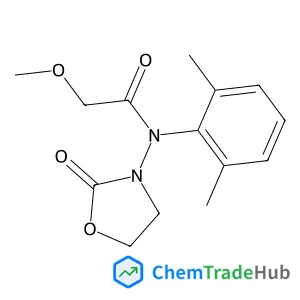
N-(2,6-Dimethylphenyl)-2-methoxy-N-(2-oxo-1,3-oxazolidin-3-yl)acetamide
CAS Number:
77732-09-3
Molecular Formula:
C14H18N2O4
Recommended Suppliers







Disclaimer
This page provides academic journal information for reference and research purposes only. We are not affiliated with any journal publishers and do not handle publication submissions. For publication-related inquiries, please contact the respective journal publishers directly.
If you notice any inaccuracies in the information displayed, please contact us at support@chemtradehub.com. We will promptly review and address your concerns.