












![(3aS,6aS)-1-Methyloctahydropyrrolo[3,4-b]pyrrole structure](https://static.chemtradehub.com/structs/877/877212-98-1-9157.webp "(3aS,6aS)-1-Methyloctahydropyrrolo[3,4-b]pyrrole structure")
Parity conservation and polarization of differential cross sections in complex-forming chemical reactions
Literature Information
Publication Date
2006-07-27
DOI
10.1039/B608811B
Impact Factor
3.676
Authors
L. Bonnet, P. Larrégaray, J.-C. Rayez, T. Gonzalez-Lezana
View Original
Abstract
For complex-forming chemical reactions, such as atom–diatom insertion reactions, quantum scattering and quantum statistical calculations usually predict sharp forward/backward peaks in the Differential Cross Sections (DCS). Conversely, the corresponding classical calculations are unable to reproduce these peaks. We show here that the basic reason for such an intriguing failure is that parity conservation is ignored in classical mechanics. A by-product of the analysis is a simple parity-restoring approximation that might significantly increase the ability of classical mechanics to describe DCSs over the whole angular range for the title processes.
Related Literature
Thermodynamic properties and interfacial tension of a model water–carbon dioxide system
Tatyana Kuznetsova, Bjørn Kvamme
2002-02-12
Paper
DOI: 10.1039/B108726F
Nanostructuring of a sodium dodecyl sulfate-covered Au(111) electrode
Marc Petri, Dieter M. Kolb
2002-02-22
Paper
DOI: 10.1039/B110142K
Predissociation dynamics in the A 3Π state of PH: An experimental and ab initio investigation
James A. J. Fitzpatrick, Oleg V. Chekhlov, David R. Morgan, Robert W. Burrows, Colin M. Western
2002-02-27
Paper
DOI: 10.1039/B111198C
Pairing of the nucleobase guanine studied by IR–UV double-resonance spectroscopy and ab initio calculations
Christoph Janzen, Petra Imhof, Karl Kleinermanns, Mattanjah S. de Vries
2002-01-29
Paper
DOI: 10.1039/B110360C
Isothermal vapor–liquid equilibria of binary systems of carbon dioxide and 1-butyne, compared to other binary CO2 + C4Hn systems in terms of global parameters
M. Bardas, N. Dahmen, T. Kraska, K.-D. Wagner, L. Yelash
2002-02-15
Paper
DOI: 10.1039/B109059C
Influence of reconstruction on the structure of self-assembled normal-alkane monolayers on Au(111) surfaces
Zhao-Xiong Xie, Zhi-Feng Huang, Xin Xu
2002-03-14
Paper
DOI: 10.1039/B109159J
Excited-state hydrogen detachment and hydrogen transfer driven by repulsive 1πσ* states: A new paradigm for nonradiative decay in aromatic biomolecules
A. L. Sobolewski, W. Domcke, C. Dedonder-Lardeux, C. Jouvet
2002-02-28
Invited Article
DOI: 10.1039/B110941N
Femtosecond spectroscopy of p-dimethylaminocyanostilbene in solution—no evidence for dual fluorescence
2002-01-31
Communication
DOI: 10.1039/B111564M
Inelastic neutron scattering spectra of the transverse acoustic modes of the normal alkanes
John Tomkinson, Stewart F. Parker, Dale A. Braden, Bruce S. Hudson
2002-01-30
Paper
DOI: 10.1039/B110091B
Rate constants for the reaction of HO2 radicals with cyclopentane and propane between 673 and 783 K
S. M. Handford-Styring, R. W. Walker
2002-01-21
Paper
DOI: 10.1039/B108578F
You might also like
Compound Q&A
What regulatory guidelines apply to 6-Bromo-2-methylimidazo[1,2-a]pyrimidine (CAS: 1111638-05-1)?
6-Bromo-2-methylimidazo[1,2-a]pyrimidine (CAS: 1111638-05-1) falls under various...
1111638-05-16-Bromo-2-methylimid...
Compound Q&A
Are there alternatives to 1-Pyrrolidineethanol, β-methyl-α-phenyl-, (αS,βR) (CAS: 123620-80-4) in synthesis?
While there are no direct alternatives, similar compounds like 1-Pyrrolidineetha...
123620-80-41-Pyrrolidineethanol...
Compound Q&A
Is 4-Methyl-2,6-bis(2-methyl-2-propanyl)phenyl methylcarbamate (CAS: 1918-11-2) safe?
4-Methyl-2,6-bis(2-methyl-2-propanyl)phenyl methylcarbamate (CAS: 1918-11-2) is ...
1918-11-24-Methyl-2,6-bis(2-m...
Compound Q&A
How should 2-(3-Bromo-4-fluorophenyl)-1,3-dioxolane (CAS: 77771-04-1) be stored?
2-(3-Bromo-4-fluorophenyl)-1,3-dioxolane (CAS: 77771-04-1) should be stored in a...
77771-04-12-(3-Bromo-4-fluorop...
Compound Q&A
What are the physical and chemical properties of 4,5,6,7-Tetrahydro-1H-indazole hydrochloride (CAS: 18161-11-0)?
4,5,6,7-Tetrahydro-1H-indazole hydrochloride is a white crystalline solid with a...
18161-11-04,5,6,7-Tetrahydro-1...
Compound Q&A
What is (2R)-1-Methoxy-3-phenyl-2-propanamine (CAS: 59919-07-2)?
(2R)-1-Methoxy-3-phenyl-2-propanamine is a chiral organic compound with the CAS ...
59919-07-2(2R)-1-Methoxy-3-phe...
Compound Q&A
What industries use Ethyl 1-(1-phenylethyl)-1H-imidazole-5-carboxylate (CAS: 56649-47-9)?
Ethyl 1-(1-phenylethyl)-1H-imidazole-5-carboxylate is used in various industries...
56649-47-9Ethyl 1-(1-phenyleth...
Compound Q&A
What regulatory guidelines apply to 4-[(1E,3S)-1-(4-Hydroxyphenyl)-1,4-pentadien-3-yl]phenol (CAS: 17676-24-3)?
4-[(1E,3S)-1-(4-Hydroxyphenyl)-1,4-pentadien-3-yl]phenol (CAS: 17676-24-3) falls...
17676-24-34-[(1E,3S)-1-(4-Hydr...
Compound Q&A
What industries use (S)-3-Amino-5-phenylpentanoic acid hydrochloride (CAS: 331846-97-0)?
(S)-3-Amino-5-phenylpentanoic acid hydrochloride is primarily used in the pharma...
331846-97-0(S)-3-Amino-5-phenyl...
Compound Q&A
How is 7-methoxy-1-benzothiophene-2-carboxylic acid (CAS: 88791-07-5) typically synthesized?
7-Methoxy-1-benzothiophene-2-carboxylic acid is typically synthesized by reactin...
88791-07-57-methoxy-1-benzothi...
Source Journal
Physical Chemistry Chemical Physics

CiteScore:
5.5
Self-citation Rate:
10.3%
Articles per Year:
3036
Physical Chemistry Chemical Physics (PCCP) is an international journal co-owned by 19 physical chemistry and physics societies from around the world. This journal publishes original, cutting-edge research in physical chemistry, chemical physics and biophysical chemistry. To be suitable for publication in PCCP, articles must include significant innovation and/or insight into physical chemistry; this is the most important criterion that reviewers and Editors will judge against when evaluating submissions. The journal has a broad scope and welcomes contributions spanning experiment, theory, computation and data science. Topical coverage includes spectroscopy, dynamics, kinetics, statistical mechanics, thermodynamics, electrochemistry, catalysis, surface science, quantum mechanics, quantum computing and machine learning. Interdisciplinary research areas such as polymers and soft matter, materials, nanoscience, energy, surfaces/interfaces, and biophysical chemistry are welcomed if they demonstrate significant innovation and/or insight into physical chemistry. Joined experimental/theoretical studies are particularly appreciated when complementary and based on up-to-date approaches.
Recommended Compounds
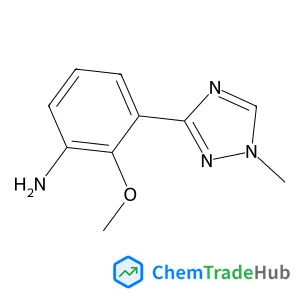
2-Methoxy-3-(1-methyl-1H-1,2,4-triazol-3-yl)aniline
CAS Number:
1609394-10-6
Molecular Formula:
C10H12N4O
Recommended Suppliers




Disclaimer
This page provides academic journal information for reference and research purposes only. We are not affiliated with any journal publishers and do not handle publication submissions. For publication-related inquiries, please contact the respective journal publishers directly.
If you notice any inaccuracies in the information displayed, please contact us at support@chemtradehub.com. We will promptly review and address your concerns.