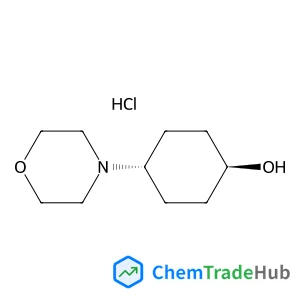
trans-4-(4-Morpholinyl)cyclohexanol hydrochloride (1:1)
CAS Number:
1588441-09-1
Molecular Formula:
C10H20ClNO2
Shiqi Zhou, Andrej Jamnik
A recently proposed third order + second order perturbation density functional theory (DFT) approach is tested for the validity and applicability to purely repulsive model fluids subjected to various external fields. Hard core repulsive Yukawa potential, point particle Yukawa potential, and inverse power potential are employed as sample models. Theoretical DFT results are compared with the corresponding simulation data obtained by grand canonical ensemble Monte Carlo simulation. This comparison indicates that the third order + second order perturbation DFT approach is suitable for these purely repulsive fluids only on condition of high accuracy of the imported bulk second order direct correlation function (DCF). However, in this case the origin of the successful performance somewhat differs from that observed for the mean field approximation applied to van der Waals fluids. In the present case it originates from the observation that the bulk second order DCF is strongly dependent on the density argument for the hard-core part, while for the distances exceeding the core dimension this dependence is considerably weaker.

European Journal of Organic Chemistry

Journal of Medical Biochemistry

Molecular Diversity

Journal of Enzyme inhibition and Medicinal Chemistry

Photochemical & Photobiological Sciences

Molecules

Coloration Technology

Advanced Engineering Materials

Angewandte Chemie International Edition

Contact Lens & Anterior Eye
Igor Leontyev, Alexei Stuchebrukhov
DOI: 10.1039/C0CP01971B
Radovan Bast, Ulf Ekström, Bin Gao, Trygve Helgaker, Kenneth Ruud, Andreas J. Thorvaldsen
DOI: 10.1039/C0CP01647K
Jorge Bañuelos, Fernando López Arbeloa, Virginia Martinez, Marta Liras, Angel Costela, Inmaculada García Moreno, Iñigo López Arbeloa
DOI: 10.1039/C0CP01147A
J. Chris Bauer, David Mullins, Meijun Li, E. Andrew Payzant
DOI: 10.1039/C0CP01859G
S. S. Sarangi, S. G. Raju, S. Balasubramanian
DOI: 10.1039/C0CP01272F
Angelina Angelova, Rada Mutafchieva, Sylviane Lesieur, Ulla Vainio, Vasil M. Garamus, Grethe V. Jensen, Jan Skov Pedersen
DOI: 10.1039/C0CP01029D
Vacharaporn Soonsin, Bei P. Luo, Ulrich K. Krieger, Claudia Marcolli, Thomas Peter, Thomas Koop
DOI: 10.1039/C0CP01273D
Uwe Hahn, Francesca Setaro, Xavier Ragàs, Angus Gray-Weale, Santi Nonell, Tomas Torres
DOI: 10.1039/C0CP01015D
D. B. Qian, X. Ma, Z. Chen, X. L. Zhu, H. P. Liu
DOI: 10.1039/C0CP00773K
Emilio Palomares, Amparo Forneli
DOI: 10.1039/C0CP01855D
Ethyl 4-chlorothieno[2,3-b]pyridine-5-carboxylate (CAS: 59713-58-5) can be synth...
5-Methyl-1H-indole-3-carbaldehyde (CAS: 52562-50-2) is subject to various regula...
(1,3-Dimethyl-2,4-dioxo-1,2,3,4-tetrahydro-5-pyrimidinyl)boronic acid is a white...
Waste containing Sulfocostunolide A (CAS: 1016983-51-9) should be handled with c...
When handling Murraxocin (CAS: 88478-44-8), ensure proper personal protective eq...
Formvar (CAS: 63148-64-1) is an alkyd resin characterized by a high molecular we...
(S)-4-benzyl-2-((benzyloxy)methyl)morpholine is generally safe when handled with...
Methyl 1-(5-bromo-2-pyrimidinyl)cyclopropanecarboxylate (CAS: 1447607-69-3) is p...
2-Methyl-1-phenyl-1-propanamine hydrochloride (CAS: 24290-47-9) is generally con...
3-(4-Bromophenyl)-2-methylpropanoic acid is synthesized through a multi-step pro...

Physical Chemistry Chemical Physics (PCCP) is an international journal co-owned by 19 physical chemistry and physics societies from around the world. This journal publishes original, cutting-edge research in physical chemistry, chemical physics and biophysical chemistry. To be suitable for publication in PCCP, articles must include significant innovation and/or insight into physical chemistry; this is the most important criterion that reviewers and Editors will judge against when evaluating submissions. The journal has a broad scope and welcomes contributions spanning experiment, theory, computation and data science. Topical coverage includes spectroscopy, dynamics, kinetics, statistical mechanics, thermodynamics, electrochemistry, catalysis, surface science, quantum mechanics, quantum computing and machine learning. Interdisciplinary research areas such as polymers and soft matter, materials, nanoscience, energy, surfaces/interfaces, and biophysical chemistry are welcomed if they demonstrate significant innovation and/or insight into physical chemistry. Joined experimental/theoretical studies are particularly appreciated when complementary and based on up-to-date approaches.
![2-Methyl-2-propanyl 1,6-diazaspiro[3.4]octane-6-carboxylate structure](https://static.chemtradehub.com/structs/115/1158749-79-1-81ee.webp "2-Methyl-2-propanyl 1,6-diazaspiro[3.4]octane-6-carboxylate structure")