


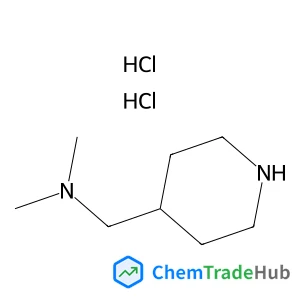
N,N-dimethyl(piperidin-4-yl)methanamine hydrochloride
CAS Number:
172281-72-0
Molecular Formula:
C8H20Cl2N2
Vacharaporn Soonsin, Bei P. Luo, Ulrich K. Krieger, Claudia Marcolli, Thomas Peter, Thomas Koop
We present measurements of water uptake and release by single micrometre-sized aqueous sucrose particles. The experiments were performed in an electrodynamic balance where the particles can be stored contact-free in a temperature and humidity controlled chamber for several days. Aqueous sucrose particles react to a change in ambient humidity by absorbing/desorbing water from the gas phase. This water absorption (desorption) results in an increasing (decreasing) droplet size and a decreasing (increasing) solute concentration. Optical techniques were employed to follow minute changes of the droplet's size, with a sensitivity of 0.2 nm, as a result of changes in temperature or humidity. We exposed several particles either to humidity cycles (between ∼2% and 90%) at 291 K or to constant relative humidity and temperature conditions over long periods of time (up to several days) at temperatures ranging from 203 to 291 K. In doing so, a retarded water uptake and release at low relative humidities and/or low temperatures was observed. Under the conditions studied here, the kinetics of this water absorption/desorption process is controlled entirely by liquid-phase diffusion of water molecules. Hence, it is possible to derive the translational diffusion coefficient of water molecules, DH2O, from these data by simulating the growth or shrinkage of a particle with a liquid-phase diffusion model. Values for DH2O-values as low as 10−24 m2 s−1 are determined using data at temperatures down to 203 K deep in the glassy state. From the experiment and modelling we can infer strong concentration gradients within a single particle including a glassy skin in the outer shells of the particle. Such glassy skins practically isolate the liquid core of a particle from the surrounding gas phase, resulting in extremely long equilibration times for such particles, caused by the strongly non-linear relationship between concentration and DH2O. We present a new parameterization of DH2O that facilitates describing the stability of aqueous food and pharmaceutical formulations in the glassy state, the processing of amorphous aerosol particles in spray-drying technology, and the suppression of heterogeneous chemical reactions in glassy atmospheric aerosol particles.

Russian Journal of Organic Chemistry

Chemistry Education Research and Practice

Organic Process Research & Development

Journal of Peptide Science

Russian Journal of Bioorganic Chemistry

Russian Journal of Applied Chemistry

Russian Journal of Coordination Chemistry

Acta Materialia

Journal of Natural Medicines

New Journal of Chemistry
Matthew T. O. Okenyi, Laura E. Ratcliff
DOI: 10.1039/D0CP04236F
Vinícius Vaz da Cruz, Sebastian Eckert
DOI: 10.1039/D0CP04726K
Xing Yang, Yuwei Wang, Ruining Xiao, Tao Wen, Yulin Shen, Huanxiang Liu, Yongfu Wang
DOI: 10.1039/D0CP04547K
Sheng Dai, Dinesh Bhalothia, Jyh-Pin Chou
DOI: 10.1039/D0CP05205A
F. Batalioto, A. F. C. Campos, A. M. Figueiredo Neto
DOI: 10.1039/D0CP05865C
Ming Hu
DOI: 10.1039/D0CP03372C
Chuqiao Yi, Yuliang Wu, Yayu Gao, Qingguo Du
DOI: 10.1039/D0CP05882C
Ethyl 4-chlorothieno[2,3-b]pyridine-5-carboxylate (CAS: 59713-58-5) can be synth...
5-Methyl-1H-indole-3-carbaldehyde (CAS: 52562-50-2) is subject to various regula...
(1,3-Dimethyl-2,4-dioxo-1,2,3,4-tetrahydro-5-pyrimidinyl)boronic acid is a white...
Waste containing Sulfocostunolide A (CAS: 1016983-51-9) should be handled with c...
When handling Murraxocin (CAS: 88478-44-8), ensure proper personal protective eq...
Formvar (CAS: 63148-64-1) is an alkyd resin characterized by a high molecular we...
(S)-4-benzyl-2-((benzyloxy)methyl)morpholine is generally safe when handled with...
Methyl 1-(5-bromo-2-pyrimidinyl)cyclopropanecarboxylate (CAS: 1447607-69-3) is p...
2-Methyl-1-phenyl-1-propanamine hydrochloride (CAS: 24290-47-9) is generally con...
3-(4-Bromophenyl)-2-methylpropanoic acid is synthesized through a multi-step pro...

Physical Chemistry Chemical Physics (PCCP) is an international journal co-owned by 19 physical chemistry and physics societies from around the world. This journal publishes original, cutting-edge research in physical chemistry, chemical physics and biophysical chemistry. To be suitable for publication in PCCP, articles must include significant innovation and/or insight into physical chemistry; this is the most important criterion that reviewers and Editors will judge against when evaluating submissions. The journal has a broad scope and welcomes contributions spanning experiment, theory, computation and data science. Topical coverage includes spectroscopy, dynamics, kinetics, statistical mechanics, thermodynamics, electrochemistry, catalysis, surface science, quantum mechanics, quantum computing and machine learning. Interdisciplinary research areas such as polymers and soft matter, materials, nanoscience, energy, surfaces/interfaces, and biophysical chemistry are welcomed if they demonstrate significant innovation and/or insight into physical chemistry. Joined experimental/theoretical studies are particularly appreciated when complementary and based on up-to-date approaches.
![Imidazo[1,5-a]pyrazine structure](https://static.chemtradehub.com/structs/274/274-49-7-d749.webp "Imidazo[1,5-a]pyrazine structure")

![2-Methyl-2-propanyl 1,6-diazaspiro[3.4]octane-6-carboxylate structure](https://static.chemtradehub.com/structs/115/1158749-79-1-81ee.webp "2-Methyl-2-propanyl 1,6-diazaspiro[3.4]octane-6-carboxylate structure")
![9,9'-Spirobi[fluoren]-2-amine structure](https://static.chemtradehub.com/structs/118/118951-68-1-0d14.webp "9,9'-Spirobi[fluoren]-2-amine structure")




