












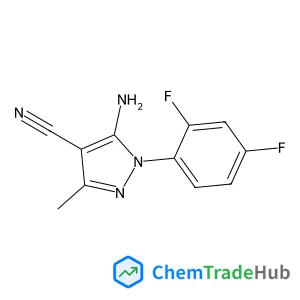
5-Amino-1-(2,4-difluorophenyl)-3-methyl-1H-pyrazole-4-carbonitrile
CAS Number:
1020057-92-4
Molecular Formula:
C11H8F2N4
Radovan Bast, Ulf Ekström, Bin Gao, Trygve Helgaker, Kenneth Ruud, Andreas J. Thorvaldsen
We give an account of some recent advances in the development of ab initio methods for the calculation of molecular response properties, involving electric, magnetic, and geometric perturbations. Particular attention is given to properties in which the basis functions depend explicitly both on time and on the applied perturbations such as perturbations involving nuclear displacements or external magnetic fields when London atomic orbitals are used. We summarize a general framework based on the quasienergy for the calculation of arbitrary-order molecular properties using the elements of the density matrix in the atomic-orbital basis as the basic variables. We demonstrate that the necessary perturbed density matrices of arbitrary order can be determined from a set of linear equations that have the same formal structure as the set of linear equations encountered when determining the linear response equations (or time-dependent self-consistent-field equations). Additional components needed to calculate properties involving perturbation-dependent basis sets are flexible one- and two-electron integral techniques for geometric or magnetic-field differentiated integrals; in Kohn–Sham density-functional theory (KS-DFT), we also need to calculate derivatives of the exchange–correlation functional. We describe a recent proposal for evaluating these contributions based on automatic differentiation. Within this framework, it is now possible to calculate any molecular property for an arbitrary self-consistent-field reference state, including two- and four-component relativistic self-consistent-field wave functions. Examples of calculations that can be performed with this formulation are presented.
F. Batalioto, A. F. C. Campos, A. M. Figueiredo Neto
DOI: 10.1039/D0CP05865C
Bartosz Błasiak, Wojciech Bartkowiak, Robert W. Góra
DOI: 10.1039/D0CP04636A
Tamar L. Greaves, Karin S. Schaffarczyk McHale, Raphael F. Burkart-Radke, Jason B. Harper, Tu C. Le
DOI: 10.1039/D0CP04227G
Maciej Strzempek, Karolina Tarach, Kinga Góra-Marek, Fernando Rey, Miguel Palomino, Susana Valencia, Witold Piskorz
DOI: 10.1039/D0CP05128D
Yun Ni, Jia Li, Wei Tao, Hao Ding, Rui-Xue Li
DOI: 10.1039/D0CP05640E
Vincent Thoréton, Mathew Niania, John Kilner
DOI: 10.1039/D0CP04953K
Alain Moissette, Isabelle Batonneau-Gener, Matthieu Hureau, Ludovic Pinard, Hervé Vezin, Michel Perdicakis, Alain Walcarius
DOI: 10.1039/D0CP06148D
Ethyl 4-chlorothieno[2,3-b]pyridine-5-carboxylate (CAS: 59713-58-5) can be synth...
5-Methyl-1H-indole-3-carbaldehyde (CAS: 52562-50-2) is subject to various regula...
(1,3-Dimethyl-2,4-dioxo-1,2,3,4-tetrahydro-5-pyrimidinyl)boronic acid is a white...
Waste containing Sulfocostunolide A (CAS: 1016983-51-9) should be handled with c...
When handling Murraxocin (CAS: 88478-44-8), ensure proper personal protective eq...
Formvar (CAS: 63148-64-1) is an alkyd resin characterized by a high molecular we...
(S)-4-benzyl-2-((benzyloxy)methyl)morpholine is generally safe when handled with...
Methyl 1-(5-bromo-2-pyrimidinyl)cyclopropanecarboxylate (CAS: 1447607-69-3) is p...
2-Methyl-1-phenyl-1-propanamine hydrochloride (CAS: 24290-47-9) is generally con...
3-(4-Bromophenyl)-2-methylpropanoic acid is synthesized through a multi-step pro...

Physical Chemistry Chemical Physics (PCCP) is an international journal co-owned by 19 physical chemistry and physics societies from around the world. This journal publishes original, cutting-edge research in physical chemistry, chemical physics and biophysical chemistry. To be suitable for publication in PCCP, articles must include significant innovation and/or insight into physical chemistry; this is the most important criterion that reviewers and Editors will judge against when evaluating submissions. The journal has a broad scope and welcomes contributions spanning experiment, theory, computation and data science. Topical coverage includes spectroscopy, dynamics, kinetics, statistical mechanics, thermodynamics, electrochemistry, catalysis, surface science, quantum mechanics, quantum computing and machine learning. Interdisciplinary research areas such as polymers and soft matter, materials, nanoscience, energy, surfaces/interfaces, and biophysical chemistry are welcomed if they demonstrate significant innovation and/or insight into physical chemistry. Joined experimental/theoretical studies are particularly appreciated when complementary and based on up-to-date approaches.
![4-[(1-Methyl-1H-pyrrol-2-yl)methylene]-1,3(2H,4H)-isoquinolinedione structure](https://static.chemtradehub.com/structs/110/1104546-89-5-a600.webp "4-[(1-Methyl-1H-pyrrol-2-yl)methylene]-1,3(2H,4H)-isoquinolinedione structure")
![2-Methyl-2-propanyl 1,6-diazaspiro[3.4]octane-6-carboxylate structure](https://static.chemtradehub.com/structs/115/1158749-79-1-81ee.webp "2-Methyl-2-propanyl 1,6-diazaspiro[3.4]octane-6-carboxylate structure")




