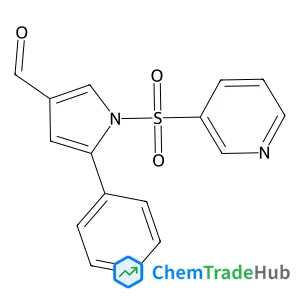
5-Phenyl-1-(pyridin-3-ylsulfonyl)-1H-pyrrole-3-carbaldehyde
CAS Number:
881676-90-0
Molecular Formula:
C16H12N2O3S
M. Micaela Gonzalez, Magali Pellon-Maison, Matias A. Ales-Gandolfo, Maria R. Gonzalez-Baró, Rosa Erra-Balsells, Franco M. Cabrerizo
UV-A radiation (320–400 nm) induces damages to the DNA molecule and its components through photosensitized reactions. β-Carbolines (βCs), heterocyclic compounds widespread in biological systems, participate in several biological processes and are able to act as photosensitizers. The photosensitization of plasmidic DNA by norharmane in aqueous solution under UV-A radiation was studied. The effect of pH was evaluated and the participation of reactive oxygen species (ROS), such as hydroxyl radical (HO˙), superoxide anion (O2˙−) and singlet oxygen (1O2) was investigated. A strong dependence of the photosensitized DNA relaxation on the pH was observed. The extent of the reaction was shown to be higher in the experiments performed at pH 4.7 than those performed at pH 10.2. As was expected, an intermediate extent of the reaction was observed at physiological pH (pH 7.4). Kinetic studies using ROS scavengers revealed that the chemical reactions between ROS and DNA are not the main pathways responsible for the damage of DNA. Consequently, the predominant mechanism yielding the DNA strand break takes place most probably via a type I mechanism (electron transfer) from the single excited state (S1) of the protonated form of norharmane (1[nHoH+]*). Additional information about the nature of the norharmane electronic excited states involved in the photocleavage reaction was obtained by using the N-methyl derivative of norharmane (N-methyl-norharmane).
Limin Zhang, Wenqing Zhao, Feng Jiang, Mengjie Tian, Yue Yang, Peng Ge, Wei Sun
DOI: 10.1039/D0SE00305K
Laleh Adlnasab, Homeira Ebrahimzadeh, Yadollah Yamini
DOI: 10.1039/C1AY05449J
Ramon Díaz, María Ibáñez, Juan V. Sancho, Félix Hernández
DOI: 10.1039/C1AY05385J
Govardhana Babu Bodedla, Geliang Tang, Jianzhang Zhao, Xunjin Zhu
DOI: 10.1039/D0SE00356E
Ping Zhou, Bo Liu, Mingming Luan, Na Li, Bo Tang
DOI: 10.1039/D1BM00619C
Xiao Shang, Jian-Hong Tang, Yujie Sun
DOI: 10.1039/D0SE00466A
(1R,3S)-1,3-Cyclopentanediol finds applications in various industries. In the ph...
When handling N'-[4-(Dimethylamino)phenyl]-N,N-dimethyl-1,4-benzenediamine, it i...
There are several alternatives to 5-(2,4-Difluorophenyl)-2-methoxypyrimidine in ...
1-(3-Methoxyphenoxy)propan-2-ol (CAS: 382141-68-6) must comply with the Globally...
Tetrodotoxin Citrate is extremely dangerous and should be handled with extreme c...
2-Methyl-2-propanyl [(1R,3S)-3-hydroxycyclopentyl]carbamate (CAS: 225641-84-9) i...
Waste containing 4-(2-Hydroxyhexafluoroisopropyl)Benzoic Acid (CAS: 16261-80-6) ...
2-Methyl-2-proanyl {(2S)-1-[(benzyloxy)amino]-3-hydroxy-3-methyl-1-oxo-2-butanyl...
Benzeneethanamine, α-ethyl-, hydrochloride (1:1) is an organic compound with the...
In the synthesis of compounds similar to 3-{(E)-[4-(Dimethylamino)phenyl]diazeny...

Organic & Biomolecular Chemistry (OBC) publishes original and high impact research and reviews in organic chemistry. We welcome research that shows new or significantly improved protocols or methodologies in total synthesis, synthetic methodology or physical and theoretical organic chemistry as well as research that shows a significant advance in the organic chemistry or molecular design aspects of chemical biology, catalysis, supramolecular and macromolecular chemistry, theoretical chemistry, mechanism-oriented physical organic chemistry, medicinal chemistry or natural products. Articles published in the journal should report new work which makes a highly-significant impact in the field. Routine and incremental work is generally not suitable for publication in the journal. More details about key areas of our scope are below. In all cases authors should include in their article clear rationale for why their research has been carried out.
![(2S)-2-{[(9H-Fluoren-9-ylmethoxy)carbonyl]amino}-4-(methylselanyl)butanoic acid structure](https://static.chemtradehub.com/structs/121/1217852-49-7-f252.webp "(2S)-2-{[(9H-Fluoren-9-ylmethoxy)carbonyl]amino}-4-(methylselanyl)butanoic acid structure")