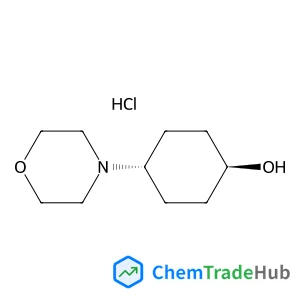
trans-4-(4-Morpholinyl)cyclohexanol hydrochloride (1:1)
CAS Number:
1588441-09-1
Molecular Formula:
C10H20ClNO2
Leif A. Eriksson
We present an overview of excited state quantum chemical calculations aimed at elucidating controversial issues regarding the photochemistry of the protein-bound chromophores astaxanthin and phytochromobilin. In particular, we show how the application of time-dependent density functional theory and other single-reference quantum chemical excited state methods have contributed to shed new light on the origin of the >0.5 eV bathochromic shift of the electronic absorption by the carotenoid astaxanthin in the protein macromolecular complex crustacyanin, and the mechanism for C15-Z,syn → C15-E,anti isomerization of the tetrapyrrole phytochromobilin that underlies the photoactivation of the plant photoreceptor phytochrome. Within the approximation that exciton coupling is neglected, the calculations on astaxanthin provide support for the notion that the bathochromic shift, which is responsible for the slate-blue coloration of lobster shell, is due to polarization rather than a conformational change of the chromophore in the protein-bound state. Furthermore, the polarization is attributed to a hydrogen-bonded protonated histidine residue. The calculations on phytochromobilin, in turn, suggest that a stepwise C15-Z,syn → C15-E,syn (photochemical), C15-E,syn → C15-E,anti (thermal) mechanism is much more favorable than a concerted, fully photochemical mechanism, and that neutral forms of the chromophore are much less likely to photoisomerize than the parent, protonated form. Accordingly, the calculations indirectly support the view that the photoactivation of phytochrome does not involve a proton transfer from the chromophore to the surrounding protein.
G. Benay, R. Schurhammer, G. Wipff
DOI: 10.1039/C0CP01975E
Miguel González, Amaia Saracibar, Ernesto Garcia
DOI: 10.1039/C0CP01188F
Anna Rita Bizzarri, Salvatore Cannistraro
DOI: 10.1039/C0CP01474E
Stefan Wellert, Matthias Karg, Olaf Holderer, André Richardt, Thomas Hellweg
DOI: 10.1039/C0CP02044C
Franziska Fennel, Stefan Lochbrunner
DOI: 10.1039/C0CP01211D
Christian Zafiu, Günter Trettenhahn, Dietmar Pum, Uwe Bernd Sleytr, Wolfgang Kautek
DOI: 10.1039/C0CP01099E
Min Zhou, Shiyu Gan, Lijie Zhong, Xiandui Dong, Li Niu
DOI: 10.1039/C0CP01692F
Chun-Jiang Jia, Ferdi Schüth
DOI: 10.1039/C0CP02680H
Emilie Klecha, Imad Arfaoui, Johannes Richardi, Dorothée Ingert, Marie-Paule Pileni
DOI: 10.1039/C0CP01237H
Yuchun Han, Yilin Wang
DOI: 10.1039/C0CP01196G
Ethyl 4-chlorothieno[2,3-b]pyridine-5-carboxylate (CAS: 59713-58-5) can be synth...
5-Methyl-1H-indole-3-carbaldehyde (CAS: 52562-50-2) is subject to various regula...
(1,3-Dimethyl-2,4-dioxo-1,2,3,4-tetrahydro-5-pyrimidinyl)boronic acid is a white...
Waste containing Sulfocostunolide A (CAS: 1016983-51-9) should be handled with c...
When handling Murraxocin (CAS: 88478-44-8), ensure proper personal protective eq...
Formvar (CAS: 63148-64-1) is an alkyd resin characterized by a high molecular we...
(S)-4-benzyl-2-((benzyloxy)methyl)morpholine is generally safe when handled with...
Methyl 1-(5-bromo-2-pyrimidinyl)cyclopropanecarboxylate (CAS: 1447607-69-3) is p...
2-Methyl-1-phenyl-1-propanamine hydrochloride (CAS: 24290-47-9) is generally con...
3-(4-Bromophenyl)-2-methylpropanoic acid is synthesized through a multi-step pro...

Physical Chemistry Chemical Physics (PCCP) is an international journal co-owned by 19 physical chemistry and physics societies from around the world. This journal publishes original, cutting-edge research in physical chemistry, chemical physics and biophysical chemistry. To be suitable for publication in PCCP, articles must include significant innovation and/or insight into physical chemistry; this is the most important criterion that reviewers and Editors will judge against when evaluating submissions. The journal has a broad scope and welcomes contributions spanning experiment, theory, computation and data science. Topical coverage includes spectroscopy, dynamics, kinetics, statistical mechanics, thermodynamics, electrochemistry, catalysis, surface science, quantum mechanics, quantum computing and machine learning. Interdisciplinary research areas such as polymers and soft matter, materials, nanoscience, energy, surfaces/interfaces, and biophysical chemistry are welcomed if they demonstrate significant innovation and/or insight into physical chemistry. Joined experimental/theoretical studies are particularly appreciated when complementary and based on up-to-date approaches.