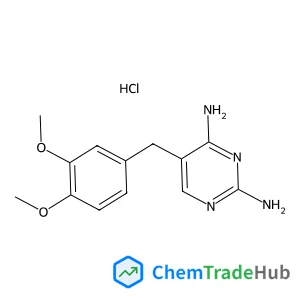
5-(3,4-Dimethoxybenzyl)-2,4-pyrimidinediamine hydrochloride (1:1)
CAS Number:
2507-23-5
Molecular Formula:
C13H17ClN4O2
Jun-Young Lee, Colin D. Wood, Darren Bradshaw, Matthew J. Rosseinsky, Andrew I. Cooper
A microporous hypercrosslinked polymer resin was synthesized and shown to adsorb 3.04 wt.% hydrogen at 77 K and 15 bar; this represents the highest level of hydrogen adsorption yet observed for an organic polymer.
Ruobing Wang, Juan Peng, Feng Qiu, Yuliang Yang, Zhiyuan Xie
DOI: 10.1039/B915378K
Karina Mondragón-Vásquez, Hugo Morales-Rojas
DOI: 10.1039/B913315A
Min Jung Kim, Kyung Mi Lee, Arun R. Jagdale, Youngmee Kim, Sung-Jin Kim, Kyung Ho Yoo
DOI: 10.1039/B913809A
Junping Zhang, Cynthia S. Day, David L. Carroll
DOI: 10.1039/B913917F
Yi Zhou, Xue-Yan You, Yuan Fang, Ju-Ying Li, Ke Liu, Cheng Yao
DOI: 10.1039/C0OB00452A
Yi-Tsu Chan, Charles N. Moorefield, George R. Newkome
DOI: 10.1039/B914743H
Amit Nathubhai, Richard Patterson, Timothy J. Woodman, Miranda T. Y. Chui, Hugo H. K. Chung, Stephanie W. S. Lau, Jun Zheng, Matthew D. Lloyd, Andrew S. Thompson, Michael D. Threadgill
DOI: 10.1039/C1OB05430A
Anupam Bandyopadhyay, Neha Agrawal, Sachitanand M. Mali, Sandip V. Jadhav, Hosahudya N. Gopi
DOI: 10.1039/C0OB00199F
Christopher D. Gabbutt, B. Mark Heron, Colin Kilner, Suresh B. Kolla
DOI: 10.1039/C0OB00141D
(1R,3S)-1,3-Cyclopentanediol finds applications in various industries. In the ph...
When handling N'-[4-(Dimethylamino)phenyl]-N,N-dimethyl-1,4-benzenediamine, it i...
There are several alternatives to 5-(2,4-Difluorophenyl)-2-methoxypyrimidine in ...
1-(3-Methoxyphenoxy)propan-2-ol (CAS: 382141-68-6) must comply with the Globally...
Tetrodotoxin Citrate is extremely dangerous and should be handled with extreme c...
2-Methyl-2-propanyl [(1R,3S)-3-hydroxycyclopentyl]carbamate (CAS: 225641-84-9) i...
Waste containing 4-(2-Hydroxyhexafluoroisopropyl)Benzoic Acid (CAS: 16261-80-6) ...
2-Methyl-2-proanyl {(2S)-1-[(benzyloxy)amino]-3-hydroxy-3-methyl-1-oxo-2-butanyl...
Benzeneethanamine, α-ethyl-, hydrochloride (1:1) is an organic compound with the...
In the synthesis of compounds similar to 3-{(E)-[4-(Dimethylamino)phenyl]diazeny...

ChemComm publishes urgent research which is of outstanding significance and interest to experts in the field, while also appealing to the journal’s broad chemistry readership. Our communication format is ideally suited to short, urgent studies that are of such importance that they require accelerated publication. Our scope covers all topics in chemistry, and research at the interface of chemistry and other disciplines (such as materials science, nanoscience, physics, engineering and biology) where there is a significant novelty in the chemistry aspects. Major topic areas covered include: Analytical Chemistry Catalysis Chemical Biology and medicinal chemistry Computational Chemistry and Machine Learning Energy and sustainable chemistry Environmental Chemistry Green Chemistry Inorganic Chemistry Materials Chemistry Nanoscience Organic Chemistry Physical Chemistry Polymer Chemistry Supramolecular Chemistry