












Raman spectroscopic monitoring of droplet polymerization in a microfluidic device
Literature Information
Publication Date
2006-07-12
DOI
10.1039/B603693G
Impact Factor
4.616
Authors
Susan E. Barnes, Zuzanna T. Cygan, Jesse K. Yates, Kathryn L. Beers, Eric J. Amis
View Original
Abstract
Microfluidic methodologies are becoming increasingly important for rapid formulation and screening of materials, and development of analytical tools for multiple sample screening is a critical step in achieving a combinatorial ‘lab on a chip’ approach. This work demonstrates the application of Raman spectroscopy for analysis of monomer composition and degree of conversion of methacrylate-based droplets in a microfluidic device. Droplet formation was conducted by flow focusing on the devices, and a gradient of component composition was created by varying the flow rates of the droplet-phase fluids into the microchannels. Raman data were collected using a fiber optic probe from a stationary array of the droplets/particles on the device, followed by partial least squares (PLS) calibration of the first derivative (1600 cm−1 to 1550 cm−1) allowing successful measurement of monomer composition with a standard error of calibration (SEC) of ±1.95% by volume. Following photopolymerization, the percentage of double bond conversion of the individual particles was calculated from the depletion of the normalized intensity of the CC stretching vibration at 1605 cm−1. Raman data allowed accurate measurement of the decrease in double bond conversion as a function of increasing crosslinker concentration. The results from the research demonstrate that Raman spectroscopy is an effective, on-chip analytical tool for screening polymeric materials on the micrometre scale.
Related Literature
Oxidative esterification of aliphatic α,ω-diols, an alternative route to polyester precursors for the synthesis of polyurethanes
Mateusz Gosecki, Monika Gosecka, Malgorzata Urbaniak
2021-11-22
Paper
DOI: 10.1039/D1PY01265G
A sequential ROMP strategy to donor–acceptor di-, tri- and tetra arylenevinylene block copolymers
Venukrishnan Komanduri, Yurachat Janpatompong, Raymundo Marcial-Hernandez, Daniel J. Tate, Michael L. Turner
2021-11-15
Paper
DOI: 10.1039/D1PY01202A
Kinetics of the reactions of OH(X2Π) radicals with 1,3-dioxolane and selected dialkoxy methanes
Carlos M. Freitas Dinis, Harald Geiger, Peter Wiesen
2001-06-12
Paper
DOI: 10.1039/B100181G
Antibacterial cotton fabric prepared by surface-initiated photochemically induced atom transfer radical polymerization of 2-(dimethylamino)ethyl methacrylate with subsequent quaternization
Mária Bučková, Katarína Mosnáčková, Jana Doháňošová, Matej Mičušík, Angela Kleinová, Peter Matúš
2021-11-23
Paper
DOI: 10.1039/D1PY01322J
Precision synthesis of a fluorene-thiophene alternating copolymer by means of the Suzuki–Miyaura catalyst-transfer condensation polymerization: the importance of the position of an alkyl substituent on thiophene of the biaryl monomer to suppress disproportionation
Yu Tokita, Masaru Katoh, Kentaro Kosaka, Yoshihiro Ohta, Tsutomu Yokozawa
2021-11-19
Paper
DOI: 10.1039/D1PY01184G
You might also like
Compound Q&A
How should waste containing (6-Bromo-2-naphthyl)oxy](dimethyl)(2-methyl-2-propanyl)silane be handled?
Waste containing (6-Bromo-2-naphthyl)oxy](dimethyl)(2-methyl-2-propanyl)silane (...
100751-65-3[(6-Bromo-2-naphthyl...
Compound Q&A
How is 7-Fluoro-4-isoquinolinecarboxylic acid (CAS: 1841081-40-0) typically synthesized?
7-Fluoro-4-isoquinolinecarboxylic acid can be synthesized via a multi-step proce...
1841081-40-07-Fluoro-4-isoquinol...
Compound Q&A
What are the physical and chemical properties of 2,3,5,6-Tetrabromothieno[3,2-b]thiophene (CAS: 124638-53-5)?
2,3,5,6-Tetrabromothieno[3,2-b]thiophene is a crystalline compound with a high m...
124638-53-52,3,5,6-Tetrabromoth...
Compound Q&A
Is 1-[4-(Benzylamino)-7,8-dihydro-5H-pyrano[4,3-d]pyrimidin-2-yl]-2-methyl-1H-indole-4-carboxamide (CAS: 1542705-92-9) safe?
1-[4-(Benzylamino)-7,8-dihydro-5H-pyrano[4,3-d]pyrimidin-2-yl]-2-methyl-1H-indol...
1542705-92-91-[4-(Benzylamino)-7...
Compound Q&A
What is the market or research trend for imidazo[5,1-d]-1,2,3,5-tetrazine-8-carboxylic acid, 3,4-dihydro-3-methyl-4-oxo- (CAS: 113942-30-6)?
The market for imidazo[5,1-d]-1,2,3,5-tetrazine-8-carboxylic acid, 3,4-dihydro-3...
113942-30-6Imidazo[5,1-d]-1,2,3...
Compound Q&A
What is 3-(Triisopropylsilyl)propiolaldehyde (CAS: 163271-80-5)?
3-(Triisopropylsilyl)propiolaldehyde is a synthetic organic compound with the CA...
163271-80-53-(Triisopropylsilyl...
Compound Q&A
What regulatory guidelines apply to 6-Nitro-2H-1,4-benzoxazin-3(4H)-one (CAS: 81721-87-1)?
6-Nitro-2H-1,4-benzoxazin-3(4H)-one (CAS: 81721-87-1) is subject to various regu...
81721-87-16-Nitro-2H-1,4-benzo...
Compound Q&A
How should waste containing (3-Fluorophenyl)(4-{[(2-methyl-2-propanyl)oxy]carbonyl}-1-piperazinyl)acetic acid (CAS: 885272-91-3) be handled?
Waste containing (3-Fluorophenyl)(4-{[(2-methyl-2-propanyl)oxy]carbonyl}-1-piper...
885272-91-3(3-Fluorophenyl)(4-{...
Compound Q&A
What are the physical and chemical properties of N,N'-4,4'-Biphenyldiyldiisonicotinamide (CAS: 55119-40-9)?
N,N'-4,4'-Biphenyldiyldiisonicotinamide is a white crystalline solid with a mole...
55119-40-9N,N'-4,4'-Biphenyldi...
Compound Q&A
What industries use 6-Bromo-8-fluoro-2-quinazolinol (CAS: 1036756-15-6)?
6-Bromo-8-fluoro-2-quinazolinol is primarily used in the pharmaceutical industry...
1036756-15-66-Bromo-8-fluoro-2-q...
Source Journal
Analyst

CiteScore:
7.8
Self-citation Rate:
5.6%
Articles per Year:
653
Analyst publishes analytical and bioanalytical research that reports premier fundamental discoveries and inventions, and the applications of those discoveries, unconfined by traditional discipline barriers.
Recommended Compounds
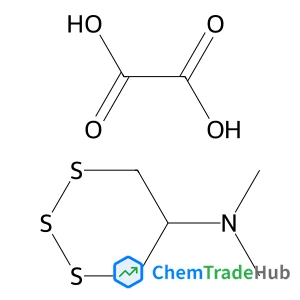
Oxalic acid compound with cyclohexylsulfamothioic O-acid (11)
CAS Number:
31895-22-4
Molecular Formula:
C7H13NO4S3
Recommended Suppliers




Disclaimer
This page provides academic journal information for reference and research purposes only. We are not affiliated with any journal publishers and do not handle publication submissions. For publication-related inquiries, please contact the respective journal publishers directly.
If you notice any inaccuracies in the information displayed, please contact us at support@chemtradehub.com. We will promptly review and address your concerns.