













DNA microarraying on compact disc surfaces. Application to the analysis of single nucleotide polymorphisms in Plum pox virus
Literature Information
Publication Date
2006-05-02
DOI
10.1039/B600049E
Impact Factor
6.222
Authors
Sergi Morais, Raquel Marco-Molés, Rosa Puchades, Ángel Maquieira
View Original
Abstract
The potential of using compact discs as high throughput screening platforms for DNA microarraying is discussed and applied to discriminate genetic variations of Plum pox virus.
Related Literature
On-surface synthesis of polyazulene with 2,6-connectivity
Qiang Sun, Ian Cheng-Yi Hou, Kristjan Eimre, Carlo A. Pignedoli, Pascal Ruffieux
2019-10-17
Communication
DOI: 10.1039/C9CC07168G
A more universal and stable method for lactate dehydrogenase isoenzyme test
Peijuan Li, Nanhai Qiu, Li Zhang, Guishu Zhong, Fancai Zeng
2019-07-17
Paper
DOI: 10.1039/C9AY01327J
Electrochemical determination of bisphenol A using a polyacrylamide–multiwalled carbon nanotube-modified glassy carbon electrode
Jian Han, Faying Li, Liping Jiang, Kai Li, Yunhui Dong, Yueyun Li
2015-08-13
Paper
DOI: 10.1039/C5AY02058A
A succinct strategy for construction of nanoporous ionic organic networks from a pyrylium intermediate
Siying Che, Ilja Popovs, Huimin Luo, Yali Luo, Wei Guo, Hao Chen, Tao Wang, Kecheng Jie, Congmin Wang
2019-10-17
Communication
DOI: 10.1039/C9CC06767A
Incorporation of thermal gels for facile microfluidic transient isotachophoresis
Jordan B. Burton, Cassandra L. Ward, David M. Klemet, Thomas H. Linz
2019-09-09
Paper
DOI: 10.1039/C9AY01384A
One-step electrochemical preparation of a reduced graphene oxide/poly(sulfosalicylic acid) nanocomposite film for detection of acetaminophen and its application in human urine and serum studies
Bo Zheng, Cong Li, Yaru Li, Yue Gu, Xiaoyi Yan, Liu Tang, Ruixue Chen, Zhiquan Zhang
2015-08-17
Paper
DOI: 10.1039/C5AY01654A
Benchmarking lithium amide versus amine bonding by charge density and energy decomposition analysis arguments
Felix Engelhardt, Christian Maaß, Diego M. Andrada, Regine Herbst-Irmer, Dietmar Stalke
2018-02-08
Edge Article
DOI: 10.1039/C7SC05368A
You might also like
Compound Q&A
What are the main uses of 1H-Indazole-6-carbonitrile (CAS: 141290-59-7)?
1H-Indazole-6-carbonitrile finds applications in pharmaceuticals, where it serve...
141290-59-71H-Indazole-6-carbon...
Compound Q&A
How should waste containing Dioctyl (2E)-2-butenedioate (CAS: 2997-85-5) be handled?
Waste containing Dioctyl (2E)-2-butenedioate (CAS: 2997-85-5) should be collecte...
2997-85-5Dioctyl (2E)-2-buten...
Compound Q&A
What industries use Sodium [(1,2-benzoxazol-3-ylmethyl)sulfonyl]azanide (CAS: 68291-98-5)?
Sodium [(1,2-benzoxazol-3-ylmethyl)sulfonyl]azanide is primarily used in pharmac...
68291-98-5Sodium [(1,2-benzoxa...
Compound Q&A
Are there alternatives to Dimethyl 4-(4,4,5,5-tetramethyl-1,3,2-dioxaborolan-2-yl)-2,6-pyridinedicarboxylate (CAS: 741709-66-0) in synthesis?
Dimethyl 4-(4,4,5,5-tetramethyl-1,3,2-dioxaborolan-2-yl)-2,6-pyridinedicarboxyla...
741709-66-0Dimethyl 4-(4,4,5,5-...
Compound Q&A
How should waste containing 2-Fluoro-6-hydrazinopyridine (CAS: 80714-39-2) be handled?
Waste containing 2-Fluoro-6-hydrazinopyridine (CAS: 80714-39-2) should be manage...
80714-39-22-Fluoro-6-hydrazino...
Compound Q&A
What is 6-Formyl-2-pyridinecarboxylic acid (CAS: 499214-11-8)?
6-Formyl-2-pyridinecarboxylic acid is an organic compound with the molecular for...
499214-11-86-Formyl-2-pyridinec...
Compound Q&A
What is the market or research trend for 3-(3,4-dimethoxyphenyl)-2,5-dimethyl-N-(2-morpholin-4-ylethyl)pyrazolo[1,5-a]pyrimidin-7-amine (CAS: 900874-91-1)?
Research trends for this compound indicate a focus on its potential applications...
900874-91-13-(3,4-dimethoxyphen...
Compound Q&A
How is 9H-Tribenzo[b,d,f]azepine (CAS: 29875-73-8) typically synthesized?
9H-Tribenzo[b,d,f]azepine is typically synthesized via a multi-step process invo...
29875-73-89H-Tribenzo[b,d,f]az...
Compound Q&A
How is 1-Cyclopropyl-7-ethoxy-6-fluoro-8-methoxy-4-oxo-1,4-dihydro-3-quinolinecarboxylic acid (CAS: 1797982-51-4) typically synthesized?
1-Cyclopropyl-7-ethoxy-6-fluoro-8-methoxy-4-oxo-1,4-dihydro-3-quinolinecarboxyli...
1797982-51-41-Cyclopropyl-7-etho...
Compound Q&A
How should waste containing Methyl 3-oxo-1,2,3,4-tetrahydro-6-quinoxalinecarboxylate (CAS: 671820-52-3) be handled?
Waste containing Methyl 3-oxo-1,2,3,4-tetrahydro-6-quinoxalinecarboxylate (CAS: ...
671820-52-3Methyl 3-oxo-1,2,3,4...
Source Journal
Chemical Communications

CiteScore:
8.6
Self-citation Rate:
4.7%
Articles per Year:
2458
ChemComm publishes urgent research which is of outstanding significance and interest to experts in the field, while also appealing to the journal’s broad chemistry readership. Our communication format is ideally suited to short, urgent studies that are of such importance that they require accelerated publication. Our scope covers all topics in chemistry, and research at the interface of chemistry and other disciplines (such as materials science, nanoscience, physics, engineering and biology) where there is a significant novelty in the chemistry aspects. Major topic areas covered include: Analytical Chemistry Catalysis Chemical Biology and medicinal chemistry Computational Chemistry and Machine Learning Energy and sustainable chemistry Environmental Chemistry Green Chemistry Inorganic Chemistry Materials Chemistry Nanoscience Organic Chemistry Physical Chemistry Polymer Chemistry Supramolecular Chemistry
Recommended Compounds
![Sodium 3-[(E)-(4-anilinophenyl)diazenyl]benzenesulfonate structure](https://static.chemtradehub.com/structs/587/587-98-4-035f.webp "Sodium 3-[(E)-(4-anilinophenyl)diazenyl]benzenesulfonate structure")
Sodium 3-[(E)-(4-anilinophenyl)diazenyl]benzenesulfonate
CAS Number:
587-98-4
Molecular Formula:
C18H14N3NaO3S


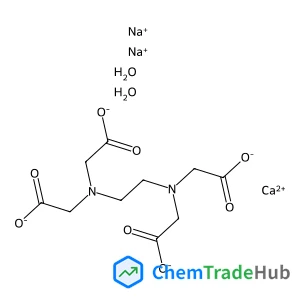
EthylenediaminetetraaceticacidcalciumDisodiumsalthydrate
CAS Number:
23411-34-9
Molecular Formula:
C10H16CaN2Na2O10
Recommended Suppliers





Disclaimer
This page provides academic journal information for reference and research purposes only. We are not affiliated with any journal publishers and do not handle publication submissions. For publication-related inquiries, please contact the respective journal publishers directly.
If you notice any inaccuracies in the information displayed, please contact us at support@chemtradehub.com. We will promptly review and address your concerns.