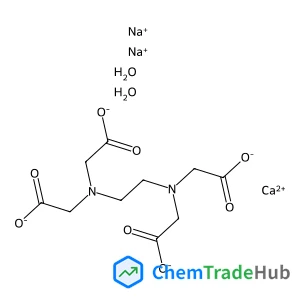
EthylenediaminetetraaceticacidcalciumDisodiumsalthydrate
CAS Number:
23411-34-9
Molecular Formula:
C10H16CaN2Na2O10
Jaesook Yun, Daesung Kim, Hoseop Yun
A new, air stable and well-defined carbene–copper(II) complex has been prepared, which is an efficient precatalyst for the 1,2- and 1,4-reduction of carbonyl compounds under hydrosilylation conditions.
Zhao-Rui Wen, Zong-Jie Guan, Ying Zhang, Yu-Mei Lin
DOI: 10.1039/C9CC05924E
Yeongju Lee, Haeri Im, Sanket Das, Misook Oh, Ji Hoon Lee, Sihyun Ham, Hyun-Suk Lim
DOI: 10.1039/C9CC03627J
Lu-Jun Zhang, Xiao-Dong Huang, Yan Wang, Chun-Yan Wang, Yong-Zhi Sun
DOI: 10.1039/C9AY01155B
Jacqueline Q. Alves, Lilian P. Franco, Marcelo F. de Oliveira
DOI: 10.1039/C8AY02243G
Peijuan Li, Nanhai Qiu, Li Zhang, Guishu Zhong, Fancai Zeng
DOI: 10.1039/C9AY01327J
Hong-Guang Fu, Heng-Yi Zhang, Hao-Yang Zhang, Yu Liu
DOI: 10.1039/C9CC06917H
Run Hao, Yameng Liu, Rugang Zhong
DOI: 10.1039/C3AY41494A
Vittorio Albergamo, Emma L. Schymanski, Rick Helmus, Milou M. L. Dingemans, Michiel H. S. Kraak
DOI: 10.1039/C9EW00741E
Qiang Sun, Ian Cheng-Yi Hou, Kristjan Eimre, Carlo A. Pignedoli, Pascal Ruffieux
DOI: 10.1039/C9CC07168G
Xuan Wang, Caicheng Long, Zixin Jiang, Taiping Qing, Kaiwu Zhang, Peng Zhang, Bo Feng
DOI: 10.1039/C9AY01627A
1H-Indazole-6-carbonitrile finds applications in pharmaceuticals, where it serve...
Waste containing Dioctyl (2E)-2-butenedioate (CAS: 2997-85-5) should be collecte...
Sodium [(1,2-benzoxazol-3-ylmethyl)sulfonyl]azanide is primarily used in pharmac...
Dimethyl 4-(4,4,5,5-tetramethyl-1,3,2-dioxaborolan-2-yl)-2,6-pyridinedicarboxyla...
Waste containing 2-Fluoro-6-hydrazinopyridine (CAS: 80714-39-2) should be manage...
6-Formyl-2-pyridinecarboxylic acid is an organic compound with the molecular for...
Research trends for this compound indicate a focus on its potential applications...
9H-Tribenzo[b,d,f]azepine is typically synthesized via a multi-step process invo...
1-Cyclopropyl-7-ethoxy-6-fluoro-8-methoxy-4-oxo-1,4-dihydro-3-quinolinecarboxyli...
Waste containing Methyl 3-oxo-1,2,3,4-tetrahydro-6-quinoxalinecarboxylate (CAS: ...

ChemComm publishes urgent research which is of outstanding significance and interest to experts in the field, while also appealing to the journal’s broad chemistry readership. Our communication format is ideally suited to short, urgent studies that are of such importance that they require accelerated publication. Our scope covers all topics in chemistry, and research at the interface of chemistry and other disciplines (such as materials science, nanoscience, physics, engineering and biology) where there is a significant novelty in the chemistry aspects. Major topic areas covered include: Analytical Chemistry Catalysis Chemical Biology and medicinal chemistry Computational Chemistry and Machine Learning Energy and sustainable chemistry Environmental Chemistry Green Chemistry Inorganic Chemistry Materials Chemistry Nanoscience Organic Chemistry Physical Chemistry Polymer Chemistry Supramolecular Chemistry