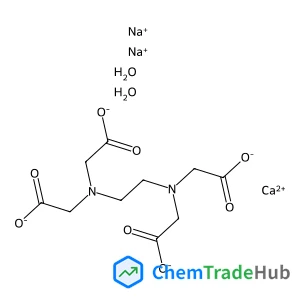
EthylenediaminetetraaceticacidcalciumDisodiumsalthydrate
CAS Number:
23411-34-9
Molecular Formula:
C10H16CaN2Na2O10
Zhao-Rui Wen, Zong-Jie Guan, Ying Zhang, Yu-Mei Lin
We report the total structure determination of a covalently bonded nanocluster polymer [Au7Ag9(dppf)3(CF3CO2)7BF4]n (1). This features a one-dimensional linear chain, consisting of unique molecular building blocks, Au7Ag8(dppf)3(CF3CO2)7 clusters, which are linked together by Ag–O bonds rather than Au–Au interactions or bidentate organic bridges as previously reported.
Jinlong He, Lin Zhang, Ling Liu
DOI: 10.1039/C9CP01585J
A. Kortyna, A. J. Samin, T. A. Miller
DOI: 10.1039/C9CP90148E
Yina Salamanca Blanco, Önder Topel, Éva G. Bajnóczi, Olle Björneholm, Ingmar Persson
DOI: 10.1039/C9CP02449B
Marianna Ambrico, Paola Manini, Paolo F. Ambrico, Teresa Ligonzo, Giuseppe Casamassima, Paola Franchi, Luca Valgimigli, Andrea Mezzetta, Cinzia Chiappe, Marco d'Ischia
DOI: 10.1039/C9CP01545K
Long Van Duong, Dang Thi Tuyet Mai, My Phuong Pham-Ho
DOI: 10.1039/C9CP00737G
DOI: 10.1039/C8CP07573E
Xiaojun Li, Jun Lu
DOI: 10.1039/C9CP01118H
Rudramani Pokhrel, Nisha Bhattarai, Prabin Baral, Jae H. Park, Martin Handfield
DOI: 10.1039/C9CP01558B
Alessandra Ronchi, Paolo Brazzo, Mauro Sassi, Luca Beverina, Jacopo Pedrini, Francesco Meinardi, Angelo Monguzzi
DOI: 10.1039/C9CP01692A
1H-Indazole-6-carbonitrile finds applications in pharmaceuticals, where it serve...
Waste containing Dioctyl (2E)-2-butenedioate (CAS: 2997-85-5) should be collecte...
Sodium [(1,2-benzoxazol-3-ylmethyl)sulfonyl]azanide is primarily used in pharmac...
Dimethyl 4-(4,4,5,5-tetramethyl-1,3,2-dioxaborolan-2-yl)-2,6-pyridinedicarboxyla...
Waste containing 2-Fluoro-6-hydrazinopyridine (CAS: 80714-39-2) should be manage...
6-Formyl-2-pyridinecarboxylic acid is an organic compound with the molecular for...
Research trends for this compound indicate a focus on its potential applications...
9H-Tribenzo[b,d,f]azepine is typically synthesized via a multi-step process invo...
1-Cyclopropyl-7-ethoxy-6-fluoro-8-methoxy-4-oxo-1,4-dihydro-3-quinolinecarboxyli...
Waste containing Methyl 3-oxo-1,2,3,4-tetrahydro-6-quinoxalinecarboxylate (CAS: ...

ChemComm publishes urgent research which is of outstanding significance and interest to experts in the field, while also appealing to the journal’s broad chemistry readership. Our communication format is ideally suited to short, urgent studies that are of such importance that they require accelerated publication. Our scope covers all topics in chemistry, and research at the interface of chemistry and other disciplines (such as materials science, nanoscience, physics, engineering and biology) where there is a significant novelty in the chemistry aspects. Major topic areas covered include: Analytical Chemistry Catalysis Chemical Biology and medicinal chemistry Computational Chemistry and Machine Learning Energy and sustainable chemistry Environmental Chemistry Green Chemistry Inorganic Chemistry Materials Chemistry Nanoscience Organic Chemistry Physical Chemistry Polymer Chemistry Supramolecular Chemistry