












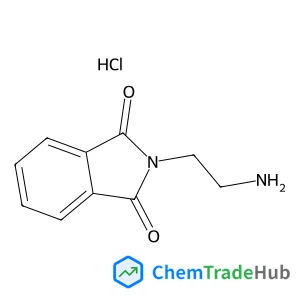
2-(2-Aminoethyl)-1H-isoindole-1,3(2H)-dione hydrochloride (1:1)
CAS Number:
30250-67-0
Molecular Formula:
C10H11ClN2O2
Chih-Kai Lin, Qian-Rui Huang, Jer-Lai Kuo
Studies on the vibrational spectra of various ammonium-centered clusters under different solvation environments have raised interest over the last thirty years. The gas-phase infrared photodissociation spectroscopy (IRPD) experiments showed that these NH4+⋯Xn clusters exhibit rich spectral features from 2600 to 3400 cm−1. In this work, we have simulated the vibrational spectra and analyzed couplings among vibrational quantum states in the aforementioned frequency range using ab initio anharmonic algorithms. Originating from the anharmonic couplings between NH stretching fundamentals and bending overtones, Fermi resonance (FR) is a common feature in these spectra, and its extent is determined by the magnitude of couplings and the energy matching conditions between relevant states, which are governed by the proton affinity, number, and bonding configuration of the solvation species. For weakly bound clusters consisting of rare gas atoms, FR is insignificant but not negligible; for strongly bound clusters, such as ammonium–water clusters, the hydrogen-bonded NH stretching fundamentals redshift and reach a better resonance condition, and thus light up the bending overtones as prominent FR bands. Our simulated spectra are in good agreement with previous experimental reports of these ammonium-centered clusters and provide a better understanding of the vibrational coupling behind the spectra of the NH stretching region.
Kaido Tammeveski, David J. Schiffrin
DOI: 10.1039/B818439A
Hema Singh, Shrikant Bhagwat, Samuel Jouen, Benoît Lefez, Anjali A. Athawale, Beatrice Hannoyer, Satishchandra Ogale
DOI: 10.1039/B917407A
Arik Yochelis, Moshe Sheintuch
DOI: 10.1039/B921918H
Ran Liu, Jonathon Duay, Timothy Lane
DOI: 10.1039/B918589P
Martin Kabeláč
DOI: 10.1039/B819350A
DOI: 10.1039/B917966F
Martin Kabeláč, Vladimír Špirko
DOI: 10.1039/B823373J
Florian Evers, Christian Reichhart, Roland Steitz, Metin Tolan, Claus Czeslik
DOI: 10.1039/B925134K
Claire E. White, John L. Provis, Thomas Proffen, Daniel P. Riley, Jannie S. J. van Deventer
DOI: 10.1039/B922993K
Waste containing 2-Ethyl-4-Methyl-1H-Imidazole-5-Carbaldehyde (CAS: 88634-80-4) ...
Triethoxy(octyl)silane (CAS: 1385031-14-0) is widely used in the pharmaceuticals...
Several alternatives to 3-iodo-7-nitro-1H-indazole (CAS: 864724-64-1) exist in t...
Yes, there are alternatives to Benzene, bis[(trimethoxysilyl)ethyl] (CAS: 266317...
Isothiazole-3-carbonitrile (CAS: 1452-17-1) is generally considered safe when us...
(3-Chlorophenyl)methanol (CAS: 873-63-2) is considered low to moderately toxic. ...
(2S,3S)-2-Hydroxy-3-({[(2-methyl-2-propanyl)oxy]carbonyl}amino)-3-(2-naphthyl)pr...
Proper handling of methyl 2-(bromomethyl)-5-methoxybenzoate requires the use of ...
6,8-Dibromoimidazo[1,2-a]pyridine-2-carboxylic acid (CAS: 904805-36-3) is an aro...
3-Amino-5-bromo-2-pyridinecarbonitrile is considered safe when handled under pro...

Physical Chemistry Chemical Physics (PCCP) is an international journal co-owned by 19 physical chemistry and physics societies from around the world. This journal publishes original, cutting-edge research in physical chemistry, chemical physics and biophysical chemistry. To be suitable for publication in PCCP, articles must include significant innovation and/or insight into physical chemistry; this is the most important criterion that reviewers and Editors will judge against when evaluating submissions. The journal has a broad scope and welcomes contributions spanning experiment, theory, computation and data science. Topical coverage includes spectroscopy, dynamics, kinetics, statistical mechanics, thermodynamics, electrochemistry, catalysis, surface science, quantum mechanics, quantum computing and machine learning. Interdisciplinary research areas such as polymers and soft matter, materials, nanoscience, energy, surfaces/interfaces, and biophysical chemistry are welcomed if they demonstrate significant innovation and/or insight into physical chemistry. Joined experimental/theoretical studies are particularly appreciated when complementary and based on up-to-date approaches.
![N-[(9H-Fluoren-9-ylmethoxy)carbonyl]-beta-phenyl-L-phenylalanine structure](https://static.chemtradehub.com/structs/201/201484-50-6-c2fc.webp "N-[(9H-Fluoren-9-ylmethoxy)carbonyl]-beta-phenyl-L-phenylalanine structure")
![N,N'-1,2-Ethanediylbis[2-(vinylsulfonyl)acetamide] structure](https://static.chemtradehub.com/structs/667/66710-66-5-b556.webp "N,N'-1,2-Ethanediylbis[2-(vinylsulfonyl)acetamide] structure")





