



Structural basis for bending of organic crystals
Literature Information
Publication Date
2005-06-23
DOI
10.1039/B505103G
Impact Factor
6.222
Authors
C. Malla Reddy, Ravi C. Gundakaram, Srinivas Basavoju, Michael T. Kirchner, K. Anantha Padmanabhan, Gautam R. Desiraju
View Original
Abstract
Bending is observed in organic crystals when the packing is anisotropic in such a way that strong and weak interaction patterns occur in nearly perpendicular directions.
Recommended Journals

Critical Reviews in Solid State and Materials Sciences

Atomization and Sprays

Acta Metallurgica Sinica-English Letters

Journal of the Indian Institute of Science

Bioorganic & Medicinal Chemistry Letters

Main Group Chemistry

Cellulose

Journal of Chemical Sciences

Electroanalysis

Biocatalysis and Biotransformation
Related Literature
Photoredox Ni-catalyzed decarboxylative arylation of oxamic acids for amide synthesis
Depeng Duan, Lu Song
2023-11-07
Research Article
DOI: 10.1039/D3QO01370G
Revision of the full stereochemistry of telomycin
Sandra Resa, Marta González, Fernando Reyes, Ignacio Pérez-Victoria
2023-11-23
Research Article
DOI: 10.1039/D3QO01411H
Correction: An efficient metal free synthesis of 2-aminobenzothiozoles – a greener approach
Ganesh Sambasivam, Govindarajulu Gavara, Ramraj S, Gaikwad Rajendra, Karthikeyan Sivashanmugam
2023-11-02
Correction
DOI: 10.1039/D3OB90143B
Directing-group-free strategy for the iodine-mediated regioselective dichalcogenation of indolines: understanding the full catalytic cycles
Xiaoxiang Zhang, Chenrui Liu, Wenwei Pang, Xiaoting Gu, Wanxing Wei, Zhuan Zhang, Haiyan Chen, Taoyuan Liang
2023-12-11
Research Article
DOI: 10.1039/D3QO01492D
Enantio- and diastereoselective conjugate addition of pyridyl alkyl ketones to enones by Cu(ii)-Lewis acid/Brønsted base catalysis
Soojin Kwak, Minhyeok Lee, Eunji Sim, Sarah Yunmi Lee
2023-12-06
Research Article
DOI: 10.1039/D3QO01707A
One-pot ipso-hydroxylation and ortho-/para-halogenation of (hetero)arylboronic acids under tungsten catalysis
Jiao Kang
2023-12-11
Research Article
DOI: 10.1039/D3QO01455J
Mn-electrocatalytic oxidative C(sp3)–H azidation of 2-oxindoles and β-keto esters and azidation–cyclization of tryptamines
Shiwen Fan, Runxia Ma, Aohua Yang, Hongbo Jia, Yufei Dong, Cheng Guo, Jingyun Ren
2023-11-22
Research Article
DOI: 10.1039/D3QO01716H
You might also like
Compound Q&A
How should 2-Methylbenzene-1,4-diamine dihydrochloride (CAS: 615-45-2) be stored?
2-Methylbenzene-1,4-diamine dihydrochloride (CAS: 615-45-2) should be stored in ...
615-45-22-Methylbenzene-1,4-...
Compound Q&A
Is (1S,4S)-2,5-Diazabicyclo[2.2.1]heptane dihydrobromide (CAS: 132747-20-7) safe?
(1S,4S)-2,5-Diazabicyclo[2.2.1]heptane dihydrobromide is generally considered sa...
132747-20-7(1S,4S)-2,5-Diazabic...
Compound Q&A
What industries use (6-Chloropyridazin-3-YL)methanamine (CAS: 871826-15-2)?
(6-Chloropyridazin-3-YL)methanamine finds applications in the pharmaceutical ind...
871826-15-2(6-Chloropyridazin-3...
Compound Q&A
What are the main uses of 2-Fluoro-3-methylphenol (CAS: 77772-72-6)?
2-Fluoro-3-methylphenol is primarily used in the synthesis of pharmaceuticals, p...
77772-72-62-Fluoro-3-methylphe...
Compound Q&A
What precautions should be taken when handling 3-Methoxy-4-nitrobenzonitrile (CAS: 177476-75-4)?
When handling 3-Methoxy-4-nitrobenzonitrile, it is important to wear appropriate...
177476-75-43-Methoxy-4-nitroben...
Compound Q&A
What precautions should be taken when handling 1,3-Oxazolo[4,5-b]pyridine-2(3H)-thione (CAS: 211949-57-4)?
When handling 1,3-Oxazolo[4,5-b]pyridine-2(3H)-thione (CAS: 211949-57-4), it is ...
211949-57-4[1,3]Oxazolo[4,5-b]p...
Compound Q&A
What regulatory guidelines apply to 4-Ethynylbenzamide (CAS: 90347-86-7)?
4-Ethynylbenzamide (CAS: 90347-86-7) falls under various regulatory guidelines i...
90347-86-74-Ethynylbenzamide
Compound Q&A
What are the main uses of 3-(2-Ethylphenyl)-2-thioxo-4-imidazolidinone (CAS: 186822-57-1)?
3-(2-Ethylphenyl)-2-thioxo-4-imidazolidinone is primarily used as an intermediat...
186822-57-13-(2-Ethylphenyl)-2-...
Compound Q&A
What is (2-Fluoro-6-methoxyphenyl)acetic acid (CAS: 500912-19-6)?
(2-Fluoro-6-methoxyphenyl)acetic acid, also known as 4-fluoro-3-methoxybenzoic a...
500912-19-6(2-Fluoro-6-methoxyp...
Compound Q&A
What is the market or research trend for 2-[4-(Hydroxymethyl)phenoxy]ethanol (CAS: 102196-18-9)?
Market trends for 2-[4-(Hydroxymethyl)phenoxy]ethanol (CAS: 102196-18-9) indicat...
102196-18-92-[4-(Hydroxymethyl)...
Source Journal
Chemical Communications

CiteScore:
8.6
Self-citation Rate:
4.7%
Articles per Year:
2458
ChemComm publishes urgent research which is of outstanding significance and interest to experts in the field, while also appealing to the journal’s broad chemistry readership. Our communication format is ideally suited to short, urgent studies that are of such importance that they require accelerated publication. Our scope covers all topics in chemistry, and research at the interface of chemistry and other disciplines (such as materials science, nanoscience, physics, engineering and biology) where there is a significant novelty in the chemistry aspects. Major topic areas covered include: Analytical Chemistry Catalysis Chemical Biology and medicinal chemistry Computational Chemistry and Machine Learning Energy and sustainable chemistry Environmental Chemistry Green Chemistry Inorganic Chemistry Materials Chemistry Nanoscience Organic Chemistry Physical Chemistry Polymer Chemistry Supramolecular Chemistry
Recommended Compounds
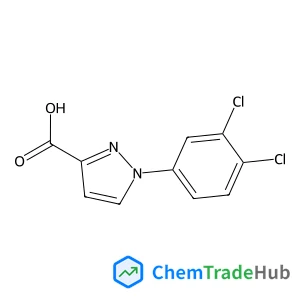
1-(3,4-Dichlorophenyl)-1H-pyrazole-3-carboxylic acid
CAS Number:
1152949-12-6
Molecular Formula:
C10H6Cl2N2O2

Recommended Suppliers





Disclaimer
This page provides academic journal information for reference and research purposes only. We are not affiliated with any journal publishers and do not handle publication submissions. For publication-related inquiries, please contact the respective journal publishers directly.
If you notice any inaccuracies in the information displayed, please contact us at support@chemtradehub.com. We will promptly review and address your concerns.