












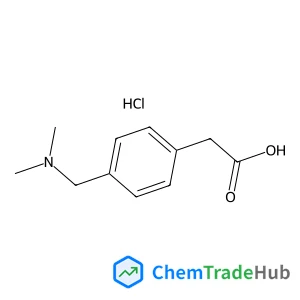
4-(Dimethylaminomethyl)phenylacetic acid hydrochloride
CAS Number:
99985-52-1
Molecular Formula:
C11H16ClNO2
Soojin Kwak, Minhyeok Lee, Eunji Sim, Sarah Yunmi Lee
We report herein a chiral Cu(II)-Lewis acid (LA)/Brønsted base-catalyzed process for the enantio- and diastereoselective conjugate addition of various 2-pyridyl alkyl ketones to β-substituted enones under mild conditions. Acid and base catalysts cooperatively deprotonate an α-proton of pyridyl ketones containing diverse alkyl chains, facilitating the generation of α-pyridyl enolates bound to Cu(II)-LA involving carboxylate ligands. The carboxylate ligands which contain extended alkyl chains such as cyclohexanebutyrates, along with a chiral bisphosphine ligand, play a significant role in stereocontrol, supported by experimental and DFT studies. Cu(II) (Z)-enolate complexes, of which one face is effectively blocked by a carboxylate, react with enones to create the stereogenic carbon–carbon bond in the rate-determining step.
Stefan Zahn, Katharina Wendler, Luigi Delle Site, Barbara Kirchner
DOI: 10.1039/C1CP20288J
Che-Hung Kuo, Chi-Ping Liu, Szu-Hsian Lee, Hsun-Yun Chang, Wei-Chun Lin, Yun-Wen You, Hua-Yang Liao
DOI: 10.1039/C1CP20590K
J. M. Valverde, F. Pontiga, C. Soria-Hoyo, M. A. S. Quintanilla, H. Moreno, F. J. Duran, M. J. Espin
DOI: 10.1039/C1CP21939A
N. Crivillers, A. Liscio, F. Di Stasio, C. Van Dyck, S. Osella, D. Cornil, S. Mian, G. M. Lazzerini, O. Fenwick, E. Orgiu, F. Reinders, S. Braun, M. Fahlman, J. Cornil, V. Palermo, F. Cacialli, P. Samorì
DOI: 10.1039/C1CP20851A
Josip Požar, Klemen Bohinc, Vojko Vlachy, Davor Kovačević
DOI: 10.1039/C1CP21291E
Maria Rosa Antognazza, Francesco Scotognella, Karol Miszta, Dirk Dorfs, Marco Zanella, Margherita Zavelani-Rossi, Liberato Manna, Francesco Tassone
DOI: 10.1039/C1CP21402K
Qiuming Wang, Nilam Shah, Jun Zhao, Chengshan Wang, Chao Zhao, Lingyun Liu, Lingyan Li, Feimeng Zhou, Jie Zheng
DOI: 10.1039/C1CP21156K
2-Methylbenzene-1,4-diamine dihydrochloride (CAS: 615-45-2) should be stored in ...
(1S,4S)-2,5-Diazabicyclo[2.2.1]heptane dihydrobromide is generally considered sa...
(6-Chloropyridazin-3-YL)methanamine finds applications in the pharmaceutical ind...
2-Fluoro-3-methylphenol is primarily used in the synthesis of pharmaceuticals, p...
When handling 3-Methoxy-4-nitrobenzonitrile, it is important to wear appropriate...
When handling 1,3-Oxazolo[4,5-b]pyridine-2(3H)-thione (CAS: 211949-57-4), it is ...
4-Ethynylbenzamide (CAS: 90347-86-7) falls under various regulatory guidelines i...
3-(2-Ethylphenyl)-2-thioxo-4-imidazolidinone is primarily used as an intermediat...
(2-Fluoro-6-methoxyphenyl)acetic acid, also known as 4-fluoro-3-methoxybenzoic a...
Market trends for 2-[4-(Hydroxymethyl)phenoxy]ethanol (CAS: 102196-18-9) indicat...

Organic Chemistry Frontiers publishes high-quality research from across organic chemistry. Emphases are placed on studies that make significant contributions to the field of organic chemistry by reporting either new or significantly improved protocols or methodologies. Topics include, but are not limited to the following: Organic synthesis Development of synthetic methodologies Catalysis Natural products Functional organic materials Supramolecular and macromolecular chemistry Physical and computational organic chemistry
![tert-Butyl 6-chloro-4-oxospiro[chroman-2,4'-piperidine]-1'-carboxylate structure](https://static.chemtradehub.com/structs/101/1011482-37-3-88a5.webp "tert-Butyl 6-chloro-4-oxospiro[chroman-2,4'-piperidine]-1'-carboxylate structure")
![2-(7,7-Difluorobicyclo[4.1.0]hept-1-yl)ethanamine structure](https://static.chemtradehub.com/structs/209/2098065-08-6-ff24.webp "2-(7,7-Difluorobicyclo[4.1.0]hept-1-yl)ethanamine structure")





