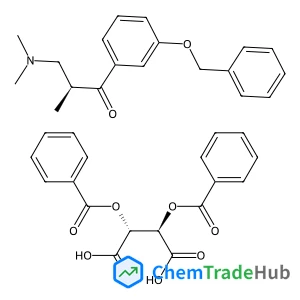
(S)-1-(3-(Benzyloxy)phenyl)-3-(dimethylamino)-2-methylpropan-1-one (2r,3r)-2,3-bis(benzoyloxy)succinate
CAS Number:
1004315-81-4
Molecular Formula:
C37H37NO10
P. Davide Cozzoli, M. Lucia Curri
Following UV-illumination, TiO2 nanorod-stabilized noble metal (Ag, Au) nanoparticles dispersed in deaerated organic mixtures can sustain a higher degree of conduction band electron accumulation than that achievable with pristine titania.
Liyuan Zhang, Yangyang Wang, Wanting Yu, Baiwan Deng, Kai Zhang, Jiexi Wang
DOI: 10.1039/C4GC00761A
Denis Prat, John Hayler, Andy Wells
DOI: 10.1039/C4GC01149J
Xing Yang, Zhuo Chen, Yuan Cai, Yi-Yong Huang, Norio Shibata
DOI: 10.1039/C4GC01357C
P. Moriel, A. B. García
DOI: 10.1039/C4GC00755G
Guangzheng Gao, Muzaffer A. Karaaslan, John F. Kadla, Frank Ko
DOI: 10.1039/C4GC00757C
Chenhua Shu, Tonghua Sun, Qingbin Guo, Jinping Jia, Ziyang Lou
DOI: 10.1039/C4GC00695J
Fang Zhang, Xiaotao Wu, Chao Liang, Xiaoyan Li, Zhen Wang, Hexing Li
DOI: 10.1039/C4GC00178H
Ling-Hong Gong, Yi-Yu Cai, Xin-Hao Li, Ya-Nan Zhang, Juan Su, Jie-Sheng Chen
DOI: 10.1039/C4GC00981A
Wei Li, Jian-Hua Xie, Ming-Lei Yuan, Qi-Lin Zhou
DOI: 10.1039/C4GC00835A
Tao Li, Xuan Li
DOI: 10.1039/C4GC00565A
2-Methylbenzene-1,4-diamine dihydrochloride (CAS: 615-45-2) should be stored in ...
(1S,4S)-2,5-Diazabicyclo[2.2.1]heptane dihydrobromide is generally considered sa...
(6-Chloropyridazin-3-YL)methanamine finds applications in the pharmaceutical ind...
2-Fluoro-3-methylphenol is primarily used in the synthesis of pharmaceuticals, p...
When handling 3-Methoxy-4-nitrobenzonitrile, it is important to wear appropriate...
When handling 1,3-Oxazolo[4,5-b]pyridine-2(3H)-thione (CAS: 211949-57-4), it is ...
4-Ethynylbenzamide (CAS: 90347-86-7) falls under various regulatory guidelines i...
3-(2-Ethylphenyl)-2-thioxo-4-imidazolidinone is primarily used as an intermediat...
(2-Fluoro-6-methoxyphenyl)acetic acid, also known as 4-fluoro-3-methoxybenzoic a...
Market trends for 2-[4-(Hydroxymethyl)phenoxy]ethanol (CAS: 102196-18-9) indicat...

ChemComm publishes urgent research which is of outstanding significance and interest to experts in the field, while also appealing to the journal’s broad chemistry readership. Our communication format is ideally suited to short, urgent studies that are of such importance that they require accelerated publication. Our scope covers all topics in chemistry, and research at the interface of chemistry and other disciplines (such as materials science, nanoscience, physics, engineering and biology) where there is a significant novelty in the chemistry aspects. Major topic areas covered include: Analytical Chemistry Catalysis Chemical Biology and medicinal chemistry Computational Chemistry and Machine Learning Energy and sustainable chemistry Environmental Chemistry Green Chemistry Inorganic Chemistry Materials Chemistry Nanoscience Organic Chemistry Physical Chemistry Polymer Chemistry Supramolecular Chemistry
![[1-(5-Methyl-2-pyridinyl)-1H-pyrazol-4-yl]methanol structure](https://static.chemtradehub.com/structs/143/1439822-99-7-6cc9.webp "[1-(5-Methyl-2-pyridinyl)-1H-pyrazol-4-yl]methanol structure")