


In situXAS and IR studies on Cu:SAPO-5 and Cu:SAPO-11: the contributory role of monomeric linear copper(i) species in the selective catalytic reduction of NOx by propene
Literature Information
Publication Date
2009-04-24
DOI
10.1039/B902491C
Impact Factor
3.676
Authors
Karina Mathisen, David G. Nicholson
View Original
Abstract
Cu:SAPO-5 and Cu:SAPO-11 were prepared by conventional and hydrothermal ion exchange. Copper incorporation is increased six-fold by hydrothermal ion exchange relative to conventional methods. In all cases, the amount of copper taken up by SAPO-11 is superior to uptake in SAPO-5. Copper is divalent and in tetragonally-distorted octahedral environments in the as-prepared samples independent of the method of incorporation for both systems. The local structures about the metal and the valence states associated with the different steps in the selective catalytic reduction of NOx in the presence of propene (SCR-HC) have been investigated using X-ray absorption spectroscopy (XAS). For both the Cu:SAPO-5 and Cu:SAPO-11 systems, heating in helium partially autoreduces copper(II) to copper(I). Following activation in oxygen, propene causes further reduction to copper(I) in all four samples as shown by the evolution of an intense pre-edge diagnostic feature. XANES analysis reveal this to be characteristic of monomeric linear two coordinate copper(I) species. This is a prime example of a pre-edge peak with such a high intensity being observed in the solid state. This is supported by IR where peaks attributed to bidentate copper were observed for Cu:SAPO-11/HT. For all four samples NOx partially reoxidises the copper(I) formed in the helium and propene steps. Ion exchanged Cu:SAPO-5 and Cu:SAPO-11 exhibit low activity in reducing NOx by propene in an oxygen rich environment. The role of the copper ion during NO adsorption was studied using in situ infra red spectroscopy. The activity of copper exchanged materials is governed by both the degree of reducibility of copper(II) and the ease of reversing the valence states with the structural characteristics of the parent materials playing a crucial role.
Recommended Journals

Chemistry Education Research and Practice

Russian Journal of Organic Chemistry

Drug Discovery Today

Russian Journal of Applied Chemistry

Russian Journal of Coordination Chemistry

Russian Journal of General Chemistry

Chemical Communications

Journal of Saudi Chemical Society

Current Opinion in Solid State & Materials Science

Saudi Pharmaceutical Journal
Related Literature
Effect of post-treatments on the photocatalytic activity of Sm2Ti2S2O5 for the hydrogen evolution reaction
Wen Zhao, Fuxiang Zhang, Takashi Hisatomi, Kazunari Domen
2013-12-06
Paper
DOI: 10.1039/C3CP54668C
Combined excitatory and inhibitory coupling in a 1-D array of Belousov–Zhabotinsky droplets
Ning Li, Irving R. Epstein, Seth Fraden
2014-04-17
Paper
DOI: 10.1039/C4CP00957F
Conversion efficiency of skutterudite-based thermoelectric modules
James R. Salvador, Jung Y. Cho, Zuxin Ye, Joshua E. Moczygemba, Alan J. Thompson, Jeffrey W. Sharp, Jan D. Koenig, Ryan Maloney, Travis Thompson, Jeffrey Sakamoto, Hsin Wang, Andrew A. Wereszczak
2014-05-16
Paper
DOI: 10.1039/C4CP01582G
Electron transport in MoWSeS monolayers in the presence of an external electric field
Nourdine Zibouche, Pier Philipsen, Thomas Heine, Agnieszka Kuc
2014-04-11
Paper
DOI: 10.1039/C4CP00966E
What makes zeolitic imidazolate frameworks hydrophobic or hydrophilic? The impact of geometry and functionalization on water adsorption
Aurélie U. Ortiz, Alexy P. Freitas, Anne Boutin, Alain H. Fuchs, François-Xavier Coudert
2013-12-20
Paper
DOI: 10.1039/C3CP54292K
Selective adsorption of bismuth telluride nanoplatelets through electrostatic attraction
2014-04-23
Paper
DOI: 10.1039/C4CP00690A
Understanding the chemical dynamics of the reactions of dicarbon with 1-butyne, 2-butyne, and 1,2-butadiene – toward the formation of resonantly stabilized free radicals
Dorian S. N. Parker, Surajit Maity, Beni B. Dangi, Ralf I. Kaiser, Alexander Landera, Alexander M. Mebel
2014-05-02
Paper
DOI: 10.1039/C4CP00639A
Effect of chromophore encapsulation on linear and nonlinear optical properties: the case of “miniSOG”, a protein-encased flavin
Nanna H. List, Frederico M. Pimenta, Lotte Holmegaard, Rasmus L. Jensen, Michael Etzerodt, Tobias Schwabe, Jacob Kongsted, Peter R. Ogilby, Ove Christiansen
2014-01-07
Paper
DOI: 10.1039/C3CP54470B
Excitonic energy transfer in polymer wrapped carbon nanotubes in gradually grown nanoassemblies
Victor A. Karachevtsev, Alexander M. Plokhotnichenko, Victor S. Leontiev
2014-04-14
Paper
DOI: 10.1039/C4CP00776J
The nature of coherences in the B820 bacteriochlorophyll dimer revealed by two-dimensional electronic spectroscopy
Marco Ferretti, Vladimir I. Novoderezhkin, Elisabet Romero, Ramunas Augulis, Anjali Pandit, Donatas Zigmantas, Rienk van Grondelle
2013-12-18
Paper
DOI: 10.1039/C3CP54634A
You might also like
Compound Q&A
What precautions should be taken when handling 2-Chloro-1,2-bis(4-methylphenyl)ethanone (CAS: 71193-32-3)?
When handling 2-Chloro-1,2-bis(4-methylphenyl)ethanone (CAS: 71193-32-3), it is ...
71193-32-32-Chloro-1,2-bis(4-m...
Compound Q&A
What industries use 4-Ethoxy-3-(5-methyl-4-oxo-7-propyl-1,4-dihydroimidazo[5,1-f][1,2,4]triazin-2-yl)benzenesulfonyl chloride (CAS: 224789-26-8)?
4-Ethoxy-3-(5-methyl-4-oxo-7-propyl-1,4-dihydroimidazo[5,1-f][1,2,4]triazin-2-yl...
224789-26-84-Ethoxy-3-(5-methyl...
Compound Q&A
How should Methyl 3-Oxo-4-Androsten-17-Carboxylate (CAS: 2681-55-2) be stored?
Methyl 3-Oxo-4-Androsten-17-Carboxylate (CAS: 2681-55-2) should be stored in a c...
2681-55-2Methyl 3-Oxo-4-Andro...
Compound Q&A
What are the main uses of (R)-3-Amino-4-(3-hexylphenylamino)-4-oxobutylphosphonic acid (CAS: 909725-61-7)?
(R)-3-Amino-4-(3-hexylphenylamino)-4-oxobutylphosphonic acid is primarily used i...
909725-61-7(R)-3-Amino-4-(3-hex...
Compound Q&A
What regulatory guidelines apply to 2-Methyl-2-propanyl 3-amino-3-carbamoyl-1-azetidinecarboxylate (CAS: 1254120-14-3)?
2-Methyl-2-propanyl 3-amino-3-carbamoyl-1-azetidinecarboxylate (CAS: 1254120-14-...
1254120-14-32-Methyl-2-propanyl ...
Compound Q&A
Are there alternatives to (E)-4-(tert-Butoxy)-4-oxobut-2-enoic acid (CAS: 135355-96-3) in synthesis?
There are alternative reagents that can be used in synthesis instead of (E)-4-(t...
135355-96-3(E)-4-(tert-Butoxy)-...
Compound Q&A
What are the physical and chemical properties of [2-(3-Chlorophenyl)-1,3-thiazol-4-yl]methanol (CAS: 121202-20-8)?
[2-(3-Chlorophenyl)-1,3-thiazol-4-yl]methanol (CAS: 121202-20-8) is a crystallin...
121202-20-8[2-(3-Chlorophenyl)-...
Compound Q&A
What is the market or research trend for Methyl (2S)-[(4S)-2,2-dimethyl-1,3-dioxolan-4-yl]{[(4-methylphenyl)sulfonyl]oxy}acetate (CAS: 166249-17-8)?
The market and research trends for Methyl (2S)-[(4S)-2,2-dimethyl-1,3-dioxolan-4...
166249-17-8Methyl (2S)-[(4S)-2,...
Compound Q&A
What is the market or research trend for 1-Bromo-2-isocyanatoethane (CAS: 42865-19-0)?
The market for 1-Bromo-2-isocyanatoethane (CAS: 42865-19-0) is driven by its use...
42865-19-01-Bromo-2-isocyanato...
Compound Q&A
What are the main uses of 4-Nitro-D-phenylalanine hydrochloride (CAS: 147065-06-3)?
4-Nitro-D-phenylalanine hydrochloride (CAS: 147065-06-3) is primarily used in re...
147065-06-34-Nitro-D-phenylalan...
Source Journal
Physical Chemistry Chemical Physics

CiteScore:
5.5
Self-citation Rate:
10.3%
Articles per Year:
3036
Physical Chemistry Chemical Physics (PCCP) is an international journal co-owned by 19 physical chemistry and physics societies from around the world. This journal publishes original, cutting-edge research in physical chemistry, chemical physics and biophysical chemistry. To be suitable for publication in PCCP, articles must include significant innovation and/or insight into physical chemistry; this is the most important criterion that reviewers and Editors will judge against when evaluating submissions. The journal has a broad scope and welcomes contributions spanning experiment, theory, computation and data science. Topical coverage includes spectroscopy, dynamics, kinetics, statistical mechanics, thermodynamics, electrochemistry, catalysis, surface science, quantum mechanics, quantum computing and machine learning. Interdisciplinary research areas such as polymers and soft matter, materials, nanoscience, energy, surfaces/interfaces, and biophysical chemistry are welcomed if they demonstrate significant innovation and/or insight into physical chemistry. Joined experimental/theoretical studies are particularly appreciated when complementary and based on up-to-date approaches.
Recommended Compounds
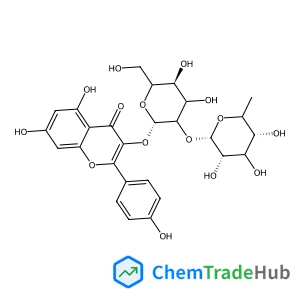
5,7-Dihydroxy-2-(4-hydroxyphenyl)-4-oxo-4H-chromen-3-yl 2-O-(6-deoxy-alpha-L-mannopyranosyl)-beta-D-glucopyranoside
CAS Number:
32602-81-6
Molecular Formula:
C27H30O15
![4-[2-(Trichlorosilyl)ethyl]benzenesulfonyl chloride structure](https://static.chemtradehub.com/structs/797/79793-00-3-de16.webp "4-[2-(Trichlorosilyl)ethyl]benzenesulfonyl chloride structure")
4-[2-(Trichlorosilyl)ethyl]benzenesulfonyl chloride
CAS Number:
79793-00-3
Molecular Formula:
C8H8Cl4O2SSi
Recommended Suppliers





Disclaimer
This page provides academic journal information for reference and research purposes only. We are not affiliated with any journal publishers and do not handle publication submissions. For publication-related inquiries, please contact the respective journal publishers directly.
If you notice any inaccuracies in the information displayed, please contact us at support@chemtradehub.com. We will promptly review and address your concerns.