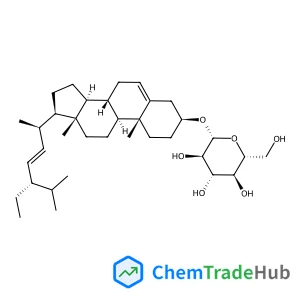
(3beta,22E)-Stigmasta-5,22-dien-3-yl beta-D-glucopyranoside
CAS Number:
19716-26-8
Molecular Formula:
C35H58O6
Melepurath Deepa, Arvind Awadhia, Shweta Bhandari
Electrochromic devices based on poly(3,4-ethylenedioxythiophene) (PEDOT) as the cathodic coloring electrode and polyaniline (PANI) or Prussian blue (PB) as the counter electrode containing a highly conductive, self-supporting, distensible and transparent polymer–gel electrolyte film encapsulating an ionic liquid, 1-butyl-1-methylpyrrolidiniumbis(trifluoromethylsulfonyl)imide, have been fabricated. Polarization, charge transfer and diffusion processes control the electrochemistry of the functional electrodes during coloration and bleaching and these phenomena differ when PEDOT and PANI/PB were employed alternately as working electrodes. While the electrochemical impedance response shows good similitude for PEDOT and PANI electrodes, the responses of PEDOT and PB were significantly different in the PEDOT–PB device, especially during reduction of PB, wherein the overall amplitude of the impedance response is enormous. Large values of the coloration efficiency maxima of 281 cm2C−1 (λ = 583 nm) and 274 cm2C−1 (λ = 602 nm), achieved at −1.0 and −1.5 V for the PEDOT–PANI and PEDOT–PB devices have been correlated to the particularly low magnitude of charge transfer resistance and high polarization capacitance operative at the PEDOT–ionic liquid based electrolyte interface at these dc potentials, thus allowing facile ion-transport and consequently resulting in enhanced absorption modulation. Moderately fast switching kinetics and the ability of these devices to sustain about 2500 cycles of clear-to-dark and dark-to-clear without incurring major losses in the optical contrast, along with the ease of construction of these cells in terms of high scalability and reproducibility of the synthetic procedure for fabrication of the electrochromic films and the ionic liquid based gel electrolyte film, are indicators of the promise these devices hold for practical applications like electrochromic windows and displays.

Current Opinion in Colloid & Interface Science

Saudi Pharmaceutical Journal

Russian Chemical Bulletin

Russian Journal of Bioorganic Chemistry

Russian Journal of Coordination Chemistry

Journal of Peptide Science

Current Opinion in Solid State & Materials Science

Chemistry Education Research and Practice

Crystallography Reports

Chemical Communications
Yongqi Liang, Johannes Messinger
DOI: 10.1039/C4CP00674G
Neerav Kharche, Mark S. Hybertsen, James T. Muckerman
DOI: 10.1039/C4CP00486H
Frank Schleifenbaum, Andreas M. Kern, Alexander Konrad, Alfred J. Meixner
DOI: 10.1039/C4CP01306A
Jia Gao, Yueh-Lin Loo
DOI: 10.1039/C4CP00665H
Kiminori Sato, Kazuomi Numata, Weili Dai, Michael Hunger
DOI: 10.1039/C4CP00990H
Cheng Li, Dan Credgington, Doo-Hyun Ko, Zhuxia Rong, Jianpu Wang, Neil C. Greenham
DOI: 10.1039/C4CP01251H
Seongjae Ko, Tetsu Tatsuma, Akiyoshi Sakoda, Yasuyuki Sakai, Kikuo Komori
DOI: 10.1039/C4CP01278J
James W. Vickers, Jordan M. Sumliner, Hongjin Lv, Mike Morris, Yurii V. Geletii, Craig L. Hill
DOI: 10.1039/C3CP55406F
Denys Shevchenko, Magnus F. Anderlund, Stenbjörn Styring, Holger Dau, Ivelina Zaharieva, Anders Thapper
DOI: 10.1039/C3CP55125C
When handling 2-Chloro-1,2-bis(4-methylphenyl)ethanone (CAS: 71193-32-3), it is ...
4-Ethoxy-3-(5-methyl-4-oxo-7-propyl-1,4-dihydroimidazo[5,1-f][1,2,4]triazin-2-yl...
Methyl 3-Oxo-4-Androsten-17-Carboxylate (CAS: 2681-55-2) should be stored in a c...
(R)-3-Amino-4-(3-hexylphenylamino)-4-oxobutylphosphonic acid is primarily used i...
2-Methyl-2-propanyl 3-amino-3-carbamoyl-1-azetidinecarboxylate (CAS: 1254120-14-...
There are alternative reagents that can be used in synthesis instead of (E)-4-(t...
[2-(3-Chlorophenyl)-1,3-thiazol-4-yl]methanol (CAS: 121202-20-8) is a crystallin...
The market and research trends for Methyl (2S)-[(4S)-2,2-dimethyl-1,3-dioxolan-4...
The market for 1-Bromo-2-isocyanatoethane (CAS: 42865-19-0) is driven by its use...
4-Nitro-D-phenylalanine hydrochloride (CAS: 147065-06-3) is primarily used in re...

Physical Chemistry Chemical Physics (PCCP) is an international journal co-owned by 19 physical chemistry and physics societies from around the world. This journal publishes original, cutting-edge research in physical chemistry, chemical physics and biophysical chemistry. To be suitable for publication in PCCP, articles must include significant innovation and/or insight into physical chemistry; this is the most important criterion that reviewers and Editors will judge against when evaluating submissions. The journal has a broad scope and welcomes contributions spanning experiment, theory, computation and data science. Topical coverage includes spectroscopy, dynamics, kinetics, statistical mechanics, thermodynamics, electrochemistry, catalysis, surface science, quantum mechanics, quantum computing and machine learning. Interdisciplinary research areas such as polymers and soft matter, materials, nanoscience, energy, surfaces/interfaces, and biophysical chemistry are welcomed if they demonstrate significant innovation and/or insight into physical chemistry. Joined experimental/theoretical studies are particularly appreciated when complementary and based on up-to-date approaches.