












Double proton transfer reactions at the transition from a concerted to a stepwise mechanism: a comparative ab initio study
Literature Information
Publication Date
2005-01-10
DOI
10.1039/B415528A
Impact Factor
3.676
Authors
Stefan Schweiger, Bernd Hartke, Guntram Rauhut
View Original
Abstract
The double proton transfer reactions between some substituted pyrazoles and guanidine were studied by ab initio calculations up to the CCSD(T) level. In contrast to standard textbook reactions, two of the systems show broad plateaus of almost constant energy along the minimum energy path (MEP) instead of well localized transition states. The impact of zero point vibrational energy (ZPE) corrections on the energy profiles are discussed in detail. Analyses based on the reaction path Hamiltonian (RPH) were used to gain further insight into the properties of the reaction paths. For one system RPH dynamics simulations were used to determine the life time on top of the plateau and the conversion coefficient entering into the overall rate constant. One dimensional (1D) tunneling effects were studied along the MEPs and a linear reaction path.
Related Literature
Comparative study of the intermolecular dynamics of imidazolium-based ionic liquids with linear and branched alkyl chains: OHD-RIKES measurements
Lianjie Xue, Fehmi Bardak, George Tamas, Edward L. Quitevis
2017-01-19
Paper
DOI: 10.1039/C6CP08263G
Nanoparticle–nanoparticle vs. nanoparticle–substrate hot spot contributions to the SERS signal: studying Raman labelled monomers, dimers and trimers
Kamila Moor, Kristina Gudun, Zarina Yelemessova, Rostislav Bukasov
2016-12-15
Paper
DOI: 10.1039/C6CP08254H
A tailored multi-frequency EPR approach to accurately determine the magnetic resonance parameters of dynamic nuclear polarization agents: application to AMUPol
P. Gast, D. Mance, E. Zurlo, M. Baldus, M. Huber
2017-01-18
Paper
DOI: 10.1039/C6CP05864G
Toward full simulation of the electrochemical oxygen reduction reaction on Pt using first-principles and kinetic calculations
Minoru Otani
2017-01-04
Paper
DOI: 10.1039/C6CP08466D
Conformational and electronic effects on the formation of anti cyclobutane pyrimidine dimers in G-quadruplex structures
Wook Lee, Spiridoula Matsika
2016-12-08
Paper
DOI: 10.1039/C6CP05604K
Prediction of a novel 10-fold gold coordinated structure in AuIn2 above 10 GPa
P. Modak, Ashok K. Verma
2017-01-06
Paper
DOI: 10.1039/C6CP07805B
Probing the degradation and homogeneity of embedded perovskite semiconducting layers in photovoltaic devices by Raman spectroscopy
K. E. A. Hooper, H. K. H. Lee, M. J. Newman, S. Meroni, J. Baker, T. M. Watson, W. C. Tsoi
2017-02-02
Paper
DOI: 10.1039/C6CP05123E
Cobalt disulfide/graphite foam composite films as self-standing electrocatalytic electrodes for overall water splitting
Yue Tong, Xiaowen Yu, Gaoquan Shi
2017-01-16
Paper
DOI: 10.1039/C6CP08176B
Nonadiabatic Renner–Teller quantum dynamics of OH(X2Π) + H+ reactive collisions
Pablo Gamallo, Sinan Akpinar, Paolo Defazio, Carlo Petrongolo
2017-01-09
Paper
DOI: 10.1039/C6CP07756K
Molecular interactions of organic molecules at the air/water interface investigated by sum frequency generation vibrational spectroscopy
2017-01-05
Paper
DOI: 10.1039/C6CP07827C
You might also like
Compound Q&A
What precautions should be taken when handling 4-(2-Furylmethyl)thiomorpholine 1,1-dioxide (CAS: 79206-94-3)?
When handling 4-(2-Furylmethyl)thiomorpholine 1,1-dioxide (CAS: 79206-94-3), it ...
79206-94-34-(2-Furylmethyl)thi...
Compound Q&A
What precautions should be taken when handling 4-Chloro-N-[2-(4-morpholinyl)ethyl]benzamide (CAS: 71320-77-9)?
When handling 4-Chloro-N-[2-(4-morpholinyl)ethyl]benzamide (CAS: 71320-77-9), it...
71320-77-94-Chloro-N-[2-(4-mor...
Compound Q&A
How should waste containing 2-[2-(2-Methoxyethoxy)ethoxy]ethyl 4-methylbenzenesulfonate (CAS: 62921-74-8) be handled?
Waste containing this compound (CAS: 62921-74-8) should be handled according to ...
62921-74-82-[2-(2-Methoxyethox...
Compound Q&A
How should waste containing (S)-Methyl 2-amino-3-cyclohexylpropanoate be handled?
Waste containing (S)-Methyl 2-amino-3-cyclohexylpropanoate should be collected i...
40056-18-6(S)-Methyl 2-amino-3...
Compound Q&A
How is 5-({4-[(2S,4R)-4-Hydroxy-2-methyltetrahydro-2H-pyran-4-yl]-2-thienyl}sulfanyl)-1-methyl-1,3-dihydro-2H-indol-2-one (CAS: 166882-70-8) typically synthesized?
This compound can be synthesized using a multi-step process involving the conjug...
166882-70-85-({4-[(2S,4R)-4-Hyd...
Compound Q&A
Are there alternatives to (2E)-3-(3,4-Dichlorophenyl)acrylic acid (CAS: 7312-27-8) in synthesis?
There are several alternatives to (2E)-3-(3,4-Dichlorophenyl)acrylic acid in syn...
7312-27-8(2E)-3-(3,4-Dichloro...
Compound Q&A
How should Ethyl 6-(2-nitrophenyl)imidazo[2,1-b][1,3]thiazole-3-carboxylate (CAS: 925437-84-9) be stored?
Ethyl 6-(2-nitrophenyl)imidazo[2,1-b][1,3]thiazole-3-carboxylate (CAS: 925437-84...
925437-84-9Ethyl 6-(2-nitrophen...
Compound Q&A
How should waste containing 2-(1,3-Thiazol-2-yl)ethanamine (CAS: 18453-07-1) be handled?
Waste containing 2-(1,3-Thiazol-2-yl)ethanamine (CAS: 18453-07-1) should be coll...
18453-07-12-(1,3-Thiazol-2-yl)...
Compound Q&A
How is Methyl 5-iodo-2-methylbenzoate (CAS: 103440-54-6) typically synthesized?
Methyl 5-iodo-2-methylbenzoate can be synthesized through the iodination of meth...
103440-54-6Methyl 5-iodo-2-meth...
Compound Q&A
How is 5-Chloro[1,2,4]triazolo[1,5-a]pyridine (CAS: 1427399-34-5) typically synthesized?
5-Chloro[1,2,4]triazolo[1,5-a]pyridine is commonly synthesized via the condensat...
1427399-34-55-Chloro[1,2,4]triaz...
Source Journal
Physical Chemistry Chemical Physics

CiteScore:
5.5
Self-citation Rate:
10.3%
Articles per Year:
3036
Physical Chemistry Chemical Physics (PCCP) is an international journal co-owned by 19 physical chemistry and physics societies from around the world. This journal publishes original, cutting-edge research in physical chemistry, chemical physics and biophysical chemistry. To be suitable for publication in PCCP, articles must include significant innovation and/or insight into physical chemistry; this is the most important criterion that reviewers and Editors will judge against when evaluating submissions. The journal has a broad scope and welcomes contributions spanning experiment, theory, computation and data science. Topical coverage includes spectroscopy, dynamics, kinetics, statistical mechanics, thermodynamics, electrochemistry, catalysis, surface science, quantum mechanics, quantum computing and machine learning. Interdisciplinary research areas such as polymers and soft matter, materials, nanoscience, energy, surfaces/interfaces, and biophysical chemistry are welcomed if they demonstrate significant innovation and/or insight into physical chemistry. Joined experimental/theoretical studies are particularly appreciated when complementary and based on up-to-date approaches.
Recommended Compounds
![5-Acetyl-2,3-dihydrobenzo[b]furan structure](https://static.chemtradehub.com/structs/908/90843-31-5-eea4.webp "5-Acetyl-2,3-dihydrobenzo[b]furan structure")

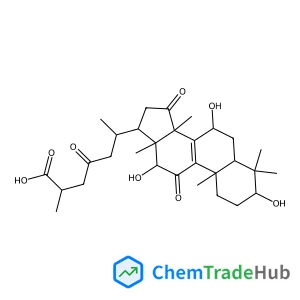
(3beta,7beta,12beta)-3,7,12-Trihydroxy-11,15,23-trioxolanost-8-en-26-oic acid
CAS Number:
98665-22-6
Molecular Formula:
C30H44O8
Recommended Suppliers





Disclaimer
This page provides academic journal information for reference and research purposes only. We are not affiliated with any journal publishers and do not handle publication submissions. For publication-related inquiries, please contact the respective journal publishers directly.
If you notice any inaccuracies in the information displayed, please contact us at support@chemtradehub.com. We will promptly review and address your concerns.