












A pyrimidine-like nickel(ii) DNA base pair
Literature Information
Publication Date
2005-01-19
DOI
10.1039/B415426F
Impact Factor
6.222
Authors
Christopher Switzer, Dongwon Shin
View Original
Abstract
4-(2′-Pyridyl)-pyrimidinone deoxyriboside is synthesized and characterized as a DNA metallo base-pair; this novel nucleoside forms a self-pair in the presence of Ni(II) and stabilizes double helical DNA to the same extent as a G·C pair.
Related Literature
Solid-state NMR studies of weak interactions in supramolecular systems
Michele R. Chierotti, Roberto Gobetto
2008-01-07
Feature Article
DOI: 10.1039/B711551B
Ni–nitrilotriacetic acid-modified quantum dots as a site-specific labeling agent of histidine-tagged proteins in live cells
Junwon Kim, Hye-Young Park, Jaeseung Kim, Jiyoung Ryu, Do Yoon Kwon, Regis Grailhe, Rita Song
2008-02-19
Communication
DOI: 10.1039/B719434J
Rigid cyanine dyenucleic acid labels‡
Adrian Fegan, Pravin S. Shirude, Shankar Balasubramanian
2008-03-26
Communication
DOI: 10.1039/B801629A
Use of ionic liquids (ILs) for the IL-anion size-dependent formation of Cr, Mo and W nanoparticles from metal carbonyl M(CO)6 precursors
Engelbert Redel, Ralf Thomann, Christoph Janiak
2008-03-14
Communication
DOI: 10.1039/B718055A
A new enantiopure unsaturated dicarboxylate as a 4-connected unit in a flexible homochiral PtS-type framework
Jian Zhang, Xianhui Bu
2008-02-11
Communication
DOI: 10.1039/B719368H
Photoinduced CO release, cellular uptake and cytotoxicity of a tris(pyrazolyl)methane (tpm) manganese tricarbonyl complex
Johanna Niesel, Antonio Pinto, Harmel W. Peindy N'Dongo, Klaus Merz, Ingo Ott, Ronald Gust, Ulrich Schatzschneider
2008-02-08
Communication
DOI: 10.1039/B719075A
Clean and efficient synthesis of O-silylcarbamates and ureas in supercritical carbon dioxide
Matthew J. Fuchter, Catherine J. Smith, Alistair Boyer, Simon Saubern, John H. Ryan, Andrew B. Holmes
2008-04-02
Communication
DOI: 10.1039/B801537F
A homospin iron(ii) single chain magnet‡
Szymon W. Przybylak, Floriana Tuna, Simon J. Teat, Richard E. P. Winpenny
2008-02-22
Communication
DOI: 10.1039/B717277J
Synthesis and reactivity of tetrakis(imino)pyracene (TIP) ligands; bifunctional analogues of the BIAN ligand class
Kalyan V. Vasudevan, Michael Findlater, Alan H. Cowley
2008-03-03
Communication
DOI: 10.1039/B719251G
You might also like
Compound Q&A
What precautions should be taken when handling 4-(2-Furylmethyl)thiomorpholine 1,1-dioxide (CAS: 79206-94-3)?
When handling 4-(2-Furylmethyl)thiomorpholine 1,1-dioxide (CAS: 79206-94-3), it ...
79206-94-34-(2-Furylmethyl)thi...
Compound Q&A
What precautions should be taken when handling 4-Chloro-N-[2-(4-morpholinyl)ethyl]benzamide (CAS: 71320-77-9)?
When handling 4-Chloro-N-[2-(4-morpholinyl)ethyl]benzamide (CAS: 71320-77-9), it...
71320-77-94-Chloro-N-[2-(4-mor...
Compound Q&A
How should waste containing 2-[2-(2-Methoxyethoxy)ethoxy]ethyl 4-methylbenzenesulfonate (CAS: 62921-74-8) be handled?
Waste containing this compound (CAS: 62921-74-8) should be handled according to ...
62921-74-82-[2-(2-Methoxyethox...
Compound Q&A
How should waste containing (S)-Methyl 2-amino-3-cyclohexylpropanoate be handled?
Waste containing (S)-Methyl 2-amino-3-cyclohexylpropanoate should be collected i...
40056-18-6(S)-Methyl 2-amino-3...
Compound Q&A
How is 5-({4-[(2S,4R)-4-Hydroxy-2-methyltetrahydro-2H-pyran-4-yl]-2-thienyl}sulfanyl)-1-methyl-1,3-dihydro-2H-indol-2-one (CAS: 166882-70-8) typically synthesized?
This compound can be synthesized using a multi-step process involving the conjug...
166882-70-85-({4-[(2S,4R)-4-Hyd...
Compound Q&A
Are there alternatives to (2E)-3-(3,4-Dichlorophenyl)acrylic acid (CAS: 7312-27-8) in synthesis?
There are several alternatives to (2E)-3-(3,4-Dichlorophenyl)acrylic acid in syn...
7312-27-8(2E)-3-(3,4-Dichloro...
Compound Q&A
How should Ethyl 6-(2-nitrophenyl)imidazo[2,1-b][1,3]thiazole-3-carboxylate (CAS: 925437-84-9) be stored?
Ethyl 6-(2-nitrophenyl)imidazo[2,1-b][1,3]thiazole-3-carboxylate (CAS: 925437-84...
925437-84-9Ethyl 6-(2-nitrophen...
Compound Q&A
How should waste containing 2-(1,3-Thiazol-2-yl)ethanamine (CAS: 18453-07-1) be handled?
Waste containing 2-(1,3-Thiazol-2-yl)ethanamine (CAS: 18453-07-1) should be coll...
18453-07-12-(1,3-Thiazol-2-yl)...
Compound Q&A
How is Methyl 5-iodo-2-methylbenzoate (CAS: 103440-54-6) typically synthesized?
Methyl 5-iodo-2-methylbenzoate can be synthesized through the iodination of meth...
103440-54-6Methyl 5-iodo-2-meth...
Compound Q&A
How is 5-Chloro[1,2,4]triazolo[1,5-a]pyridine (CAS: 1427399-34-5) typically synthesized?
5-Chloro[1,2,4]triazolo[1,5-a]pyridine is commonly synthesized via the condensat...
1427399-34-55-Chloro[1,2,4]triaz...
Source Journal
Chemical Communications

CiteScore:
8.6
Self-citation Rate:
4.7%
Articles per Year:
2458
ChemComm publishes urgent research which is of outstanding significance and interest to experts in the field, while also appealing to the journal’s broad chemistry readership. Our communication format is ideally suited to short, urgent studies that are of such importance that they require accelerated publication. Our scope covers all topics in chemistry, and research at the interface of chemistry and other disciplines (such as materials science, nanoscience, physics, engineering and biology) where there is a significant novelty in the chemistry aspects. Major topic areas covered include: Analytical Chemistry Catalysis Chemical Biology and medicinal chemistry Computational Chemistry and Machine Learning Energy and sustainable chemistry Environmental Chemistry Green Chemistry Inorganic Chemistry Materials Chemistry Nanoscience Organic Chemistry Physical Chemistry Polymer Chemistry Supramolecular Chemistry
Recommended Compounds

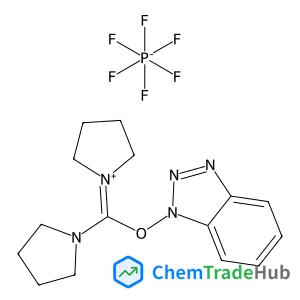
(1H-Benzotriazol-1-yloxy)(di-1-pyrrolidinyl)methylium hexafluorophosphate
CAS Number:
105379-24-6
Molecular Formula:
C15H21F6N5OP

(3beta,7beta,12beta)-3,7,12-Trihydroxy-11,15,23-trioxolanost-8-en-26-oic acid
CAS Number:
98665-22-6
Molecular Formula:
C30H44O8
Recommended Suppliers





Disclaimer
This page provides academic journal information for reference and research purposes only. We are not affiliated with any journal publishers and do not handle publication submissions. For publication-related inquiries, please contact the respective journal publishers directly.
If you notice any inaccuracies in the information displayed, please contact us at support@chemtradehub.com. We will promptly review and address your concerns.