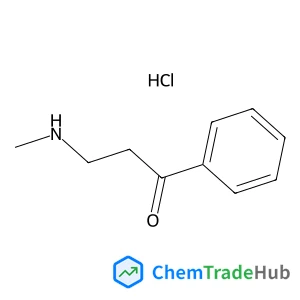
3-(Methylamino)-1-phenyl-1-propanone hydrochloride (1:1)
CAS Number:
2538-50-3
Molecular Formula:
C10H14ClNO
Laure Catala, Corine Mathonière, Alexandre Gloter, Odile Stephan, Thierry Gacoin, Jean-Pierre Boilot, Talal Mallah
Nanorods of the photomagnetic coordination network Mo(CN)8Cu2 coated with polyvinylpyrrolidone were prepared and exhibit an enhanced effect upon irradiation when compared to the bulk.
DOI: 10.1039/C5CP03499J
Giulia Mangione, Silvia Carlotto, Mauro Sambi, Giovanni Ligorio, Andrea Vittadini
DOI: 10.1039/C6CP01423B
Suehiro Iwata, Dai Akase, Misako Aida, Sotiris S. Xantheas
DOI: 10.1039/C6CP02487D
Song Gao, Rui Qing Fan, Xin Ming Wang, Li Guo Wei, Yang Song, Xi Du, Kai Xing, Ping Wang, Yu Lin Yang
DOI: 10.1039/C6CP02530G
Matthew Becton, Xianqiao Wang
DOI: 10.1039/C5CP03460D
Hiroyuki Saigusa, Daisuke Nakamura, Shu-hei Urashima
DOI: 10.1039/C5CP03494A
Po-Yu Tsai, Hou-Kuan Li, King-Chuen Lin
DOI: 10.1039/C5CP03408F
Sahn Nahm, Won Il Cho, Chongmok Lee
DOI: 10.1039/C5CP03375F
Maryana I. Nave, Yu-chen Karen Chen-Wiegart, Jun Wang, Konstantin G. Kornev
DOI: 10.1039/C5CP03431K
M. H. Yang, Y. Li, J. H. Li, B. X. Liu
DOI: 10.1039/C6CP90176J
When handling 4-(2-Furylmethyl)thiomorpholine 1,1-dioxide (CAS: 79206-94-3), it ...
When handling 4-Chloro-N-[2-(4-morpholinyl)ethyl]benzamide (CAS: 71320-77-9), it...
Waste containing this compound (CAS: 62921-74-8) should be handled according to ...
Waste containing (S)-Methyl 2-amino-3-cyclohexylpropanoate should be collected i...
This compound can be synthesized using a multi-step process involving the conjug...
There are several alternatives to (2E)-3-(3,4-Dichlorophenyl)acrylic acid in syn...
Ethyl 6-(2-nitrophenyl)imidazo[2,1-b][1,3]thiazole-3-carboxylate (CAS: 925437-84...
Waste containing 2-(1,3-Thiazol-2-yl)ethanamine (CAS: 18453-07-1) should be coll...
Methyl 5-iodo-2-methylbenzoate can be synthesized through the iodination of meth...
5-Chloro[1,2,4]triazolo[1,5-a]pyridine is commonly synthesized via the condensat...

ChemComm publishes urgent research which is of outstanding significance and interest to experts in the field, while also appealing to the journal’s broad chemistry readership. Our communication format is ideally suited to short, urgent studies that are of such importance that they require accelerated publication. Our scope covers all topics in chemistry, and research at the interface of chemistry and other disciplines (such as materials science, nanoscience, physics, engineering and biology) where there is a significant novelty in the chemistry aspects. Major topic areas covered include: Analytical Chemistry Catalysis Chemical Biology and medicinal chemistry Computational Chemistry and Machine Learning Energy and sustainable chemistry Environmental Chemistry Green Chemistry Inorganic Chemistry Materials Chemistry Nanoscience Organic Chemistry Physical Chemistry Polymer Chemistry Supramolecular Chemistry
![[4-Amino-2-(methylsulfanyl)-5-pyrimidinyl]methanol structure](https://static.chemtradehub.com/structs/588/588-36-3-fc73.webp "[4-Amino-2-(methylsulfanyl)-5-pyrimidinyl]methanol structure")