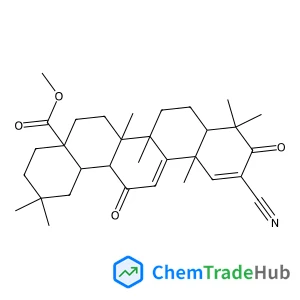
Methyl 2-cyano-3,12-dioxooleana-1,9(11)-dien-28-oate
CAS Number:
218600-53-4
Molecular Formula:
C32H43NO4
Po-Yu Tsai, Hou-Kuan Li, King-Chuen Lin
Photodissociation of isobutyraldehyde (C3H7CHO) at 248 nm is investigated using time-resolved Fourier-transform infrared emission spectroscopy to demonstrate the growing importance of the roaming pathway with increasing molecular size of aliphatic aldehydes. Each acquired CO rotational distribution from v = 1 to 4 is well characterized by a single Boltzmann rotational temperature from 637 to 750 K, corresponding to an average rotational energy of 5.9 ± 0.6 kJ mol−1. The roaming signature that shows a small fraction of CO rotational energy disposal accompanied by a vibrationally hot C3H8 co-fragment is supported by theoretical prediction. The energy difference between the tight transition state (TS) and the roaming saddle point (SP) is found to be −27, 4, 15, 22, and 30 kJ mol−1 for formaldehyde, acetaldehyde, propionaldehyde, isobutyraldehyde, and 2,2-dimethyl propanal, respectively. The roaming SP is stabilized by a larger alkyl moiety. It is suggested that the roaming photodissociation rate of aldehydes increasingly exceeds those via the tight TS, resulting in the dominance of the CO + alkane products, as the size of aldehydes becomes larger. Along with formaldehyde, acetaldehyde, and propionaldehyde, in this work isobutyraldehyde is further demonstrated that this aldehyde family with special functional group is the first case in the organic compound to follow predominantly a roaming dissociation pathway, as the molecular size becomes larger.
Ping Wu, Pan Du, Hui Zhang, Chenxin Cai
DOI: 10.1039/C3CP50900A
G. E. Davydyuk, H. Kamarudin, G. L. Myronchuk, S. P. Danylchuk, A. O. Fedorchuk, L. V. Piskach, M. Yu. Mozolyuk, O. V. Parasyuk
DOI: 10.1039/C3CP50836F
Shinji Aono, Takashi Hosoya, Shigeyoshi Sakaki
DOI: 10.1039/C3CP43892A
Nina O. C. Winter, Nora K. Graf, Samuel Leutwyler, Christof Hättig
DOI: 10.1039/C2CP42694C
R. E. Ovcharenko, I. I. Tupitsyn, E. P. Savinov, E. N. Voloshina, B. Paulus, Yu. S. Dedkov, A. S. Shulakov
DOI: 10.1039/C3CP44304C
Terry D. Humphries, Derek Birkmire, Bjørn C. Hauback, G. Sean McGrady, Craig M. Jensen
DOI: 10.1039/C3CP50777G
Idan Hod, Zion Tachan, Menny Shalom, Arie Zaban
DOI: 10.1039/C3CP50242B
Pierre Terech, Minhao Yan, Manuel Maréchal, Guy Royal, Jose Galvez, Sabareesh K. P. Velu
DOI: 10.1039/C3CP50671A
Alexei Bagrets
DOI: 10.1039/C3CP44286A
When handling 4-(2-Furylmethyl)thiomorpholine 1,1-dioxide (CAS: 79206-94-3), it ...
When handling 4-Chloro-N-[2-(4-morpholinyl)ethyl]benzamide (CAS: 71320-77-9), it...
Waste containing this compound (CAS: 62921-74-8) should be handled according to ...
Waste containing (S)-Methyl 2-amino-3-cyclohexylpropanoate should be collected i...
This compound can be synthesized using a multi-step process involving the conjug...
There are several alternatives to (2E)-3-(3,4-Dichlorophenyl)acrylic acid in syn...
Ethyl 6-(2-nitrophenyl)imidazo[2,1-b][1,3]thiazole-3-carboxylate (CAS: 925437-84...
Waste containing 2-(1,3-Thiazol-2-yl)ethanamine (CAS: 18453-07-1) should be coll...
Methyl 5-iodo-2-methylbenzoate can be synthesized through the iodination of meth...
5-Chloro[1,2,4]triazolo[1,5-a]pyridine is commonly synthesized via the condensat...

Physical Chemistry Chemical Physics (PCCP) is an international journal co-owned by 19 physical chemistry and physics societies from around the world. This journal publishes original, cutting-edge research in physical chemistry, chemical physics and biophysical chemistry. To be suitable for publication in PCCP, articles must include significant innovation and/or insight into physical chemistry; this is the most important criterion that reviewers and Editors will judge against when evaluating submissions. The journal has a broad scope and welcomes contributions spanning experiment, theory, computation and data science. Topical coverage includes spectroscopy, dynamics, kinetics, statistical mechanics, thermodynamics, electrochemistry, catalysis, surface science, quantum mechanics, quantum computing and machine learning. Interdisciplinary research areas such as polymers and soft matter, materials, nanoscience, energy, surfaces/interfaces, and biophysical chemistry are welcomed if they demonstrate significant innovation and/or insight into physical chemistry. Joined experimental/theoretical studies are particularly appreciated when complementary and based on up-to-date approaches.