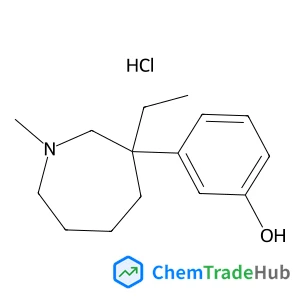
3-(3-Ethyl-1-methyl-3-azepanyl)phenol hydrochloride (1:1)
CAS Number:
59263-76-2
Molecular Formula:
C15H24ClNO
Suehiro Iwata, Dai Akase, Misako Aida, Sotiris S. Xantheas
The influence of the nearest neighbor and next-nearest neighbor water molecules on the strength of the hydrogen (H) bonds was examined for the polyhedral clusters of cubic (H2O)8, dodecahedral (H2O)20 and tetrakaidecahedral (H2O)24 cages. The relative stability and the characteristics of the H bond networks are also studied. The charge-transfer (CT) and dispersion interaction terms of every pair of H bonds are evaluated using perturbation theory based on the locally-projected molecular orbitals (LPMO PT). Every water molecule and every H-bonded pair in these polyhedral clusters are classified by the types of the neighbor molecules and H bonds. The relative binding energies among the polyhedral clusters are grouped by these classifications. The optimized O⋯O distances, which are strongly correlated with the calculated pairwise CT terms, are dependent on the 49 sub-groups of the H bonds determined by the type of the neighbor molecules. The electronic origin of this dependence is analyzed using Mulliken's charge-transfer theory, and employing a few assumptions, the analytical formulas for the contribution of the CT terms to the H bond energy are derived.
Wei Wen
DOI: 10.1039/D1PY00223F
Mariya Edeleva, Yoshi W. Marien, Paul H. M. Van Steenberge
DOI: 10.1039/D1PY00151E
Jiaxin Shi, Tianze Zheng, Yao Zhang, Baohua Guo, Jun Xu
DOI: 10.1039/D1PY00157D
Tingyu He, Yanqiu Wang, Liang Xu, Xiangming Fu, Atsushi Narumi, Shin-ichiro Sato
DOI: 10.1039/D1PY00070E
Chai Won Kim, Ji Hye Lee, Seunguk Cho, Hyung Jong Kim, Jinhyo Hwang, Yong Woo Kim, Dae Hyuk Choi, Min Ju Cho, Kwangyeol Lee, Dong Hoon Choi
DOI: 10.1039/D1PY00497B
Huan-Huan Ding, Mu-Han Zhao, Le Zhai, Jian-Bin Zhen, Le-Yun Sun, Jia-Zhu Chigan, Cheng Chen, Jia-Qi Li, Han Gao, Ke-Wu Yang
DOI: 10.1039/D0PY01751E
Takahiro Kawatsu, Keita Fuchise, Katsuhiko Takeuchi, Jun-Chul Choi, Kazuhiko Sato, Kazuhiro Matsumoto
DOI: 10.1039/D0PY01503B
Chao Li, Li Han, Xiping Chen, Xinyu Bao, Qi Sun, Hongwei Ma, Yang Li
DOI: 10.1039/D1PY00416F
Anaïs Pitto-Barry
DOI: 10.1039/D0PY01392G
When handling 4-(2-Furylmethyl)thiomorpholine 1,1-dioxide (CAS: 79206-94-3), it ...
When handling 4-Chloro-N-[2-(4-morpholinyl)ethyl]benzamide (CAS: 71320-77-9), it...
Waste containing this compound (CAS: 62921-74-8) should be handled according to ...
Waste containing (S)-Methyl 2-amino-3-cyclohexylpropanoate should be collected i...
This compound can be synthesized using a multi-step process involving the conjug...
There are several alternatives to (2E)-3-(3,4-Dichlorophenyl)acrylic acid in syn...
Ethyl 6-(2-nitrophenyl)imidazo[2,1-b][1,3]thiazole-3-carboxylate (CAS: 925437-84...
Waste containing 2-(1,3-Thiazol-2-yl)ethanamine (CAS: 18453-07-1) should be coll...
Methyl 5-iodo-2-methylbenzoate can be synthesized through the iodination of meth...
5-Chloro[1,2,4]triazolo[1,5-a]pyridine is commonly synthesized via the condensat...

Physical Chemistry Chemical Physics (PCCP) is an international journal co-owned by 19 physical chemistry and physics societies from around the world. This journal publishes original, cutting-edge research in physical chemistry, chemical physics and biophysical chemistry. To be suitable for publication in PCCP, articles must include significant innovation and/or insight into physical chemistry; this is the most important criterion that reviewers and Editors will judge against when evaluating submissions. The journal has a broad scope and welcomes contributions spanning experiment, theory, computation and data science. Topical coverage includes spectroscopy, dynamics, kinetics, statistical mechanics, thermodynamics, electrochemistry, catalysis, surface science, quantum mechanics, quantum computing and machine learning. Interdisciplinary research areas such as polymers and soft matter, materials, nanoscience, energy, surfaces/interfaces, and biophysical chemistry are welcomed if they demonstrate significant innovation and/or insight into physical chemistry. Joined experimental/theoretical studies are particularly appreciated when complementary and based on up-to-date approaches.
![[4-(Heptyloxy)phenyl]boronic acid structure](https://static.chemtradehub.com/structs/136/136370-19-9-ad33.webp "[4-(Heptyloxy)phenyl]boronic acid structure")