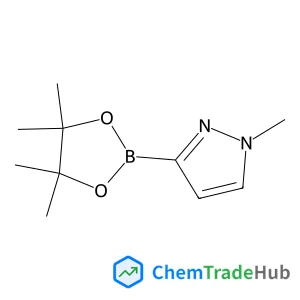
1-Methyl-3-(4,4,5,5-tetramethyl-1,3,2-dioxaborolan-2-yl)-1H-pyrazole
CAS Number:
1020174-04-2
Molecular Formula:
C10H17BN2O2
Reactions of multilayer hydrocarbon films with a polycrystalline V substrate have been investigated using temperature-programmed desorption and time-of-flight secondary ion mass spectrometry. Most of the benzene molecules were dissociated on V, as evidenced by the strong depression in the thermal desorption yields of physisorbed species at 150 K. The reaction products dehydrogenated gradually after the multilayer film disappeared from the surface. Large amount of oxygen was needed to passivate the benzene decomposition on V. These behaviors indicate that the subsurface sites of V play a role in multilayer benzene decomposition. Decomposition of the n-hexane multilayer films is manifested by the desorption of methane at 105 K and gradual hydrogen desorption starting at this temperature, indicating that C–C bond scission precedes C–H bond cleavage. The n-hexane dissociation temperature is considerably lower than the thermal desorption temperature of the physisorbed species (140 K). The n-hexane multilayer morphology changes at the decomposition temperature, suggesting that a liquid-like phase formed after crystallization plays a role in the low-temperature decomposition of n-hexane.
DOI: 10.1039/D1PY90044G
Chai Won Kim, Ji Hye Lee, Seunguk Cho, Hyung Jong Kim, Jinhyo Hwang, Yong Woo Kim, Dae Hyuk Choi, Min Ju Cho, Kwangyeol Lee, Dong Hoon Choi
DOI: 10.1039/D1PY00497B
Huan-Huan Ding, Mu-Han Zhao, Le Zhai, Jian-Bin Zhen, Le-Yun Sun, Jia-Zhu Chigan, Cheng Chen, Jia-Qi Li, Han Gao, Ke-Wu Yang
DOI: 10.1039/D0PY01751E
Chao Li, Li Han, Xiping Chen, Xinyu Bao, Qi Sun, Hongwei Ma, Yang Li
DOI: 10.1039/D1PY00416F
Saleh Al-Mousawi
DOI: 10.1039/D1PY00193K
Hao Lu, Jiansong Cai, Ke Zhang
DOI: 10.1039/D0PY01707H
Gokhan Sagdic, Ozgun Daglar, Ufuk Saim Gunay, Emrah Cakmakci, Gurkan Hizal, Umit Tunca, Hakan Durmaz
DOI: 10.1039/D1PY00726B
Xianheng Shi, Min Liu, Lishan Li, Jiandong Zhang, Haiyan Li, Zhihao Huang, Wei Zhang, Zhengbiao Zhang, Nianchen Zhou, Xiulin Zhu
DOI: 10.1039/D1PY00165E
When handling 4-(2-Furylmethyl)thiomorpholine 1,1-dioxide (CAS: 79206-94-3), it ...
When handling 4-Chloro-N-[2-(4-morpholinyl)ethyl]benzamide (CAS: 71320-77-9), it...
Waste containing this compound (CAS: 62921-74-8) should be handled according to ...
Waste containing (S)-Methyl 2-amino-3-cyclohexylpropanoate should be collected i...
This compound can be synthesized using a multi-step process involving the conjug...
There are several alternatives to (2E)-3-(3,4-Dichlorophenyl)acrylic acid in syn...
Ethyl 6-(2-nitrophenyl)imidazo[2,1-b][1,3]thiazole-3-carboxylate (CAS: 925437-84...
Waste containing 2-(1,3-Thiazol-2-yl)ethanamine (CAS: 18453-07-1) should be coll...
Methyl 5-iodo-2-methylbenzoate can be synthesized through the iodination of meth...
5-Chloro[1,2,4]triazolo[1,5-a]pyridine is commonly synthesized via the condensat...

Physical Chemistry Chemical Physics (PCCP) is an international journal co-owned by 19 physical chemistry and physics societies from around the world. This journal publishes original, cutting-edge research in physical chemistry, chemical physics and biophysical chemistry. To be suitable for publication in PCCP, articles must include significant innovation and/or insight into physical chemistry; this is the most important criterion that reviewers and Editors will judge against when evaluating submissions. The journal has a broad scope and welcomes contributions spanning experiment, theory, computation and data science. Topical coverage includes spectroscopy, dynamics, kinetics, statistical mechanics, thermodynamics, electrochemistry, catalysis, surface science, quantum mechanics, quantum computing and machine learning. Interdisciplinary research areas such as polymers and soft matter, materials, nanoscience, energy, surfaces/interfaces, and biophysical chemistry are welcomed if they demonstrate significant innovation and/or insight into physical chemistry. Joined experimental/theoretical studies are particularly appreciated when complementary and based on up-to-date approaches.