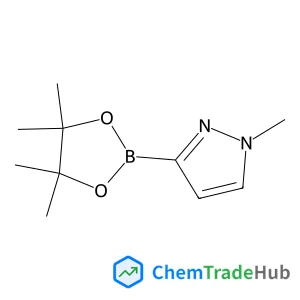
1-Methyl-3-(4,4,5,5-tetramethyl-1,3,2-dioxaborolan-2-yl)-1H-pyrazole
CAS Number:
1020174-04-2
Molecular Formula:
C10H17BN2O2
Francis D. Pope, Carina A. Smith, Michael N. R. Ashfold, Andrew J. Orr-Ewing
Absorption cross sections have been measured for the 220430 and 230410 vibrational bands of the Ã1A2–1A1 electronic transition of formaldehyde in the wavelength range 313–320 nm. Accurate values are of considerable importance for atmospheric monitoring and to understand the photochemistry of this compound. The 0.10 cm−1 FWHM wavenumber resolution of the experiments is determined by the bandwidth of the ultraviolet laser used, and is a factor of 10 or more higher than any previously reported data. The absorption cross section data are thus obtained at a spectrometer resolution close to the Doppler broadening limit at 294 K of 0.07 cm−1 FWHM, for isolated rotational lines, but lifetime broadening effects contribute a further ∼0.5 cm−1 of width. Our spectral resolution is thus higher than required to resolve the sharpest spectral features and, as a consequence, the cross sections peak at greater values than previous studies of these structured rovibronic bands conducted at much lower spectrometer resolutions. Previous data can be quantitatively reproduced by convolution of the newly obtained spectra with lower-resolution instrument functions. Pressure broadening of regions of the spectra in the presence of up to 500 Torr of N2 is examined and the effects on peak absorption cross sections are very small. The influence of reduced temperature on the spectrum is also explored through experimental measurements and spectral simulations.
Lingyu Liu, Meng Hu, Chao Liu, Xiaowei Liang, Yilong Pan, Pan Ying, Zhisheng Zhao, Guoying Gao, Julong He, Yongjun Tian
DOI: 10.1039/C8CP00107C
Lifu Chen, Chuhong Lin, Richard G. Compton
DOI: 10.1039/C8CP02311E
DOI: 10.1039/C8CP02133C
Jianwei Li, Yihang Nie, Fuming Xu, Yunjin Yu, Bin Wang
DOI: 10.1039/C8CP02322K
Silong Quan, Linghui He, Yong Ni
DOI: 10.1039/C8CP04360D
Senbo Xiao, Zhiliang Zhang, Jianying He
DOI: 10.1039/C8CP03256D
Chunyue Hou, Huihui Li, Xiaoli Sun, Yanfang Wang, Shangtao Chen
DOI: 10.1039/C8CP02464B
Jonathan M. Polfus, Mehdi Pishahang, Rune Bredesen
DOI: 10.1039/C8CP00168E
Jingxiang Guo, Jeremy C. Palmer
DOI: 10.1039/C8CP04237C
When handling 4-(2-Furylmethyl)thiomorpholine 1,1-dioxide (CAS: 79206-94-3), it ...
When handling 4-Chloro-N-[2-(4-morpholinyl)ethyl]benzamide (CAS: 71320-77-9), it...
Waste containing this compound (CAS: 62921-74-8) should be handled according to ...
Waste containing (S)-Methyl 2-amino-3-cyclohexylpropanoate should be collected i...
This compound can be synthesized using a multi-step process involving the conjug...
There are several alternatives to (2E)-3-(3,4-Dichlorophenyl)acrylic acid in syn...
Ethyl 6-(2-nitrophenyl)imidazo[2,1-b][1,3]thiazole-3-carboxylate (CAS: 925437-84...
Waste containing 2-(1,3-Thiazol-2-yl)ethanamine (CAS: 18453-07-1) should be coll...
Methyl 5-iodo-2-methylbenzoate can be synthesized through the iodination of meth...
5-Chloro[1,2,4]triazolo[1,5-a]pyridine is commonly synthesized via the condensat...

Physical Chemistry Chemical Physics (PCCP) is an international journal co-owned by 19 physical chemistry and physics societies from around the world. This journal publishes original, cutting-edge research in physical chemistry, chemical physics and biophysical chemistry. To be suitable for publication in PCCP, articles must include significant innovation and/or insight into physical chemistry; this is the most important criterion that reviewers and Editors will judge against when evaluating submissions. The journal has a broad scope and welcomes contributions spanning experiment, theory, computation and data science. Topical coverage includes spectroscopy, dynamics, kinetics, statistical mechanics, thermodynamics, electrochemistry, catalysis, surface science, quantum mechanics, quantum computing and machine learning. Interdisciplinary research areas such as polymers and soft matter, materials, nanoscience, energy, surfaces/interfaces, and biophysical chemistry are welcomed if they demonstrate significant innovation and/or insight into physical chemistry. Joined experimental/theoretical studies are particularly appreciated when complementary and based on up-to-date approaches.