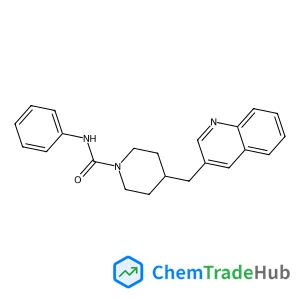
N-phenyl-4-(quinolin-3-ylmethyl)piperidine-1-carboxamide
CAS Number:
959151-50-9
Molecular Formula:
C22H23N3O
Christoph Krafft, Stephan B. Sobottka, Gabriele Schackert, Reiner Salzer
This study uses infrared (IR) spectroscopic, point detection, mapping procedures to examine tissue samples from normal brain specimens and from astrocytic gliomas, the most frequent human brain tumors. Model systems were derived from cultured glioma cell lines. IR spectra of normal tissue sections distinguished white matter from gray matter by increased spectral contributions from lipids and cholesterol. Qualitatively the same differences were found in IR spectra of low and high grade glioma tissue sections pointing to a significant reduction of brain lipids with increasing malignancy. Whereas spectral contributions of proteins and lipids were similar in IR spectra of glioma cells and tissues, nucleic acid bands were more intense for cells suggesting higher proliferative activities. For statistical analyses of IR spectroscopic maps from 71 samples, a parameter for the lipid to protein ratio was introduced involving the CH2 symmetric stretch band with lipids as main contributors and the amide I band of proteins. As this parameter correlated with the grade of gliomas obtained from standard histopathological examination, it was applied to classify brain tissue sections based on IR spectroscopic mapping.

Medicinal Chemistry Research

Colloid Journal

Bioorganic & Medicinal Chemistry Letters

NDT & E International

Chinese Journal of Chemistry

Topics in Catalysis

Biocatalysis and Biotransformation

Journal of the Indian Institute of Science

Herald of the Russian Academy of Sciences

Critical Reviews in Solid State and Materials Sciences
Anna Nalepa, Marco Malferrari, Wolfgang Lubitz, Anton Savitsky
DOI: 10.1039/C7CP03942E
Adolfo B. Poma, Mateusz Chwastyk, Marek Cieplak
DOI: 10.1039/C7CP05269C
Minglei Sun, Jyh-Pin Chou, Yiming Zhao, Jin Yu, Wencheng Tang
DOI: 10.1039/C7CP04535B
Charles Bou-Nader, Ludovic Pecqueur, David Cornu, Murielle Lombard, Manuela Dezi, Magali Nicaise, Christophe Velours, Marc Fontecave, Djemel Hamdane
DOI: 10.1039/C7CP05599D
Ninett Frenzel, Jennifer Hartley, Gero Frisch
DOI: 10.1039/C7CP05483A
Francis Opoku, Krishna Kuben Govender, Cornelia Gertina Catharina Elizabeth van Sittert, Penny Poomani Govender
DOI: 10.1039/C7CP04440B
Gongli Ma, Guoliang Song, Zhen Hua Li
DOI: 10.1039/C7CP05538B
Carlos E. S. Bernardes, Filipe Agapito, Filomena Martins, Seishi Shimizu, Manuel E. Minas da Piedade, Adam J. Walker
DOI: 10.1039/C7CP05076C
Ivan Lunev, Airat Khamzin, Anna Greenbaum (Gutina), Yuri Gusev, Yuri Feldman
DOI: 10.1039/C7CP05731H
Mohammad Adil Afroz, Keval K. Sonigara, Telugu Bhim Raju, Saurabh S. Soni
DOI: 10.1039/C7CP05226J
Waste containing 2-Ethyl-4-Methyl-1H-Imidazole-5-Carbaldehyde (CAS: 88634-80-4) ...
Triethoxy(octyl)silane (CAS: 1385031-14-0) is widely used in the pharmaceuticals...
Several alternatives to 3-iodo-7-nitro-1H-indazole (CAS: 864724-64-1) exist in t...
Yes, there are alternatives to Benzene, bis[(trimethoxysilyl)ethyl] (CAS: 266317...
Isothiazole-3-carbonitrile (CAS: 1452-17-1) is generally considered safe when us...
(3-Chlorophenyl)methanol (CAS: 873-63-2) is considered low to moderately toxic. ...
(2S,3S)-2-Hydroxy-3-({[(2-methyl-2-propanyl)oxy]carbonyl}amino)-3-(2-naphthyl)pr...
Proper handling of methyl 2-(bromomethyl)-5-methoxybenzoate requires the use of ...
6,8-Dibromoimidazo[1,2-a]pyridine-2-carboxylic acid (CAS: 904805-36-3) is an aro...
3-Amino-5-bromo-2-pyridinecarbonitrile is considered safe when handled under pro...

Analyst publishes analytical and bioanalytical research that reports premier fundamental discoveries and inventions, and the applications of those discoveries, unconfined by traditional discipline barriers.
![[3-Chloro-5-(diethylcarbamoyl)phenyl]boronic acid structure](https://static.chemtradehub.com/structs/957/957120-59-1-febc.webp "[3-Chloro-5-(diethylcarbamoyl)phenyl]boronic acid structure")
methanone structure](https://static.chemtradehub.com/structs/814/81449-01-6-786d.webp "[4-(Hydroxymethyl)phenyl](phenyl)methanone structure")