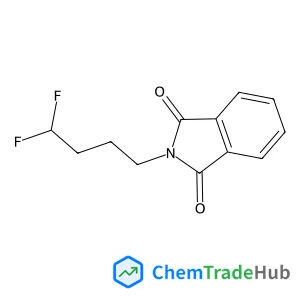
2-(4,4-Difluorobutyl)-1H-isoindole-1,3(2H)-dione
CAS Number:
1265341-14-7
Molecular Formula:
C12H11F2NO2
Alison Y. Cheng, Scott B. Clendenning, Guocheng Yang, Zheng-Hong Lu, Christopher M. Yip, Ian Manners
Thin films of a cobalt-clusterized poly(ferrocenylsilane) have been shown to behave as a negative-tone resist for UV photolithography, allowing access to feature sizes between 20 and 300 µm. Pyrolysis of the patterned polymer at 900 °C under a N2 atmosphere afforded patterned ferromagnetic ceramics with excellent shape retention.
Stéphane Despax, Fuchao Jia, Michel Pfeffer, Pascal Hébraud
DOI: 10.1039/C4CP00726C
Huanli Dong, Hao-li Zhang, Wenping Hu
DOI: 10.1039/C4CP01700E
Thomas J. Penfold, Maarten Nachtegaal, Chris J. Milne, Majed Chergui
DOI: 10.1039/C4CP03301A
J. E. Newton, J. A. Preece, N. V. Rees, S. L. Horswell
DOI: 10.1039/C4CP00991F
Yuesheng Wang, Pin Liu, Lin Gu, Yong-Sheng Hu, Hong Li, George P. Demopoulos, Liquan Chen
DOI: 10.1039/C4CP02957G
Alexandra Szemjonov, Thierry Pauporté, Ilaria Ciofini, Frédéric Labat
DOI: 10.1039/C4CP02886D
Yu. I. Prylutskyy, I. S. Pashkova, D. Wyrzykowski, A. Woziwodzka, G. Gołuński, J. Piosik, V. V. Cherepanov, U. Ritter
DOI: 10.1039/C4CP03367A
Micael Silva, Angelo Miguel Figueiredo, Eurico J. Cabrita
DOI: 10.1039/C4CP03534H
Carlos Zaldo, Concepción Cascales
DOI: 10.1039/C4CP03616F
N-(4-Methoxybenzyl)-2-pyridinamine (CAS: 52818-63-0) is increasingly being used ...
When handling Ethyl 4-(2-chlorophenyl)-1,3-thiazole-2-carboxylate, appropriate p...
Diethyldiselane (CAS: 628-39-7) is classified under the Globally Harmonized Syst...
The market for oxocopper (CAS: 12053-18-8) is primarily driven by its use in cat...
The market for 5-{[(2-Methyl-2-propanyl)oxy]carbonyl}-5-azaspiro[2.4]heptane-7-c...
2-(1-Pyrrolidinyl)-4-pyridinamine is a chemical compound with the CAS number 359...
2-(3-Pyridinyl)-1-azabicyclo[2.2.2]octane (CAS: 91556-75-1) is a crystalline sol...
(S)-Alpha-allyl-proline hydrochloride is usually synthesized via a Wittig reacti...
3-Methyl-1,2-oxazole-5-carboxylic acid (CAS: 4857-42-5) is an organic compound w...
Lys-SMCC-DM1 is synthesized via a multi-step process involving the coupling of S...

ChemComm publishes urgent research which is of outstanding significance and interest to experts in the field, while also appealing to the journal’s broad chemistry readership. Our communication format is ideally suited to short, urgent studies that are of such importance that they require accelerated publication. Our scope covers all topics in chemistry, and research at the interface of chemistry and other disciplines (such as materials science, nanoscience, physics, engineering and biology) where there is a significant novelty in the chemistry aspects. Major topic areas covered include: Analytical Chemistry Catalysis Chemical Biology and medicinal chemistry Computational Chemistry and Machine Learning Energy and sustainable chemistry Environmental Chemistry Green Chemistry Inorganic Chemistry Materials Chemistry Nanoscience Organic Chemistry Physical Chemistry Polymer Chemistry Supramolecular Chemistry