












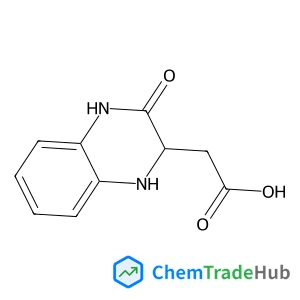
(3-Oxo-1,2,3,4-tetrahydro-2-quinoxalinyl)acetic acid
CAS Number:
136584-14-0
Molecular Formula:
C10H10N2O3
Séverine Raoult, Marie-Thérèse Rayez, Jean-Claude Rayez, Robert Lesclaux
A new investigation of the primary steps of the benzene oxidation, involving complementary experimental and theoretical approaches, is presented. The reactions of the OH-adduct (hydroxy-cyclohexadienyl radical c-C6H6-OH) were investigated using laser flash photolysis and producing OH radicals by H2O2 photolysis at 248 nm. It is confirmed that the adduct is in equilibrium with the corresponding peroxy radical RO2, near atmospheric conditions, the measured equilibrium constant being: Kc,2b = (2.62 ± 0.24) × 10−19 cm3 molecule−1 at 295 K, with the temperature dependent expression: ln(Kc,2b/cm3 molecule−1) = −63.29 + 6049/T, obtained by using the calculated entropy of reaction. The rate constant of the association reaction yielding RO2 is: k2b = (1.31 ± 0.12) × 10−15 cm3 molecule−1 s−1. Calculated data are in agreement with those values. In addition, data analysis shows that the reaction c-C6H6-OH + O2 involves an irreversible loss of radical species, yielding phenol and other oxidation products, with the global rate constant: kloss = (2.52 ± 0.40) × 10−16 cm3 molecule−1 s−1. Quoted errors are statistical (2σ), the possible total errors on the above values being estimated at around 40%. By comparison with the kloss value, the rate constant for phenol formation, calculated using a combination of DFT and ab initio CCSD(T) methods, corresponds to a phenol yield of about 55%, in reasonable agreement with experimental observations. Thermochemical and kinetic parameters have been calculated for the formation and for the reactions of the two RO2 stereoisomers, cis and trans. They show that the observed equilibrium must involve the trans isomer, which is more stable and is formed more rapidly than the cis isomer. Calculations show that the only possible reactions of peroxy radicals, under atmospheric conditions, is cyclisation yielding a bicyclic radical. However, cyclisation of the RO2(trans) is calculated to be too slow, compared to the rate of the irreversible radical loss, whereas it is very fast in the case of the cis isomer and can lead readily to oxidation products. On the basis of those results, a reaction mechanism is proposed for the first steps of benzene oxidation, consistent with all experimental and theoretical data, and which accounts for the principal oxidation products observed.
A. Subha Mahadevi, Y. Indra Neela, G. Narahari Sastry
DOI: 10.1039/C1CP21346F
Jörg Meyer, Anja Wadewitz, Lokamani, Cormac Toher, Roland Gresser, Karl Leo, Moritz Riede, Francesca Moresco
DOI: 10.1039/C1CP20999J
V. Brites, K. Franzreb, J. N. Harvey, S. G. Sayres, M. W. Ross, D. E. Blumling, A. W. Castleman, Jr., M. Hochlaf
DOI: 10.1039/C1CP21566C
Helga Dögg Flosadóttir, Hannes Jónsson, Snorri Th. Sigurdsson, Oddur Ingólfsson
DOI: 10.1039/C1CP21298B
Josip Požar, Klemen Bohinc, Vojko Vlachy, Davor Kovačević
DOI: 10.1039/C1CP21291E
I. Panas
DOI: 10.1039/C0CP02132F
N. Crivillers, A. Liscio, F. Di Stasio, C. Van Dyck, S. Osella, D. Cornil, S. Mian, G. M. Lazzerini, O. Fenwick, E. Orgiu, F. Reinders, S. Braun, M. Fahlman, J. Cornil, V. Palermo, F. Cacialli, P. Samorì
DOI: 10.1039/C1CP20851A
Ren-Yu Tian, Xiao-Bao Yang, Song-Lin Peng
DOI: 10.1039/C1CP20974D
M. Isabel Burguete, Eduardo García-Verdugo, Santiago V. Luis, Julián A. Restrepo
DOI: 10.1039/C1CP20970A
This compound is mainly used as an intermediate in the synthesis of antipsychoti...
Waste containing 1-(D-Ribofuranosyl)-1,4-dihydro-3-pyridinecarboxamide (CAS: 191...
2-Methyl-2-propanyl 3-bromo-3-(hydroxymethyl)-1-azetidinecarboxylate (CAS: 20079...
N-(4-Chloro-2-pyridinyl)acetamide (CAS: 245056-66-0) is a chemical compound with...
5-Chloro-2-hydroxybenzoic acid, also known as 5-chlorosalicylic acid, is an arom...
When handling 1,1-Dichloro-1-fluoroethane (CAS: 1717-00-6), it is important to u...
Fmoc-(2S,3R)-3-phenylpyrrolidine-2-carboxylic acid is a white crystalline solid ...
4-Amino-5-bromo-2-pyridinecarboxylic acid is primarily used as a precursor in th...
Handling this compound should be done with personal protective equipment (PPE) i...
When handling 8-bromo-2,2-dimethyl-3,4-dihydro-2H-1,4-benzoxazin-3-one, use prop...

Physical Chemistry Chemical Physics (PCCP) is an international journal co-owned by 19 physical chemistry and physics societies from around the world. This journal publishes original, cutting-edge research in physical chemistry, chemical physics and biophysical chemistry. To be suitable for publication in PCCP, articles must include significant innovation and/or insight into physical chemistry; this is the most important criterion that reviewers and Editors will judge against when evaluating submissions. The journal has a broad scope and welcomes contributions spanning experiment, theory, computation and data science. Topical coverage includes spectroscopy, dynamics, kinetics, statistical mechanics, thermodynamics, electrochemistry, catalysis, surface science, quantum mechanics, quantum computing and machine learning. Interdisciplinary research areas such as polymers and soft matter, materials, nanoscience, energy, surfaces/interfaces, and biophysical chemistry are welcomed if they demonstrate significant innovation and/or insight into physical chemistry. Joined experimental/theoretical studies are particularly appreciated when complementary and based on up-to-date approaches.
![4-Chloro-3-(trifluoromethyl)-1H-pyrrolo[2,3-b]pyridine structure](https://static.chemtradehub.com/structs/869/869335-75-1-a9d0.webp "4-Chloro-3-(trifluoromethyl)-1H-pyrrolo[2,3-b]pyridine structure")


